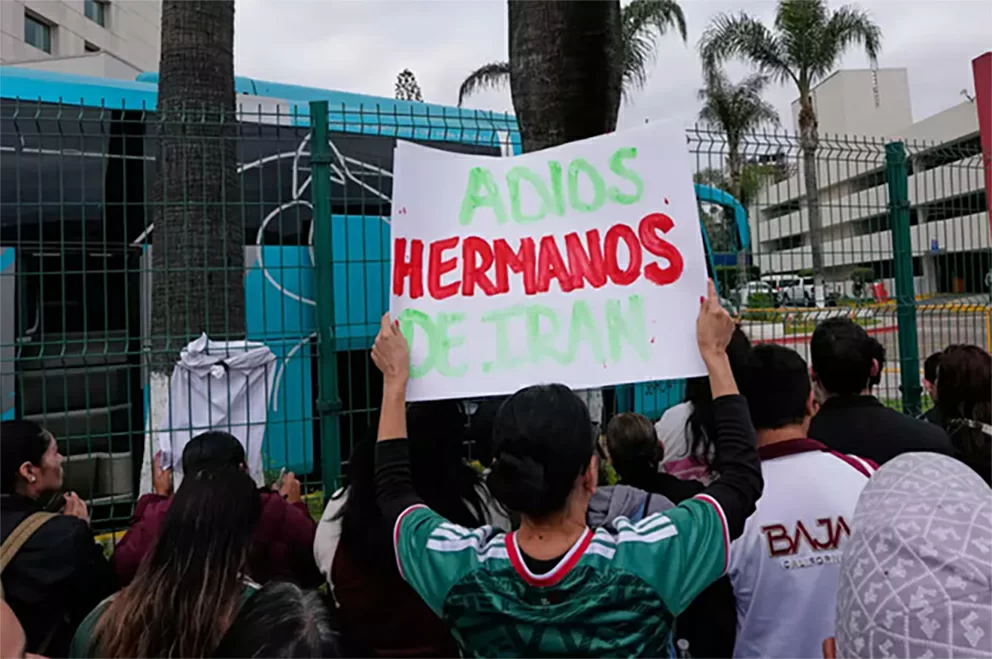
Iran’s national men’s football team departed their World Cup base in Tijuana, Mexico on Tuesday, bringing a close to one of the most dramatic and politically charged campaigns in this year’s tournament. The side exited the group stage after narrowly missing out on a historic knockout round berth, ending a run defined by off-field geopolitical tensions, inspiring on-field performances, and ultimately crushing late disappointment.
After fighting to three hard-fought draws in their group matches, Iran’s knockout fate hung on the final simultaneous group games between Algeria and Austria. When Algeria took the lead in stoppage time, the Iranian camp erupted in celebration – one lifelong fan, Kimia Ranjbar, who traveled from the Los Angeles area to support the team, described the room as exploding with unfiltered joy. But Austria equalized in the dying seconds of the match, turning that celebration into stunned, sorrowful silence.
That late heartbreak was not the only setback Iran faced throughout the tournament. Earlier in group play, a potential winning goal from defender Shoja Khalilzadeh against Egypt was controversially disallowed, denying the side three points that would have secured their knockout spot. Off the pitch, geopolitical tensions between Iran, the United States and Israel overshadowed the entire campaign, creating significant logistical and political headwinds for the team before they even kicked a ball. Iran’s participation faced calls for removal, with some pushing to replace the side with Italy, and the team was forced to relocate their training base from Arizona to Mexico after facing strict visa restrictions for coaching and support staff that were only partially lifted just before their final group match.
In the aftermath of Iran’s elimination, U.S. Homeland Security Secretary Markwayne Mullin drew fierce condemnation from the team after announcing he had danced for joy when the side was knocked out, adding he was glad to see them depart. The Iranian team called the remarks disrespectful and a violation of basic international sporting norms, noting that Mullin’s open celebration of their elimination revealed more about his own petty bias than it did about the team. “It reflects a small-mindedness that cannot even tolerate the presence of a football team competing on the world’s biggest stage,” the team said in a statement.
Before departing for the airport, the squad thanked the Mexican government and people of Tijuana for their warm hospitality, but doubled down on criticism of the treatment they received from U.S. authorities. “The decisions and logistical arrangements put in place undermined our sense of fair play, especially on the final match day,” the team said.
The tournament also highlighted the divided views of the Iranian diaspora in North America, with some choosing not to support the team amid political tensions back home. But many fans argued that sport and politics should remain separate, pointing out that players are never held responsible for the actions of their home governments. “You don’t see anyone blaming Christian Pulisic for what Donald Trump does,” noted Mohammad Modarres, a fan who traveled from San Diego to see the team off.
While the team avoided explicit political statements related to domestic issues, they did take a quiet, respectful stand to honor victims of a deadly rocket attack that hit a school early in the regional conflict that killed 168 people, most of them children. Players wore pins bearing the number 168 on their jerseys, and left a note in the Los Angeles Stadium changing room calling for peace “between all nations” with the hashtags #168 and #minab, the name of the targeted school.
For all the turmoil and final disappointment, the tournament included a number of standout sporting moments for Iran. Captain and goalkeeper Alireza Beiranvand put in a man-of-the-match performance with seven spectacular saves to hold pre-tournament favorites Belgium to a 0-0 draw, while winger Ramin Rezaeian scored a stunning solo goal against New Zealand that earned viral acclaim across global football circles.
Many fans who supported the team throughout the campaign say they do not see the side as losers, despite the early exit. “We are not going home as losers, we are going home as winners,” said Sherry Ghaemi, an Iranian-American fan. “We are so proud of what they achieved against all odds.”
For Siavash Khosrowshahi, a fan who visited the team during their stay in Tijuana, the campaign provided a much-needed moment of connection amid ongoing regional conflict. He was unable to reach his parents in Tehran for days after fighting broke out, but arranged a surprise phone call between his mother and Beiranvand that gave her a much-needed moment of joy amid chaos. “It’s a source of joy for her, even right now,” he said.
The warm welcome the team received in Tijuana also built a lasting bond between Iranian and Mexican fans, with local supporters turning out in droves to greet the side during their stay and cheer them on as they left their hotel. Chants of “¡Irán, hermano, ya eres Mexicano!” – “Iran, brother, you are one of us now” – rang out as players boarded their bus for the airport. Arely Ramírez, a local Tijuana resident who came to the team’s hotel hoping to meet players, said the warm welcome was just how Mexico receives visitors. “Iran is taking the best of our country and our city home with them, that’s how we welcome outsiders here,” she said.
Head coach Amir Ghalenoei, speaking through an interpreter before the team departed for the airport, summed up the feeling the side was leaving with. “We are leaving Tijuana physically, but our hearts and our souls remain here with the people who welcomed us,” he said.