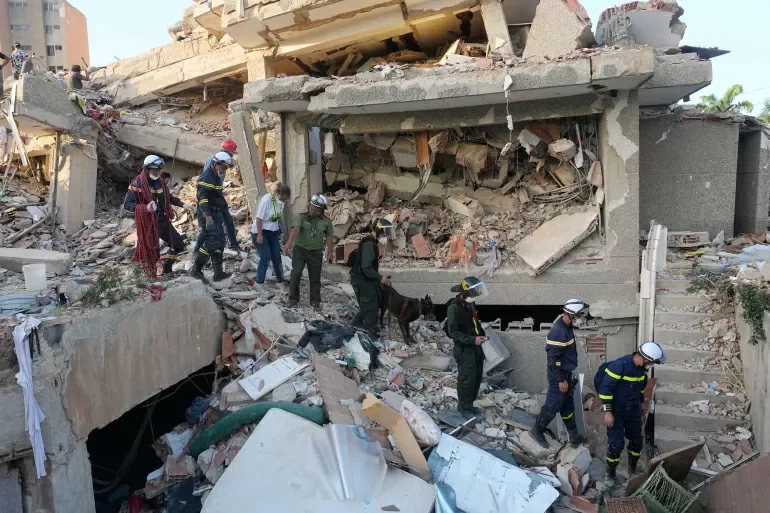
Two weeks after a pair of devastating back-to-back earthquakes struck coastal Venezuela, rescue and aid workers are sounding urgent alarms over an impending public health disaster that threatens to worsen the already catastrophic death toll from the disaster. The June 24 quakes left widespread destruction across northern Venezuelan regions, including Catia La Mar and La Guaira, displacing thousands of residents who now crowd into overcrowded emergency evacuation shelters with no consistent access to clean drinking water or functional sanitation infrastructure — conditions that create a perfect breeding ground for contagious infectious disease outbreaks.
As of Wednesday, official government data confirms at least 2,295 people have been killed by the earthquakes, with more than 11,000 others suffering injuries ranging from minor cuts to life-threatening trauma. Medical personnel on the ground warn that the single greatest threat to life now is not untreated trauma from collapsed buildings, but the rapid spread of preventable infections among survivors exposed to unsanitary conditions for weeks after the disaster.
Eugenio Cova, head of the trauma department at Caracas’ Hospital Jose Gregorio Hernandez, explained that the situation is deteriorating by the day. “We have already treated thousands of complex trauma injuries from the quake, but many of these cases are now being made far more dangerous by secondary infections that would be easily avoidable with proper hygiene and care,” Cova said.
Aid teams have already reported rising cases of diarrhea and other communicable illnesses among displaced populations in the hardest-hit areas, and are calling for immediate deployments of critical sanitation supplies including portable toilets, along with better coordination and management of overcrowded shelter sites to slow further spread of disease.
The international community has begun to mobilize support for Venezuela’s rescue and relief operations. The United States has deployed roughly 900 military personnel to assist with logistics and recovery efforts: troops have already repaired a damaged runway at Caracas’ primary international airport, while U.S. naval vessels have been positioned off the Venezuelan coast to provide ongoing logistical backing. The U.S. State Department has also sent an additional 100 support personnel to the region, and the U.S. government has allocated $300 million in aid to be distributed through non-governmental aid organizations and United Nations agencies.
That funding, however, amounts to only a small fraction of the total estimated damage from the quakes. Satellite imagery analysis conducted by the UN Development Programme pegs total infrastructure damage at $6.7 billion, leaving a massive funding gap for recovery efforts.
More than 50 international search-and-rescue teams from countries including Ecuador and Israel have also arrived in Venezuela to assist with clearing rubble and locating survivors. Just days ago, responders pulled a toddler alive from beneath collapsed building rubble after the child was trapped for six days, a rare moment of hope amid widespread destruction.
One volunteer, Kevin Simm, described the scale of destruction he has witnessed on the ground as comparable to a war zone. “The level of devastation reminds me of conflict zones in Gaza and Ukraine. This is not a peacetime disaster — what we are seeing here looks like something out of a disaster movie,” Simm said.
Complicating all relief and recovery efforts is the fact that Venezuela’s healthcare system was already in a state of deep, years-long crisis before the earthquakes struck. Even before the disaster, Venezuelan hospitals struggled with chronic shortages of clean water, reliable electricity, medical equipment, and trained clinical staff. Since 2013, more than 7.7 million Venezuelans have fled the country’s prolonged economic and political collapse, including a large share of the nation’s doctors and nurses.
Data from the Venezuelan Medical Association shows that roughly one-third of the country’s 60,000 registered physicians have left Venezuela since the crisis began. A 2025 national healthcare survey found that more than 30% of all emergency medical supplies were unavailable nationwide, and over 70% of operating room equipment was missing from public hospitals. Most clinical laboratories can only operate at minimal capacity, with limited ability to run diagnostic tests.
Huniades Urbina, a leader of Venezuela’s pediatric association, said the earthquake disaster has laid bare the Venezuelan government’s long-standing failure to build and maintain a functional public healthcare system that can meet the basic needs of the population. “What we are seeing now is the consequence of decades of neglect: a healthcare system that could not handle routine care before a disaster, now completely overwhelmed by a catastrophe of this scale,” Urbina noted.