In late June, a high-stakes international consultative conference focused on advancing reparatory action for the transatlantic trafficking of enslaved Africans kicked off in Accra, the capital of Ghana. Convened as a follow-up to a landmark March 2025 United Nations General Assembly resolution that formally classified the transatlantic slave trade and chattel slavery as crimes against humanity, the event drew top regional leaders, including Mia Mottley, Prime Minister of Barbados, senior government representatives from Caribbean and African Union member states, and leading subject-matter experts. Suriname, one of the core CARICOM member states participating in the reparations movement, was represented at the gathering by Fidelia Gran Galon, Suriname’s ambassador to Ghana.
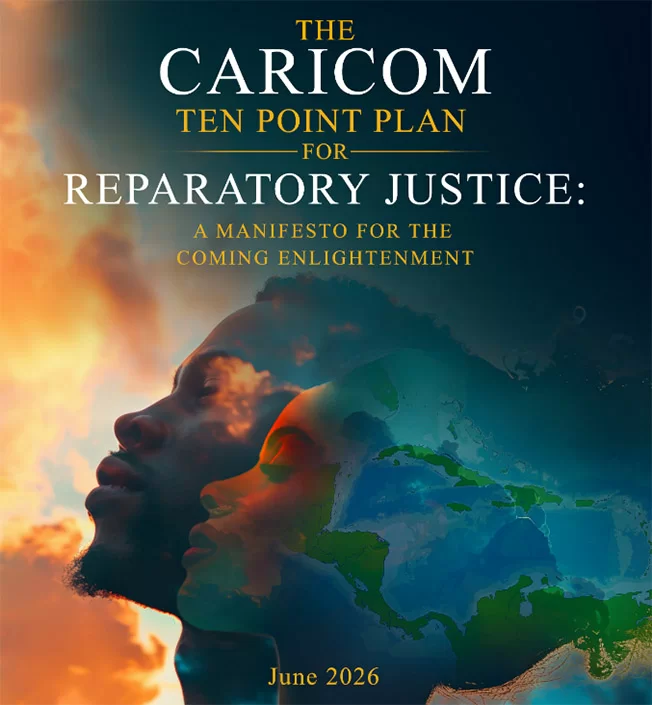
During the Accra conference, Prime Minister Mottley, who chairs CARICOM’s Prime Ministerial Sub-Committee on Reparations, officially presented the updated third edition of the CARICOM Ten Point Plan for Reparatory Justice. Fully titled *The CARICOM Ten Point Plan for Reparatory Justice: A Manifesto for the Coming Enlightenment*, this revised document represents over a decade of collaborative policy development across the Caribbean community.
The push for formal reparatory justice traces its institutional roots back to 2013, when CARICOM leaders at their 34th plenary meeting voted to add the issues of Indigenous genocide and the legacies of transatlantic slavery to their core policy agenda. That same year, two key governing bodies were established: the Prime Ministerial Sub-Committee (PMSC), led by Barbados with representation from heads of government of Barbados, Guyana, St. Vincent and the Grenadines, Suriname and Haiti, and the CARICOM Reparations Commission (CRC), made up of chairs of national reparations commissions from 13 CARICOM member states. A dedicated research institute affiliated with the University of the West Indies was also launched to support archival work and evidence-building for the reparations claim. While differing perspectives have emerged across these bodies over the years, final decision-making authority rests with the PMSC and full CARICOM heads of government.
The first iteration of the Ten Point Plan was originally launched by CARICOM leaders in 2014, with an initial revision completed in 2018. The third edition, unveiled in Accra, marks the most significant expansion of the framework to date, reflecting the movement’s growth from a regional advocacy effort to a global movement for racial and economic justice. The updated 52-page document expands coverage of gender-based harms from slavery, includes greater input from the African diaspora, and integrates new analysis of how historical exploitation exacerbates contemporary climate vulnerability for small island CARICOM states. It also adds two extensive annexes with supporting research and policy guidance.
The revised 10 core priorities of the plan, updated to reflect contemporary realities, are as follows: 1) Full and formal official apologies from former slave-trading and slave-owning nations; 2) A targeted development plan for Indigenous peoples whose communities were decimated by colonial genocide; 3) Support for voluntary repatriation and resettlement of descendant communities in Africa; 4) Restitution of stolen cultural heritage and support for cultural reconnection for diaspora communities; 5) Targeted action to address ongoing racial health disparities rooted in the legacies of slavery; 6) Capacity-building and development through expanded education and skills training; 7) Reparation for gender-based violence and the destruction of enslaved family structures; 8) Support for psychological rehabilitation for intergenerational trauma from slavery; 9) Advancing sovereign development rights through access to technology, innovation support and entrepreneurship development; 10) Debt cancellation, financial reparations and formal completion of decolonization for formerly enslaved nations.
Three new inclusions stand out as particularly notable in the revised framework. First, at a CARICOM heads of government meeting held in Guyana in March 2025, leaders voted to formally add indentured contract labor—primarily of South Asian people brought to replace enslaved workers after abolition—to the list of crimes against humanity addressed by the plan. Second, the third edition integrates climate change as a core reparations issue, noting that low-lying CARICOM states, which contributed almost nothing to historical greenhouse gas emissions, now face existential climate risk rooted in their colonial history of resource extraction. Third, the framework explicitly references a 2023 research report from U.S.-based economic consultants The Brattle Group, which calculated that reparations for the harms of transatlantic slavery alone amount to tens of trillions of dollars in damages.
Across the updated document, CARICOM leaders emphasize that the systemic harms of chattel slavery and colonialism continue to shape economic, social and racial inequities across the Caribbean and African diaspora today. The final takeaway of the new manifesto is clear: after more than a decade of institutional work, the global movement for reparatory justice still has a long road ahead to achieve full redress for centuries of systemic exploitation.