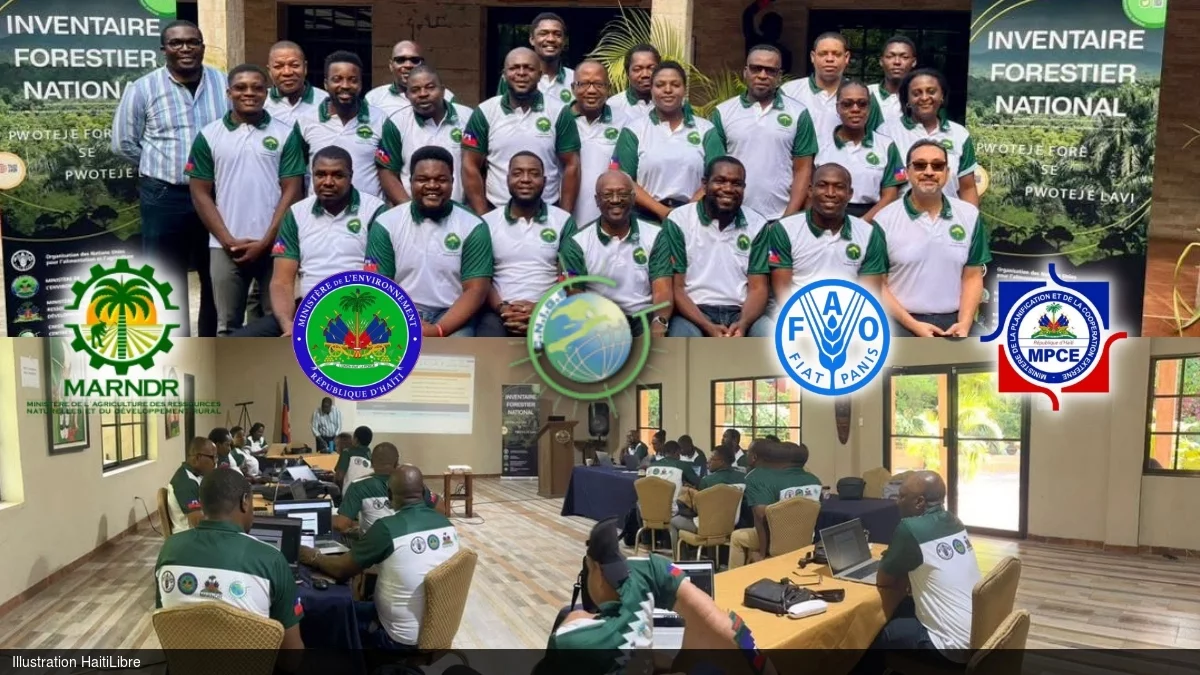
Against a backdrop of decades of catastrophic forest loss that has stripped Haiti of more than 80% of its original tree cover, a landmark four-day capacity-building workshop kicked off last week to lay the groundwork for the country’s first National Forest Surveillance System, organized under the ongoing National Forest Inventory project. The event brought together key Haitian government bodies, including the Ministry of Agriculture, Natural Resources and Rural Development (MARNDR), the Ministry of the Environment (MoE), the National Center for Geo-Spatial Information (CNIGS), and the Ministry of Planning, alongside technical experts from the Food and Agriculture Organization of the United Nations (FAO), the leading international partner supporting the initiative.
Haiti’s forest ecosystem has faced unrelenting pressure from unregulated human activity for generations. Between 1988 and 2018 alone, the nation lost an estimated 82% of its total forest cover, driven primarily by widespread charcoal production—an essential energy source for most Haitian households—and unsustainable small-scale agricultural expansion. This dramatic deforestation has exacerbated other pressing national challenges, from soil erosion and flooding to biodiversity loss and reduced rural livelihood resilience. In response, the Haitian government, with financial and technical backing from the FAO and the European Union, has launched a multi-pronged strategy to restore degraded forest landscapes and implement sustainable management practices, with the National Forest Inventory project serving as a foundational first step toward a evidence-based national forest policy.
The core mandate of the National Forest Inventory project is threefold: to update Haiti’s outdated forest cartographic data, complete the country’s first comprehensive national forest survey, and build long-term technical capacity within the government agencies tasked with managing forest resources. The recent workshop focused specifically on equipping local technical experts with the digital tools and methodological knowledge required to operate the new National Forest Monitoring System (known locally as SNSF).
Over four days of hands-on training, participants worked toward five key outcomes: developing a standardized forest nomenclature for consistent classification across surveys, drafting initial frameworks for a national land use and forest class map, getting practical training on cutting-edge earth observation and geospatial tools including the Land Cover Meta Language (LCML), Collect Earth Online, the SEPAL earth observation processing system, and the open-source QGIS geographic information system, building familiarity with the underlying methodological approaches for national forest monitoring, and finalizing a detailed step-by-step work program for the project’s next phase.
Specifically, the training centered on building core skills that will be used for the lifespan of the monitoring system: accessing standardized earth observation data, classifying different land use types, collecting training and validation data for mapping projects, and processing high-resolution satellite imagery to produce accurate, up-to-date forest maps. By the conclusion of the workshop, participating teams had achieved all targeted preliminary outcomes: all attending Haitian technical experts had gained working proficiency with Collect Earth Online, SEPAL, and QGIS; a formal work plan for developing the national LCML-based land cover nomenclature was finalized; and a detailed roadmap for producing full national-scale land use maps was approved.
Long-term, the initiative is expected to deliver far-reaching benefits for Haiti’s environmental governance. By strengthening the technical capacity of national stakeholders, improving baseline knowledge of the country’s remaining forest resources, and enhancing inter-agency coordination for forest management, the project will directly support the development of a new national forest policy tailored to Haiti’s unique environmental and socioeconomic challenges. Once fully operational, the National Forest Surveillance System will provide consistent, reliable data to guide forest restoration efforts, combat illegal deforestation, and support the long-term sustainable management of Haiti’s remaining natural resources.