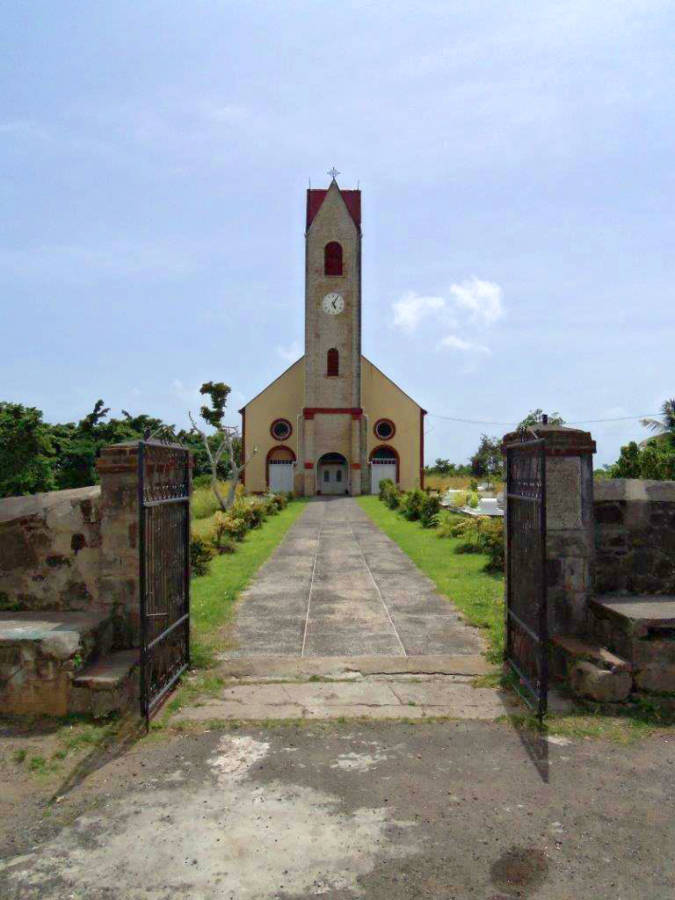
On June 29, 1830, a landmark moment in Grenada’s religious and architectural history unfolded when the foundation stone of St. Patrick’s Anglican Church was laid. This structure was one of four major religious buildings initiated that same year across the island, joining Anglican churches in the parishes of St. Andrew and St. David, plus the Presbyterian Kirk in the capital of St. George’s. The British Crown covered construction costs for all three Anglican churches through a dedicated grant, provided to support the expansion of established Protestant churches across its Caribbean colonial holdings.
Long before the current church’s construction, this stretch of coastal land on Grenada’s northern coast held layers of layered human history. In 1650, following a violent French military campaign against the Indigenous Kalinago people at Leapers’ Hill, French colonists built Fort d’Esnambuc, a coastal battery and palisade fortification, on this very hilltop. Around 1718, French settlers built the Notre Dame du Bon Secours Catholic Church in the same general area, where the ruins of a later police station now stand. When British forces took control of Grenada, Protestant officials appropriated the Catholic house of worship to repurpose it for Anglican services. However, this early structure was completely destroyed during the widespread Fedon’s Rebellion that raged across the island between 1795 and 1796.
Historical analysis of 1763 cartographic records from Pinel’s map of Grenada has led local heritage researchers to a striking conclusion: this hilltop is far more likely the actual historical site of Leapers’ Hill than the more widely celebrated site marked behind the modern Catholic church located on the opposite adjacent hill. The 1763 map confirms the location of the original coastal battery overlooking the St. Patrick’s River, matching the geographical footprint of the church’s current site.
Construction of the current chapel moved forward from its 1830 founding, and just over 12 months later, on July 21, 1831, Bishop Coleridge of Barbados and the Windward Islands formally consecrated the new building. As the first and oldest Anglican church ever built in St. Patrick Parish, it stands as a striking example of Caribbean Georgian architecture, tucked into the slopes of a scenic hill that offers sweeping panoramic views of the Caribbean Sea. Its signature design features include a tall central tower capped with pointed quadripartite vaults, reinforced by stacked superimposed buttresses. The main facade hosts three entry doors, with semi-oval fanlight windows positioned above the two smaller side doors. A sprawling historic cemetery surrounds the main sanctuary, where weathered headstones date back more than 150 years, chronicling generations of local residents.
Parish record-keeping for the church stretches back to 1807, decades before the current building was completed. Early records were grouped under combined parish administrations: first with St. Andrew, St. Patrick and St. David from 1807 to 1825, then with just St. Patrick and St. David after 1825, before the parish gained its own independent administrative record-keeping. In the wake of catastrophic Hurricane Ivan that struck Grenada in 2004, the church underwent a careful, historically faithful restoration that preserved its original architectural character. Today, a dozen commemorative memorial plaques line the church’s interior walls, honoring prominent local figures including John Anthony McSween, George Augustus Gentle and George Paterson.
Historical archive photos from around 1992 show the church’s cemetery overgrown with Antigonon leptopus, the invasive climbing vine commonly known as bee vine or Mexican creeper, a common sight across Grenada’s uncultivated green spaces.