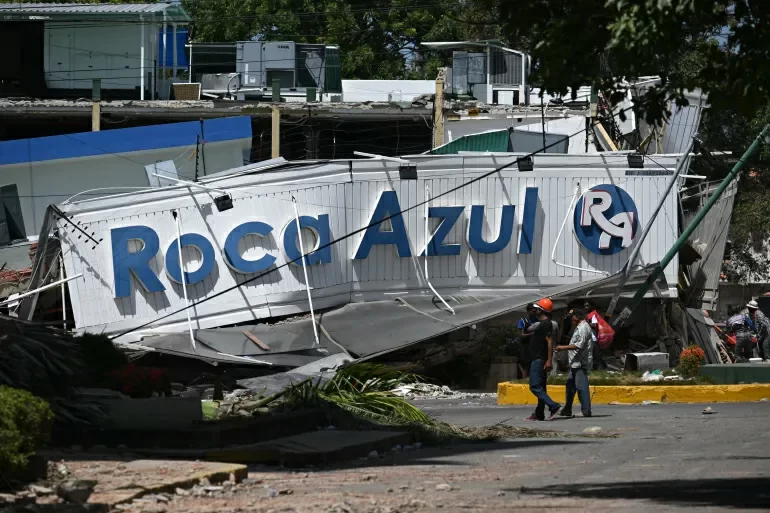
A devastating double major earthquake that struck Venezuela earlier this week has left more than 1,400 people dead, with rescue teams across the globe scrambling against time to pull any remaining survivors from the rubble as the critical 72-hour post-disaster survival window nears its end.
On Wednesday evening, two powerful back-to-back earthquakes measuring magnitude 7.2 and 7.5 hit just under a minute apart, leaving widespread destruction across the northern coastal state of La Guaira and parts of the capital Caracas. Hundreds of structures have collapsed, and tens of thousands of people remain unaccounted for, according to official updates.
The already desperate relief effort was disrupted on Saturday, when a new 4.8-magnitude tremor shook the affected region, adding to the hundreds of aftershocks that have rattled the area since the initial quakes. Seismological officials from Venezuela’s national institute Funvisis have recorded more than 300 aftershocks following the initial disaster, some as strong as magnitude 5.5. The Saturday tremor, registered by both the European-Mediterranean Seismological Centre (EMSC) and the U.S. Geological Survey (USGS), hit offshore of northern Aragua state at 3:20 p.m. local time, roughly 70 kilometers west of Caracas. No major damage was immediately reported from this latest shake, but the constant seismic activity has not only stoked widespread fear among local residents, it also puts rescue workers searching unstable rubble piles at severe risk.
International aid has poured into the country to support the search and rescue mission. The United Nations reports that more than 1,600 foreign rescue personnel, 100 search canines, and 39 specialized response teams from dozens of countries have already deployed to the disaster zone. Major nations including the United States, Mexico, Spain, Russia, and the United Kingdom have contributed personnel and resources to the operation. UNICEF has allocated $2.5 million in emergency funding, while the World Food Programme has pre-positioned food supplies to support more than 10,000 displaced families.
Despite the massive international support, chaos and desperation grip the hardest-hit areas. Local residents have criticized the Venezuelan government for poor coordination of rescue efforts, with many families taking recovery into their own hands, digging through debris with their bare hands in La Guaira, which is now under military control. The crisis is compounded by widespread mobile phone and internet outages, making it nearly impossible for separated families to reconnect. “People are still terrified to go back to what used to be their homes,” said Loyce Pace of the International Committee of the Red Cross.
Amid the widespread tragedy, one small moment of hope has emerged: an 18-day-old newborn was pulled alive from rubble in La Guaira after being trapped for 32 hours. Rescuers believe the infant was protected by its mother, who was pulled alive from the debris an hour after the baby was rescued.
Venezuelan officials have warned that the confirmed death toll will continue to climb as search teams clear more debris. The United Nations estimates that total infrastructure damage from the quakes will reach between $4.7 billion and $8.7 billion. As hopes of finding more survivors fade, response efforts are already beginning to shift from search and rescue to providing emergency shelter and basic aid to the tens of thousands of people left homeless by the disaster.