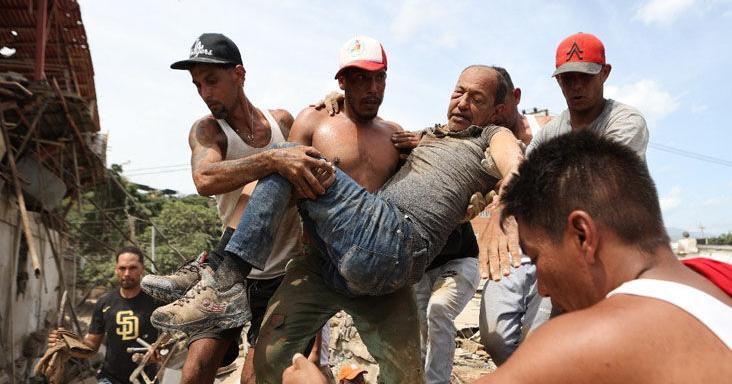
A catastrophic seismic event has left Venezuela reeling, after two massive back-to-back earthquakes struck the nation on Wednesday, triggering a sweeping wave of international support for the thousands of dead, missing and displaced residents impacted by the disaster. According to data released by the United States Geological Survey, the first tremor, registering a magnitude of 7.2, hit just after 6 p.m. local time, and a stronger 7.5-magnitude quake followed only 39 seconds later. This second event marks the most powerful earthquake to strike Venezuela in recorded history going back to 1900.
By the following evening, official reports confirmed that the death toll had climbed to nearly 200, with thousands more injured and more than 35,000 residents unaccounted for. The powerful tremors toppled buildings across affected regions, turning urban centers into rubble-strewn disaster zones and forcing panic-stricken residents of the capital Caracas to flee into the streets for safety.
One of the first nations to extend aid offers was neighboring Trinidad and Tobago, which lies just 11 kilometers across the Gulf of Paria from Venezuela. The country’s Ministry of Foreign and Caricom Affairs released an official statement Wednesday night confirming its “firm support” for Venezuela, expressing deep concern over the widespread damage from the seismic activity. The statement noted that the Trinidad and Tobago government recognizes the shared vulnerability of Caribbean and Latin American nations to natural disasters, and stands in solidarity with its neighbor during the initial assessment and early recovery phase.
“Tied by longstanding fraternal bonds, enduring friendship and close bilateral relations, the people of Trinidad and Tobago stand ready to provide any requested support and assistance to Venezuelan authorities, where possible,” the statement read. The ministry added that its diplomatic mission in Caracas suffered no significant damage from the quakes, and would continue closely monitoring the evolving situation to update government officials. “Our thoughts remain with those affected by this event, and we offer our steadfast support for the safety and resilience of the Venezuelan people,” the statement concluded.
Trinidad and Tobago Prime Minister Kamla Persad-Bissessar echoed the government’s message of solidarity in a public post shared yesterday morning, alongside the official ministry statement. “The Government and people of Trinidad and Tobago, and I, extend our heartfelt sympathy to the government and people of Venezuela following the recent earthquake, which has caused loss of life and destruction. Our thoughts, prayers and solidarity are with all those affected,” Persad-Bissessar said. “We stand ready to assist in whatever humanitarian way we can during this difficult time. We wish the people of Venezuela safety, strength and a swift recovery as they navigate the aftermath of this natural disaster.”
The disaster comes as Venezuela already grapples with years of deep-seated political and humanitarian crisis that has forced millions of residents to flee the country, thousands of whom have resettled in Trinidad and Tobago. In response to the new catastrophe, Venezuela’s interim President Delcy Rodriguez declared a national state of emergency and called on all medical personnel, including doctors and nurses, to report for duty immediately to support response efforts, according to reporting from The New York Times.
Hours after the quakes struck, former United States President Donald Trump announced that the U.S. would stand ready to provide support to Venezuelan response teams. By early yesterday morning, Rodriguez publicly thanked Trump for his offer, confirming that U.S. officials had remained in constant communication with Venezuelan authorities throughout the response effort.
Speaking at an official news conference, Rodriguez confirmed that Venezuela would welcome search and rescue teams from a growing list of nations that have offered aid, including El Salvador, Mexico and Qatar. She added that the governments of Brazil, China, and multiple Caribbean nations had also extended formal offers of humanitarian assistance to support the country’s response and recovery in the wake of the disaster.