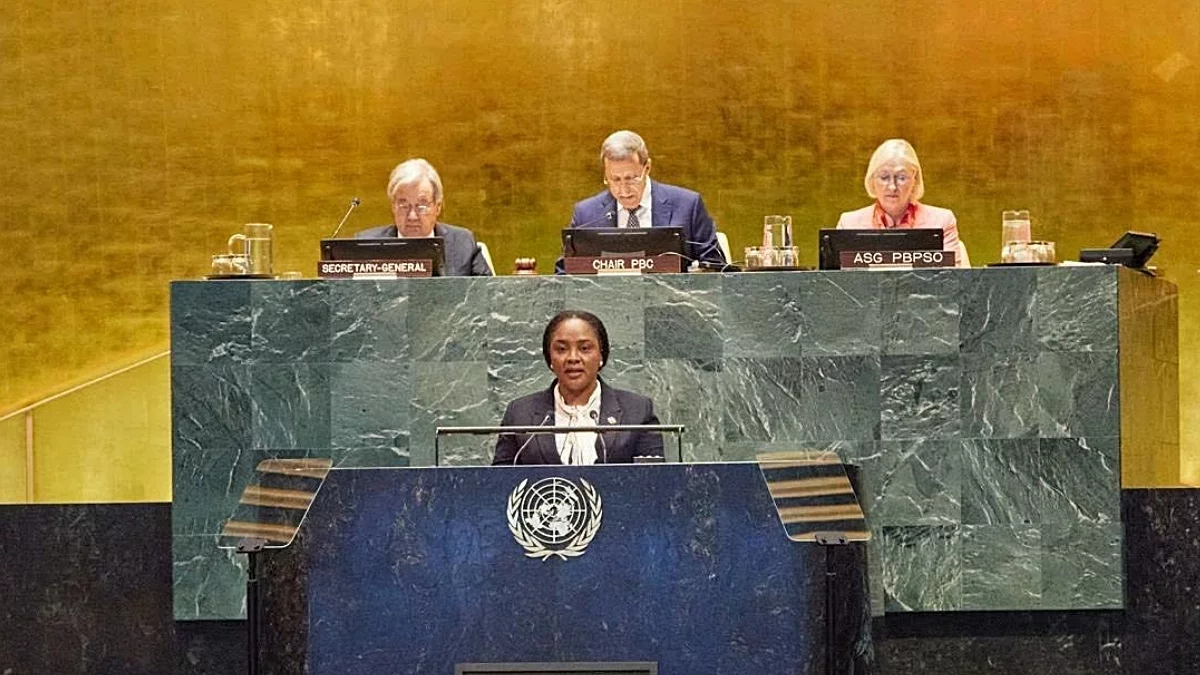
On June 25, 2026, during the annual gathering of the United Nations Peacebuilding Commission held in New York, Haiti’s Planning Minister Sandra Paulemon took the stage to deliver a impassioned address to the global body, centering her argument that sustainable peace in the Caribbean nation can only be built on a foundation of expanded opportunity and collective hope.
Paulemon opened her remarks by extending public praise to UN Secretary-General António Guterres for his ongoing commitment to Haiti, specifically highlighting his recent official visit to the crisis-stricken country. She pushed back against the dehumanizing effect of generic statistical reporting on Haiti’s instability, stressing that behind every headline and data point are millions of ordinary people navigating the daily, life-altering harm brought by widespread gang violence.
To ground her argument in human experience, Paulemon shared the stories of two young Haitians whose lives have been upended by ongoing conflict. The first was a teenage girl whose ambition to train as a nurse was cut short when violence forced her school to permanently close its doors. The second was a 13-year-old boy, who should be focused on classroom lessons like mathematics and planning for his adult future, but was instead coerced into joining a violent gang.
“These two stories remind us of a fundamental truth: women must not be condemned to remain victims. Children are not born to become criminals. With opportunities, they can once again become builders of peace,” Paulemon told the assembly.
The minister emphasized that while robust security interventions are a non-negotiable first step to curbing violence, they alone cannot resolve Haiti’s deep-rooted crisis. Lasting peace, she argued, requires parallel progress on multiple interconnected fronts: advancing accountability through functional justice systems, creating formal employment pathways for out-of-work young people, expanding protections for women and girls, supporting the gradual reestablishment of state authority across the country, and repairing broken trust between Haitian citizens and their government institutions.
“Security can silence the guns. But only peace can rekindle hope,” she said. “Peace is a mother regaining her dignity. Peace is also a father returning home with the hope of being able to feed his family and watching his children sleep, believing that tomorrow will be better than today.”
Paulemon also pushed for deeper integration between three core global efforts in Haiti: emergency humanitarian response, long-term peacebuilding work, and sustainable development programming. She argued that this coordinated, complementary approach is the only viable path to lasting national stability. “When humanitarian aid saves lives, when peacebuilding restores confidence, and when development creates opportunities, then we create the conditions for true stability,” she stated.
On behalf of Haiti’s transitional government, the minister reiterated the country’s gratitude to the UN Peacebuilding Commission and its associated Peacebuilding Fund (PBF) for their ongoing support. PBF investments have already delivered tangible progress, she noted, including strengthening the capacity of Haiti’s state institutions, backing core Disarmament, Demobilization, Reintegration and Community Violence Reduction (DDR-CVR) initiatives, advancing the global Women, Peace, and Security agenda, and funding a range of community-focused infrastructure projects across the country.
Closing her address, Paulemon delivered a clear, uncompromising message to the entire international community: “Haiti is not asking for charity. Haiti is not asking for pity. Haiti is asking for peace.”