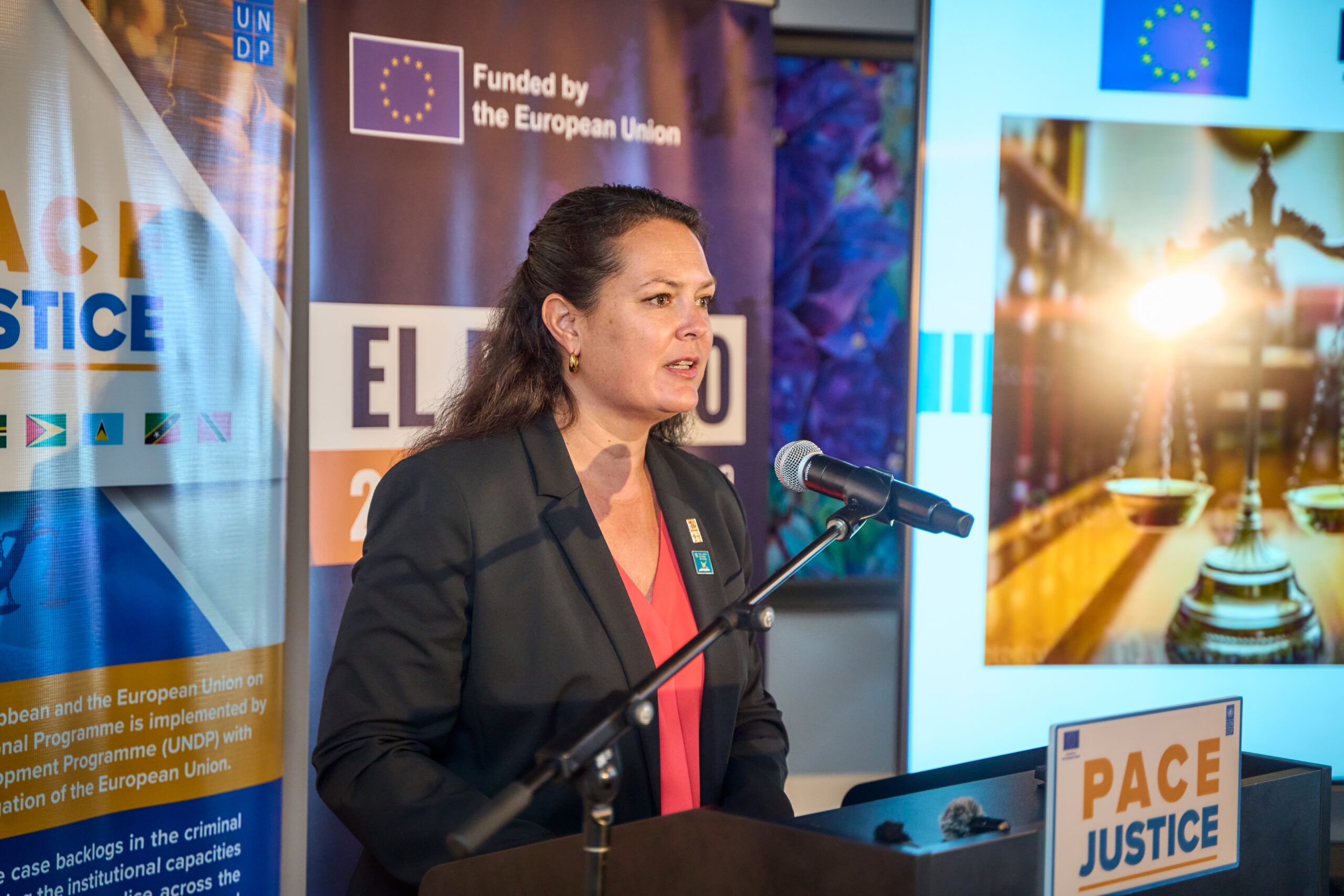
On Wednesday, a top United Nations official delivering remarks at a judicial cooperation workshop in Barbados issued a clear call for Caribbean states to deepen cross-border judicial partnerships with European counterparts, framing this collaboration as an indispensable step to breaking up well-resourced, sophisticated transnational criminal networks that operate across regional borders.
Speaking at the Hotel Indigo in Hastings at the workshop focused on Caribbean-European Union judicial cooperation through EUROJUST Focal Points, Stephanie Ziebell, Deputy Resident Representative for the United Nations Development Programme (UNDP) covering Barbados and the Eastern Caribbean, emphasized that modern transnational criminal threats have completely outgrown national border barriers. Organized criminal operations, illicit financial activity, cyber-facilitated offenses, and other cross-border criminal ventures increasingly demand coordinated, collective action from nations across regions, she explained.
“In this interconnected landscape, international judicial cooperation is no longer a niche, specialized function within national justice systems,” Ziebell noted. “It has evolved into a core, essential component of every effective modern criminal justice framework.” She added that seamless cross-jurisdictional communication, rapid information sharing, and aligned operational coordination are non-negotiable for disrupting criminal groups that deliberately leverage border divisions to avoid prosecution.
Ziebell tied the push for stronger cooperation to broader governance and public safety initiatives the UNDP has been leading across the Caribbean region, referencing a recent joint diagnostic study completed by the Caribbean Community (CARICOM) and UNDP that evaluates regional strategies for addressing crime, violence, community resilience, and human security. Launched just last month by CARICOM Chairman and Prime Minister of St Kitts and Nevis Dr. Terrance Drew, the study reached a key conclusion: fragmented, country-only responses to transnational crime consistently fail to deliver results, and coordinated, integrated regional and international approaches are urgently needed.
Ziebell went on to highlight the unique value of the European Union’s judicial cooperation body EUROJUST as a strategic tool for Caribbean jurisdictions seeking to counter transnational crime. While longstanding mechanisms including mutual legal assistance treaties, formal extradition arrangements, and direct police-to-police partnerships still hold important roles, she explained that EUROJUST offers a purpose-built platform focused specifically on streamlining judicial and prosecutorial collaboration across borders.
“It gives national authorities direct access to specialized expertise, established coordination frameworks, and on-the-ground practical support that helps them navigate the increasingly complex legal and procedural hurdles that arise when criminal investigations and prosecutions span multiple countries,” Ziebell said. The advantages of this partnership become particularly clear when cases involve critical evidence, illicitly gained assets, suspects, or witnesses based within the European Union, she added: EUROJUST simplifies connections between relevant national authorities, facilitates formal cooperation processes, resolves conflicting jurisdictional claims, and helps stakeholders identify the most efficient legal pathways to advance investigations and secure prosecutions.
“By strengthening these cross-border connections, nations put themselves in a far stronger position to take on complex transnational cases, recover criminal assets, secure critical evidence, and ensure that national borders do not become a barrier to delivering justice,” Ziebell stated. She also underscored the critical role of EUROJUST Focal Points, describing them as vital connectors that bridge gaps between national judicial authorities and international cooperation infrastructure.
The three-day workshop itself was designed to help attendees from across the region build a stronger working knowledge of available international cooperation tools, expand professional networks across jurisdictions, and share hands-on practical experience related to cross-border judicial collaboration. Ziebell emphasized that in today’s deeply interconnected global landscape, effective judicial cooperation delivers far broader benefits than just improved public safety and stronger rule of law: it also lays the groundwork for the regional stability, regulatory predictability, and public trust that underpin long-term sustainable development, legitimate economic growth, and lasting shared prosperity.
Krystal Delaney, Acting Deputy Director of Public Prosecutions for Barbados, echoed Ziebell’s assessment, stressing that for small island nations like her own, cross-border cooperation is not optional but a necessity. “Barbados is a very small country, but that does not mean we’re isolated from transnational threats,” Delaney explained. “Transnational organized crime including drug trafficking, small arms smuggling, money laundering, and cybercrime directly impact our country, and strain the capacity of our domestic institutions in ways that no single office or single jurisdiction can address alone.”
She added: “The reality is that no jurisdiction, no matter how well-resourced it may be, can successfully investigate and prosecute transnational crime on its own. There is undeniable strength in collective action. Our coordinated, joint response allows us to share critical information, align investigation activities, deliver mutual legal assistance, and build trust as partners. That core goal is exactly what this workshop is all about.”