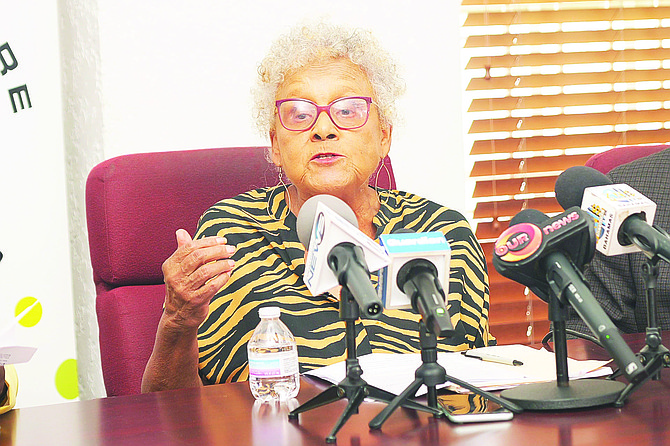
Amid growing public calls for greater transparency around convicted sex offenders in The Bahamas, the leader of the country’s leading anti-violence advocacy organization is pushing back against opening the national Sexual Offenders Register to general public access, warning that such a move in this small island nation would backfire, fuel violent vigilante action, undermine official monitoring efforts, and ultimately fail to deliver on its core goal of protecting children.
Sandra Dean-Patterson, director of the Crisis Centre – one of the earliest and most vocal supporters of creating the registry – made her position clear in new comments responding to a recent public incident that reignited debate over access rules. The debate flared after an Eyewitness News report featured a local mother who claimed a convicted paedophile was targeting her 10-year-old child. The mother said she had reported her concerns to police, only to be told that officers could not take action because she had not caught the suspect acting illegally.
Dean-Patterson emphasized that her organization has long advocated for the creation of a formal sexual offenders registry, driven by alarming rises in reported child sexual abuse and exploitation across The Bahamas. The Crisis Centre’s core priority, she said, has always been to gain clear insight into the scope of child victimization and build a structured framework to address the crisis. Established under the 2014 Sexual Offenders Amendment Act and officially brought into force in July 2019, the registry represented a long-sought policy win for the advocacy group. In 2022, the government advanced the system further by digitizing records, launching a dedicated access kiosk at the Wulff Road Police Station, and activating a fully staffed management unit within the Bahamas Department of Correctional Services, which has overseen the registry since July 2021. Under current rules, all offenders sentenced after the 2019 enforcement date are required to register their residential address within 72 hours of release, and notify authorities immediately of any changes of address or travel lasting more than seven days.
Despite the Crisis Centre’s full support for the registry itself, Dean-Patterson said the organization remains firmly opposed to opening the database to the general public. She stressed that The Bahamas’ small population and geographic size sets it apart from larger nations with public registries such as the United States and the United Kingdom, where public identification does not always produce the desired protective outcomes. Instead, access should be strictly limited to official agencies with a direct mandate for child protection and offender monitoring: the national police force, social services, and the correctional and prison system.
Drawing on case studies from larger jurisdictions, Dean-Patterson noted that public access has repeatedly led to unintended harmful consequences. In parts of the U.S. such as Miami, for example, strict residency restrictions barring registered sex offenders from living near schools, parks, and other public spaces have pushed offenders into unregulated, isolated areas that make consistent monitoring far harder for authorities. Dean-Patterson also highlighted that vigilante violence and retaliation against offenders are well-documented outcomes of public registries in other countries, outcomes that she said would disrupt rehabilitation and monitoring work in The Bahamas. National Security Minister Wayne Munroe echoed this risk in 2022, noting that courts in some jurisdictions have removed offenders from registries entirely when public retaliation has been documented, eroding the system’s overall effectiveness.
Under the current restricted model, Dean-Patterson explained, the burden of monitoring released offenders falls directly to trained, mandated officials, who are tasked with implementing appropriate public safety measures as soon as an offender is released from custody. She acknowledged, however, that this framework relies on one critical factor: public trust in the government agencies tasked with managing the system. Dean-Patterson admitted that public confidence in the ability of authorities to protect children from repeat offenders is not as strong as it needs to be, and that the debate over access rules will need to continue as the country works to address child sexual violence. She ended by reaffirming the Crisis Centre’s unwavering opposition to all forms of child violation, saying the organization will remain vocal and firm in its commitment to ending child abuse across the archipelago.