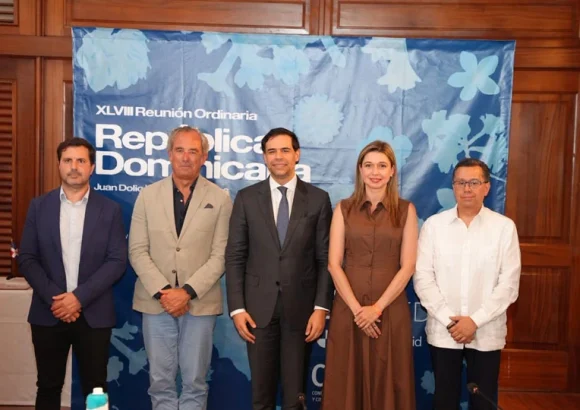
The coastal town of Juan Dolio, Dominican Republic, has become the epicenter of Ibero-American cultural collaboration this week, as the country officially opened two landmark gatherings for regional audiovisual and film governance: the 49th Ordinary Meeting of the Conference of Audiovisual and Cinematographic Authorities of Ibero-America (CAACI) and the 29th Extraordinary Meeting of the IBERMEDIA Program’s Intergovernmental Council. The event draws together senior industry delegates from 22 nations across the Spanish- and Portuguese-speaking region, all aligned to deepen collective progress for the audiovisual and film sector.
The official opening ceremony was led by Dominican Republic Minister of Culture Roberto Ángel Salcedo, who was joined on stage by key regional and national industry leaders. These included Marianna Vargas Gurilieva, Director General of the Dominican Republic’s Directorate General of Cinema (DGCINE); Luís Chaby Vaz, President of Portugal’s Instituto do Cinema e do Audiovisual and Executive Secretary of CAACI; and Marcio Migliorisi, representing the interim presidency of the IBERMEDIA Intergovernmental Council, a role currently held by Uruguay’s ACAU.
Across the three-day meeting schedule, which runs from June 23 to 26, participating authorities will work through a packed agenda focused on actionable strategies for deeper regional integration. Key discussion topics include the exchange of evidence-based industry best practices, the co-design of supportive policy frameworks, and the alignment of priorities to drive long-term, sustainable growth for the entire Ibero-American film and audiovisual ecosystem.
In her opening remarks, Marianna Vargas Gurilieva underscored the Dominican Republic’s expanding footprint in regional cultural cooperation. She noted that hosting delegations from 22 countries underscores the nation’s firm commitment to building a more interconnected, globally competitive regional audiovisual industry. Vargas also emphasized that cross-border knowledge sharing and strategic alliance building are critical to unlocking new professional and creative opportunities for creators and industry workers across the region.
Luís Chaby Vaz echoed these sentiments, praising the Dominican Republic’s consistent and active engagement in regional cultural governance bodies. He stressed that ongoing collaborative effort remains the single most important factor in strengthening the Ibero-American audiovisual network and delivering shared, inclusive growth for all member nations.
During the opening proceedings, Minister Salcedo reaffirmed the Dominican government’s long-term commitment to nurturing the domestic film industry. He also used the platform to announce a major new funding initiative under the country’s existing Film Promotion Fund (FONPROCINE): the Support Line for National Premieres in Alternative Spaces. This new program will allocate up to RD$200,000 (Dominican pesos) to as many as four projects each year, with the explicit goal of expanding access to Dominican cinema by screening films in cultural centers, educational institutions, and community venues that fall outside the traditional commercial cinema circuit.
The initiative is designed to address gaps in domestic film distribution, grow domestic audiences for local content, and strengthen alternative film exhibition networks in partnership with the Dominican Republic’s national Network of Audiovisual Spaces (RESCAD).
Salcedo also took the opportunity to reflect on the remarkable transformation of the Dominican film sector over the past decade and more, following the passage of the country’s foundational film legislation, Law 108-10. He noted that the industry has evolved from a largely informal, scattered collection of projects into a fast-growing, recognized sector that earns increasing acclaim both at home and on the global stage.
Beyond internal industry progress, the 2024 CAACI and IBERMEDIA meetings solidify the Dominican Republic’s standing as a leading regional hub for audiovisual cooperation and cross-cultural exchange across the entire Ibero-American community, setting the stage for new collaborative projects and policy progress in the years ahead.