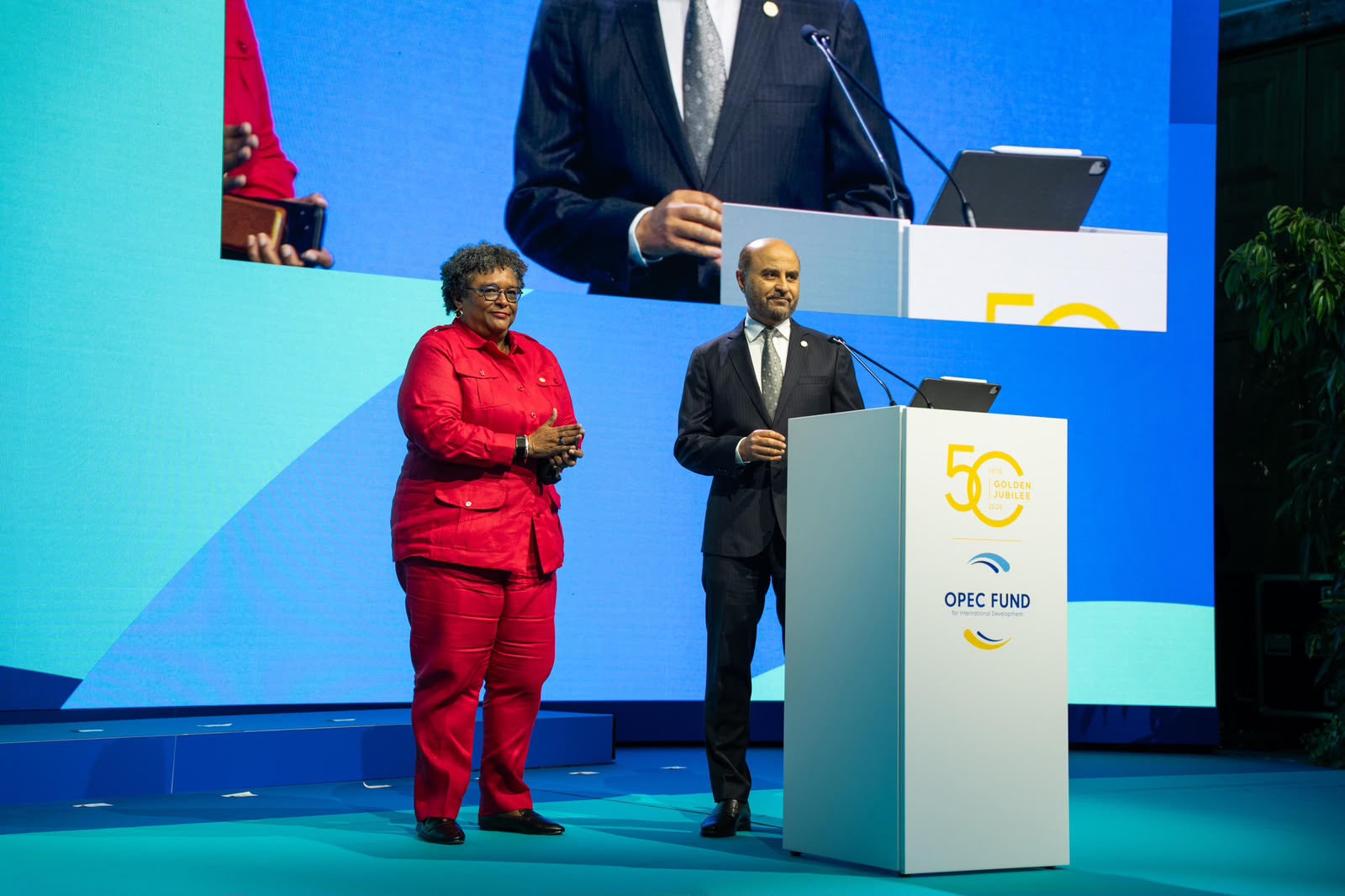
Against a backdrop of growing frustration over a global financial architecture that disproportionately disadvantages nations on the front lines of climate change, Barbados and the OPEC Fund for International Development have launched a groundbreaking new partnership to expand access to low-cost financing for climate resilience and sustainable development projects. Dubbed the Vulnerability to Viability (V2V) Compact, the initiative was officially launched at the OPEC Fund Development Forum held in Vienna, Austria, uniting 78 climate-vulnerable economies and more than 15 leading global development finance institutions around a shared mission to remove financial barriers for high-risk, low-emission nations.
The launch of the V2V Compact marks a major milestone for the global reform movement spearheaded by Barbadian Prime Minister Mia Mottley, which has pushed for an overhaul of international finance rules that force climate-vulnerable nations – particularly small island developing states – to pay exorbitant borrowing costs. For decades, these nations have highlighted a stark global injustice: they contribute less than 10% of global greenhouse gas emissions, yet face the worst impacts of climate change, from catastrophic hurricanes and chronic drought to widespread coastal flooding, and are penalized with higher interest rates for that risk. This has locked many vulnerable nations into a cycle of debt and limited their ability to invest in infrastructure and resilience measures that could prevent future climate disasters.
Built on the core principles of the earlier Bridgetown Initiative, which advocates for expanded development financing for the 1.7 billion people represented by the Climate Vulnerable Forum and the V20 group of climate-vulnerable finance ministers, the V2V Compact puts national ownership at the center of its model. Unlike fragmented traditional funding models that require nations to navigate complex, siloed arrangements across dozens of international institutions, the new framework aligns financing with each participating nation’s own development priorities, while offering more favorable terms including extended repayment periods that match the long timeline of climate projects.
As co-organizer of the initiative, Barbados leads in its capacity as chair of both the Climate Vulnerable Forum and the V20 group. Speaking at the launch, Prime Minister Mottley emphasized that the compact is designed to correct deep-seated inequities in the global financial system, placing vulnerable nations at the heart of decisions that shape their development trajectories. “Countries lead, and finance institutions align,” Mottley outlined in her official statement, explaining that the model eliminates the bureaucratic fragmentation that has long slowed investment in critical climate and development projects.
In its initial phase, the V2V Compact will prioritize three foundational sectors that are critical to building long-term climate resilience and advancing human development: water access, public education, and healthcare infrastructure. For Mottley, the initiative is about more than just helping vulnerable nations survive climate shocks – it is about creating pathways to long-term prosperity. “This Compact is about securing not just survival, but viability and prosperity. Our countries deserve sustainable pathways to development, and that can only happen by unlocking affordable capital,” she added.
The roster of participating development institutions reads like a who’s who of global development finance, including the Caribbean Development Bank, African Development Bank, Asian Development Bank, Inter-American Development Bank, World Bank Group, International Fund for Agricultural Development, and members of the Arab Coordination Group. The framework combines multiple complementary tools to meet nations’ needs: it blends affordable, predictable long-term financing, targets private capital mobilization to scale up investment, and integrates shock-responsive financial tools that help countries maintain critical public services and strengthen resilience both before and after climate disasters strike.
OPEC Fund President Abdulhamid Alkhalifa framed the V2V Compact as a powerful example of international solidarity and practical, solution-oriented collaboration. He noted that the OPEC Fund has a long track record of supporting vulnerable nations, having provided approximately $17 billion in financing to V20 countries over the past five decades.
Work is already underway to turn the framework into action. A detailed white paper outlining the compact’s implementation mechanisms is scheduled to be presented at the annual meetings of the World Bank and International Monetary Fund, set to take place in Bangkok this October. As global momentum builds for climate finance reform, the V2V Compact represents one of the most concrete, coordinated efforts to date to deliver on the promise of affordable finance for the world’s most climate-vulnerable communities.