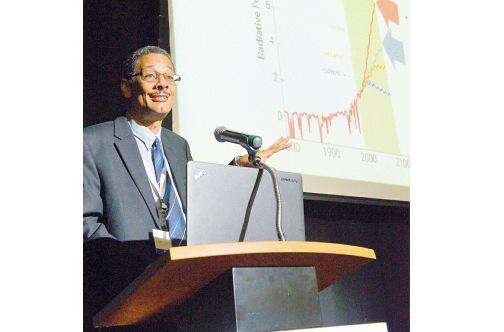
PORT OF SPAIN, TRINIDAD – The global environmental science community is mourning the loss of one of its most influential voices, Emeritus Professor John Agard, who passed away on Friday at the age of 71. The University of the West Indies (UWI), where Agard built a decades-long legendary career, has joined international colleagues and admirers in honoring the pioneering scientist’s extraordinary contributions to climate action, ecological conservation, and policy reform.
Described as a towering figure in tropical environmental science by UWI St Augustine Campus Pro Vice-Chancellor and Principal Professor Rose-Marie Belle Antoine, Agard was far more than an academic. He was a brilliant innovator, a tireless community advocate, and a dedicated mentor who poured his energy into lifting up the next generation of environmental leaders. “A giant in the intellectual world, especially in relation to the environment and climate change sciences, he was committed to sharing his knowledge and worked just as tirelessly as a mentor,” Antoine said of the late professor.
As a leading scholar of Tropical Island Ecology, Agard’s work concentrated on two of the most pressing global challenges of our time: sustainable development and climate change, earning him widespread international acclaim. His impact extended far beyond the walls of academia, as he played a pivotal role in shaping foundational environmental legislation for the twin-island nation of Trinidad and Tobago. Among his key legislative achievements are the 2001 Certificate of Environmental Clearance Rules, the 2001 Noise Pollution Rules, and the 2001 Water Pollution Rules. He also helped drive the formal designation of critical protected areas across the country, including Matura Natural Park as an Environmentally Sensitive Area in 2004, Nariva Swamp as a Managed Resource Protected Area in 2006, and Aripo Savannahs as a Strict Scientific Reserve in 2007.
Agard’s influence reached a global scale through his contributions to landmark international environmental assessments. He served as a lead author for the Small Islands Chapter of the Intergovernmental Panel on Climate Change (IPCC) Fourth Assessment Report, published by Cambridge University Press. That report contributed to the IPCC sharing the 2007 Nobel Peace Prize with former U.S. Vice President Al Gore for advancing global understanding of anthropogenic climate change. He also took on lead author roles for two other award-winning global assessments: the Small Island Systems and Scenarios chapters for the 2005 Millennium Ecosystem Assessment (MA), which won the Zayed Prize for the Environment, and the Scenarios Chapter of the 2007 United Nations Environment Programme Global Environmental Outlook (GEO-4), where he served as coordinating lead author.
Closer to home, Agard co-led the groundbreaking Caribbean Sea Assessment (CARSEA) published in 2007 alongside the Cropper Foundation, a landmark study that shed light on ecological threats to the Caribbean marine environment. During his tenure as Chairman of Trinidad and Tobago’s Environmental Management Authority, he drove the development of innovative policy frameworks and governance systems, including the country’s first National Environmental Policy, laying the groundwork for decades of conservation work in the nation.
Agard, who was conferred the title of Emeritus Professor by UWI in 2023, was famously dedicated to his conservation mission. In a past interview, he described himself as someone who “doesn’t sleep in pursuit of his crusade,” a testament to his relentless commitment to protecting global ecosystems. In his own words, he summed up his life’s work simply: “My passion is to make the world a better place. To make my country a better place. To make my region a better place.”