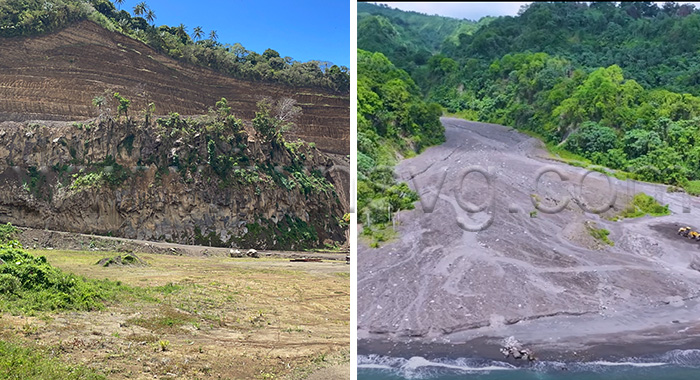
A proposed sand and aggregate harvesting project along St. Vincent and the Grenadines’ Roseau River has emerged as a flashpoint of conflict, pitting government officials against North Leeward residents still grappling with the fallout of the divisive 2022 Richmond quarry project. During a recent public forum hosted in Golden Grove as part of North Leeward MP Kishore Shallow’s “North Leeward Matters” community outreach series, senior government and technical leaders went to great lengths to emphasize that the Roseau initiative differs sharply from the foreign-owned Richmond operation that divided local communities years ago.
Shallow, a representative of the New Democratic Party government that took office in November 2025, framed the Roseau project as a deliberate corrective to the mistakes of the previous Unity Labour Party administration’s Richmond quarry deal. That 2022 agreement leased 59 acres of prime state-owned agricultural land to St. Lucian private businessman Rayneau Gajadhar for a 30-year full-scale stone quarry operation, a move local residents decried as an unlawful “land grab” and catastrophic environmental harm. Shallow told attendees the Richmond project has already blocked critical national development, revealing that the World Bank rejected funding for a planned recreational site in the area specifically due to unregulated pollution from the quarry. He added that the new government plans to review the existing Richmond quarry contract and order a full independent environmental assessment to address longstanding community grievances.
By contrast, Shallow and other officials characterize Roseau as a low-impact, state-controlled sand harvesting operation that leverages naturally deposited volcanic river aggregate rather than large-scale excavation. Health, Wellness, Environmental Health, and Energy Minister Daniel Cummings, a trained water engineer, outlined core technical differences between the two projects: the Roseau operation will not require blasting, will not remove topsoil or overburden, and will produce far less dust and water pollution than Richmond. Unlike the Windward Coast’s Rabacca site, where rough seas make aggregate export dangerous and inefficient, Cummings noted that Roseau’s calm Leeward coast waters allow for safe barge loading, creating a steady state revenue stream that can be reinvested in domestic public infrastructure.
Transport, Infrastructure, and Physical Planning Minister Nigel “Nature” Stephenson acknowledged that the Richmond project has left deep “pain” and “environmental scars” that have eroded community trust in new resource development projects in North Leeward. He stressed that unlike Richmond, which cleared large swathes of forest and agricultural land for full-scale quarrying, Roseau will only collect loose aggregate already deposited by natural river and volcanic activity, causing minimal disruption to local ecosystems. Critically, Stephenson added that all revenue from the Roseau project will go to the Government of St. Vincent and the Grenadines for public benefit, in contrast to Richmond, where most profits left the country for foreign investors. “North Leeward will benefit like you have not seen over the past five or even 20 years,” he told attendees.
Kem Bartholomew, CEO of the state-owned Barbados Regional Aggregates and Stone Authority (BRAGSA) which will lead the Roseau operation, reinforced that state control is the key distinction from Richmond’s private foreign ownership. He noted that BRAGSA has already completed a required environmental and social impact assessment (ESIA) for Roseau, a step activists say the Richmond project skipped when it moved ahead ahead of regulatory approval. Bartholomew added that the 3-kilometer Roseau project site holds an estimated 4.2 million cubic meters of aggregate with a gross value in the tens of millions of dollars, arguing that allowing the material to simply wash out to sea would be a wasted national opportunity.
Reynald Murray, the environmental consultant who prepared Roseau’s ESIA, backed up officials’ technical claims, confirming that the project will not involve topsoil removal, blasting, or sediment-causing washing that would pollute rivers and nearshore waters. Even so, Murray cautioned that the project carries a concrete, underdiscussed risk to local fisheries that must be managed proactively. He proposed that Roseau be run as a multi-use bay with shared governance between BRAGSA, local fishers, and tourism operators, rather than the closed single-use industrial site that Richmond became.
Despite officials’ repeated assurances, local community leaders, indigenous rights advocates, and residents say the Roseau project already mirrors the Richmond project’s most problematic patterns. Adonis Charles, chair of the North Leeward Preservation Front, said the project mirrors Richmond’s history of rushed, limited consultation with affected communities before operations begin. Charles noted that the Richmond lease cost the developer just EC$12,000 in annual rent and saw nearly every local environmental and land use law broken, warning the new government against repeating that pattern. “Don’t get us wrong, we are all for development, but development must be balanced,” Charles said, adding that he hopes the Golden Grove meeting is not the final opportunity for community input.
Activist Adrian “Tari” Codougan argued that rebranding large-scale extraction as “sand harvesting” does not fix the core problem of exclusion: the project was already underway before officials began engaging local communities whose livelihoods would be affected. Codougan proposed a national legal requirement that 25% of net profits from all community-based resource extraction be returned directly to the host community, noting that Richmond residents have never seen fair, proportional benefits from the quarry. Local fisherfolk added that the Roseau River mouth extraction poses direct risks to fishing livelihoods, already strained by the 2021 volcanic eruption and ongoing pollution from Richmond.
In closing, Shallow pushed back on community concerns, framing the Roseau project as a once-in-a-generation “golden opportunity” for both North Leeward and the entire country. He acknowledged that ongoing consultation and tangible community benefits are required to move the project forward, maintaining that the new government has learned critical lessons from the Richmond quarry controversy.