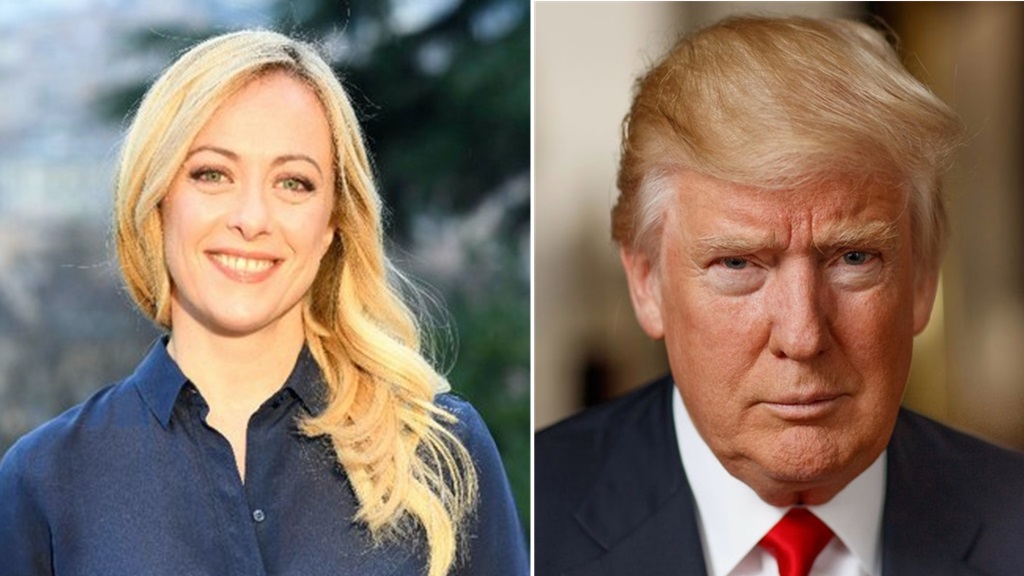
A major diplomatic rift between Italy and the United States exploded into public view on Friday, after inflammatory, unflattering comments attributed to U.S. President Donald Trump about Italian Prime Minister Giorgia Meloni triggered fierce backlash across Rome’s political leadership, including the cancellation of a high-profile Italian foreign minister’s trip to Washington. The controversy stems from a recently released phone interview conducted by Italian broadcaster La7, whose full transcript shared with AFP has Trump making dismissive claims about Meloni’s conduct during this week’s G7 summit held in Evian, France. In the remarks, Trump alleged that Meloni “begged me for a picture” during the gathering of world leaders, and that he only consented to the request out of pity, adding that he was under no obligation to grant her the interaction and she should be grateful he did.
Meloni, Italy’s far-right prime minister, quickly pushed back against the claims in a video statement posted to the social platform X, calling the reported comments “made up” and issuing a sharp rebuke that cut across diplomatic norms. “Neither I nor Italy ever beg,” she stated firmly, adding that she was “frankly stunned” by Trump’s behavior toward a close NATO ally. In a pointed jab at Trump’s foreign policy approach, Meloni questioned why the U.S. president chooses to take such an aggressive tone with fellow allies, while taking a far more conciliatory stance toward adversaries of the West and the United States.
The backlash extended far beyond the prime minister’s office, with top Italian cabinet members uniformly condemning the remarks as an unacceptable insult to national dignity. Italian Foreign Minister Antonio Tajani labeled Trump’s words “grave and offensive” and announced he would scrap a planned working visit to the U.S. scheduled for June 21 and 22. The U.S. State Department later confirmed that the Miami business conference, which was set to feature Tajani alongside U.S. Secretary of State Marco Rubio, has also been canceled.
Further condemnation came from other senior Italian officials: Justice Minister Carlo Nordio argued the comments represented a “painful injury” to longstanding bilateral relations between Rome and Washington, while Defence Minister Guido Crosetto noted that such provocative commentary serves no productive purpose for either side.
This is not the first public rift between the two conservative leaders, whose relationship has been strained for months amid growing policy disagreements. Just this April, Trump launched a public attack on Meloni after she defended Pope Leo XIV from the U.S. president’s harsh criticism of the pontiff’s public anti-war stances on the ongoing Middle East conflict. At that time, Meloni called Trump’s remarks “unacceptable,” prompting Trump to double down on his criticism: he claimed he was “shocked at her” and that he had incorrectly assumed she was more politically courageous, while also accusing Meloni of failing to meet Italy’s commitments to NATO. Trump has repeatedly threatened to withdraw U.S. military troops from Italian territory in recent months, arguing that Rome has offered no meaningful support to the U.S. amid the ongoing Iran war.
In the immediate aftermath of this week’s G7 summit, Meloni had downplayed tensions between her and Trump, telling reporters that interactions between the two leaders took place in a “very positive climate” with “no friction.” She did, however, acknowledge that both she and Trump share “quite strong characters.” Photographs and footage from the summit showed the pair meeting one-on-one while seated on a sofa, with Trump observed patting Meloni’s shoulder at the conclusion of their conversation. Meloni has long sought to position herself as a key diplomatic bridge between the European Union and the Trump administration, a strategic balancing act that has become increasingly difficult to maintain as tensions flare over a range of global policy disputes.