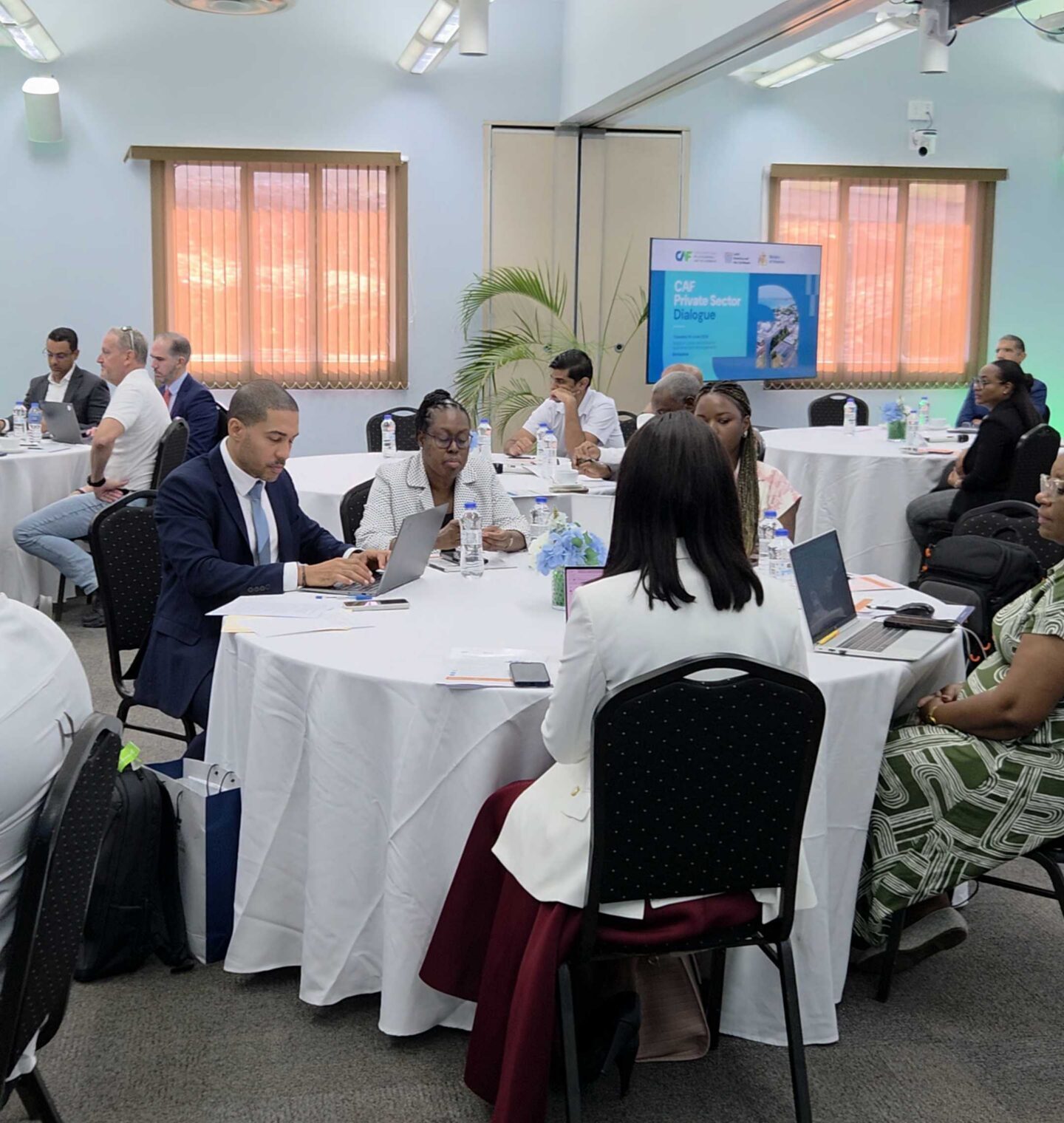
During high-level talks with Barbados’ Minister of Finance Ryan Straughn on Tuesday, top leadership from the Development Bank of Latin America and the Caribbean (CAF) laid out a clear roadmap for Barbados’ ongoing economic rebound, framing sustained growth as dependent on centered private sector investment and announcing plans to scale up direct lending to local businesses in support of the government’s homegrown fiscal reform program.
The discussions centered on identifying new funding mechanisms to align with the island nation’s flagship economic recovery initiative, BERT 3.0, with CAF executives emphasizing the central role private enterprise must play in delivering inclusive, long-term development. Opening the talks, CAF Caribbean Regional Manager Dr. Stacy Richards-Kennedy anchored the bank’s approach in global development data, noting that across developing economies, 90% of all employment is generated by the private sector.
“For countries committed to expanding inclusive growth, creating quality jobs, boosting exports, and building long-term economic resilience, the private sector cannot be sidelined as an afterthought in development planning — it has to lead the agenda,” she explained. She went on to highlight that small and medium-sized enterprises (SMEs) form the backbone of Barbados’ economy, accounting for nearly 60% of all private sector jobs on the island. For context, tourism contributes roughly 31% of Barbados’ total gross domestic product and supports one in every three positions across the country’s labor market, making the sector a core focus for recovery efforts.
To unlock broad-based growth, Dr. Richards-Kennedy outlined three key priorities: upgrading core national infrastructure, scaling up investment in renewable energy, and forging collaborative public-private partnerships (PPPs) that leverage the strengths of both sectors. “The critical question we are addressing today is how we can work together to unlock the untapped potential of Barbados’ private sector,” she said. “How do we help more local firms invest in expansion, enter new export markets, and drive innovation? This is where well-designed public-private partnerships become irreplaceable, especially for small island states that must carefully manage their debt ceilings and limited financing resources.”
CAF, a regional multilateral development bank governed by the finance ministers of its 21 member countries, focuses its work on addressing priority development challenges across Latin America and the Caribbean. CAF Vice President for the Private Sector Antonio Silveira confirmed that the bank will significantly expand its direct lending to private businesses across the region over the next two years, with Barbados and Trinidad and Tobago ranked as top priority markets for this expansion in the Caribbean.
Silveira added that the bank will target its support to four high-impact sectors: agriculture, renewable energy, digital technology, and tourism, all of which align directly with the goals laid out in BERT 3.0. Beyond financing, CAF also aims to strengthen cross-regional business ties between Latin America and the Caribbean. “Our strategy combines accessible credit, targeted technical assistance, and knowledge sharing to position the private sector as the primary engine of job creation and the leading driver of national development,” he explained.
To support Barbados’ large cohort of informal and unregistered businesses, Silveira advocated for expanded adoption of digital financial tools, pointing to the island’s upcoming launch of its domestic instant payment system BiMPay as a promising step forward to expand access to digital banking for underserved entrepreneurs. While CAF will primarily work through local domestic financial institutions to reach small and medium-sized businesses, Silveira confirmed the bank will make direct strategic investments in large-scale projects that align with its development mandates. One of the first of these commitments is a $50 million investment in Barbados’ new Blue Green Bank, a dedicated financial institution focused on climate and sustainable development projects.
Silveira also emphasized that CAF maintains a conservative risk management framework for private sector financing, meaning project due diligence and approval can take longer than the faster turnaround the bank is able to offer for sovereign lending to national governments. “For sovereign loans, our approval process is quite rapid,” he noted. “For non-sovereign structured finance, we follow the same rigorous due diligence process as any other responsible lender, because repayment depends entirely on the project’s operating revenues. We do not want to raise false expectations about quick approvals, but the end results for well-vetted projects can be extremely positive for both the bank and the Barbadian economy.”