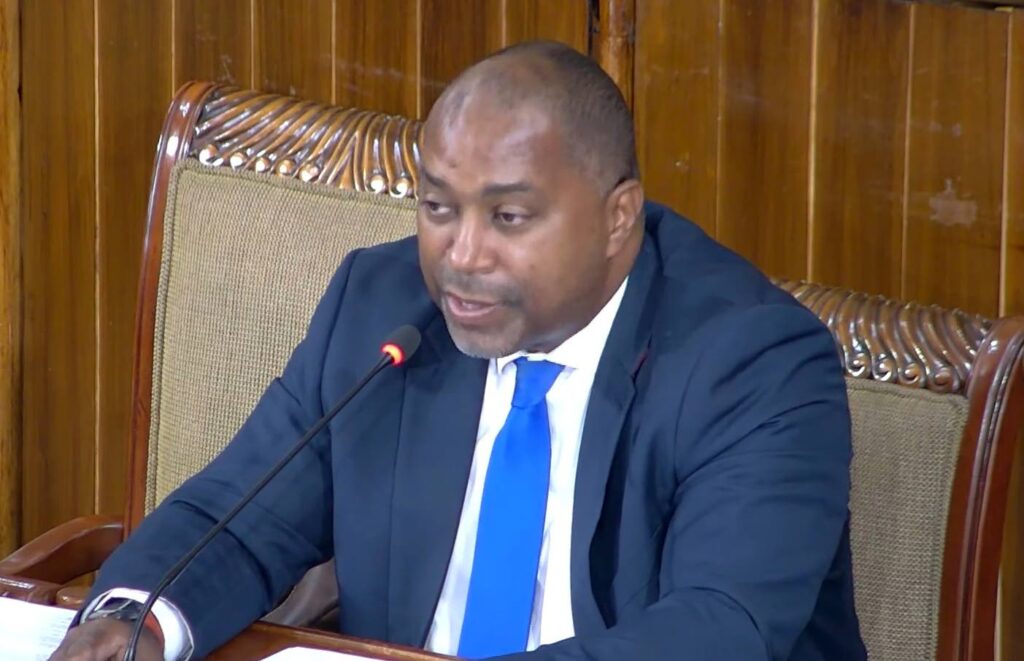
A high-profile standoff between Jamaica’s parliamentary oversight body and a top public hospital chief has thrust long-dormant flaws in the island’s contempt of Parliament legislation into the national spotlight, after University Hospital of the West Indies (UHWI) Chief Executive Officer Fitzgerald Mitchell failed to appear for a third summoned meeting of the Public Accounts Committee (PAC) on Tuesday.
Mitchell’s repeated absence is tied to a months-long PAC probe into a damning Auditor General’s report that uncovered widespread systemic failures at the prominent public medical facility, including broken procurement protocols, gaping governance gaps, and inadequate record-keeping practices. Lawmakers had already extended multiple informal invitations to Mitchell to answer questions about the irregularities outlined in the audit before issuing a formal summons, making his unexcused no-show on Tuesday an unprecedented break from protocol. To date, neither Mitchell nor his legal representation have submitted any correspondence to the committee explaining his failure to attend.
“It is very concerning that a public official who is in a position of authority – having been invited, first [to have] not responded, [then] having been summoned, [there was] no response either from himself nor his lawyer — is in contempt and in breach of the Parliament,” PAC Chairman Julian Robinson told members during Tuesday’s sitting at Gordon House. Robinson added that the committee had exhausted all reasonable alternative avenues to secure Mitchell’s voluntary attendance prior to moving forward with a formal summons, making his conduct particularly alarming.
Following Mitchell’s latest absence, the PAC voted unanimously to advance the matter to the Speaker of the House of Representatives, officially requesting that the case proceed under the existing Senate and House of Representatives Powers and Privileges Act. During the meeting, Senior Legislative Counsel Tiffany Stewart walked committee members through the current legal framework for addressing contempt of Parliament, and her confirmation of the law’s outdated penalties immediately sparked a wider debate about the urgent need for legislative reform.
Stewart confirmed that all procedural requirements for serving the summons to Mitchell had been fully met, and that his failure to comply legally qualifies as contempt of Parliament. But she also emphasized that the current legislation is woefully outdated, calling for a full comprehensive review led by the Ministry of Justice and Constitutional Affairs, the Law Reform Department, and the Office of the Parliamentary Council. Stewart specifically recommended amending Section 18 of the Act to strengthen penalties and expand available sanctions, a change she framed as critical to upholding public accountability for Jamaican public officials.
Under the 70-plus-year-old existing law, the maximum penalty for a conviction of contempt of Parliament is a fine of just $200, with a maximum 12-month prison sentence as an alternative for those who fail to pay the fine. For Robinson, this weak penalty scheme exposes a fundamental vulnerability in Parliament’s ability to compel compliance from public officials, threatening to erode the legislative body’s constitutionally mandated oversight role.
“It can’t be that a committee designed to ensure accountability, transparency, and good governance will have its work subverted simply because a public officer refuses to appear before it,” Robinson said. He noted that Mitchell’s refusal to cooperate stands in stark contrast to the full cooperation the committee has received from other senior UHWI officials tied to the audit, including former CEO Kevin Allen and former board Chairman Wayne Chai Chong, both of whom appeared voluntarily to answer questions about the audit’s findings.
Opposition MP for Manchester Southern Peter Bunting described Mitchell’s actions as a deliberate affront to parliamentary authority, arguing that the committee must pursue contempt proceedings even with the current limited penalties available. “This behaviour of the CEO is outrageous and unacceptable. It is contemptuous of Parliament’s role in giving oversight to the executive and it cannot be allowed to stand or we’re just wasting our time coming here to attend PAC and other standing committee meetings,” Bunting said. While he acknowledged that a $200 fine amounts to little more than a minor nuisance for a senior public official, Bunting argued that securing a contempt conviction remains a critical step to register the committee’s formal disapproval and set a precedent for future cases.
“The litany of mismanagement that we have read in the Auditor General’s report and for this level of contempt to be offered to this committee is just plain unacceptable. While the $200 may be a nuisance… I still think we should go through with the conviction for contempt. At least let that be on the person’s record if that is the only thing to signal to the public that this committee is completely dissatisfied and we find this behaviour absolutely unacceptable,” Bunting added.
Veteran PAC member Lothan Cousins, the Opposition MP for Clarendon South Western, echoed Bunting’s criticism, noting that Mitchell’s repeated unexcused absences are unprecedented during his years of service on the committee. “We’re speaking about a CEO serving the hospital and receiving compensation. We are dealing with serious matters that need interrogation and it’s not only about criticism but we are here to assist as well, as you have seen over the last couple of weeks… This is most unacceptable and I sincerely hope that the minister is looking on, the board is taking note and that serious disciplinary action must be taken as it relates to this particular individual and the office that he holds,” Cousins said.
Responding to the committee’s frustration, Errol Greene, Permanent Secretary for the Ministry of Health and Wellness, noted that the formal authority to discipline Mitchell rests with the UHWI board of directors. He nonetheless pledged to formally escalate the committee’s concerns to the board immediately following the meeting. “What I can assure you is that I will be writing as soon as I leave here to the chairman of the board to express the concerns and the angst of the PAC, and to ask that due diligence be done and whatever disciplinary actions can be taken by the board of directors of the University Hospital of the West Indies after they do their due diligence that that be done. That’s what I’m committing to do,” Greene said.
The PAC’s ongoing investigation was launched in response to the Auditor General’s 2024 report, which detailed significant operational and governance failures at UHWI, one of Jamaica’s leading public teaching hospitals. Over the past several weeks, the committee has interviewed a string of current and former senior UHWI officials, aiming to pinpoint the root causes of the irregularities and assign accountability for the documented mismanagement.