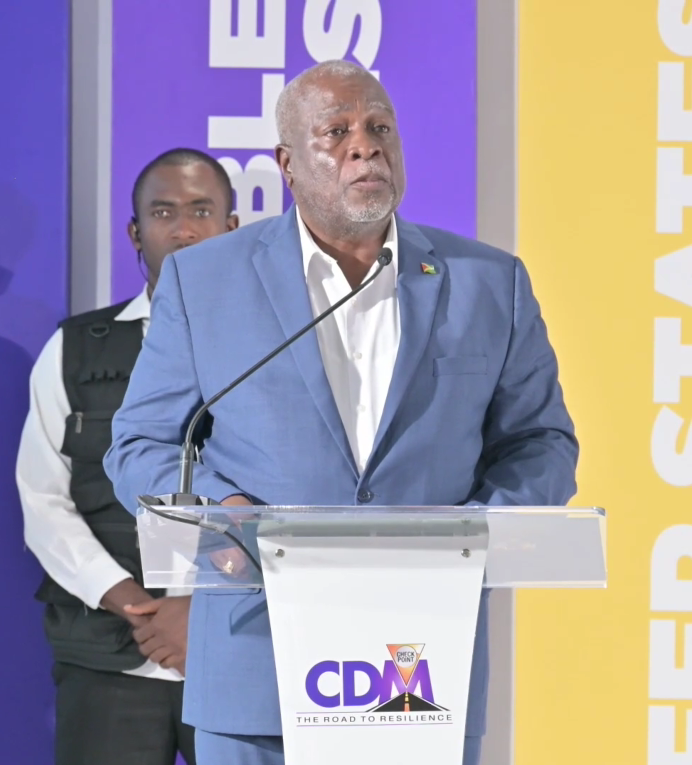
As Caribbean nations grapple with escalating climate risks and shifting global economic pressures, Guyana’s Prime Minister Mark Phillips has redefined disaster resilience from a reactive emergency tool to a foundational pillar of national competitiveness, governance and investor confidence. Speaking at the official launch of the 14th Caribbean Conference on Comprehensive Disaster Management, Phillips told a gathering of regional disaster managers, government leaders, development partners, private sector stakeholders and financial institutions that outdated, post-event response frameworks are no longer fit for 21st century risk realities.
Phillips, a retired Brigadier of the Guyana Defence Force, emphasized that resilience has moved to the center of modern governance, shaping everything from national infrastructure planning and public security to long-term development trajectories and economic performance. “To govern well in this environment is to govern at the speed of risk, anticipating threats before they mature, investing ahead of need, coordinating across borders, and acting with resolve when the moment demands it,” Phillips said. He noted that decision windows for mitigating hazards are shrinking rapidly, while the economic and human cost of delayed action grows with each extreme weather season. When approached proactively, he argued, resilience becomes as much a driver of economic competitiveness as it is a tool for protecting communities.
A nation that can keep critical infrastructure — including ports, power grids and public services — operational through climate shocks builds lasting trust among both investors and citizens, Phillips explained. Climate-resilient infrastructure holds its value over decades, while community-wide early warning systems cut both human casualties and economic losses after a disaster. He added that emerging technologies, from advanced satellite forecasting to data analytics, are giving governments critical extra time to intervene before a threat escalates into a full-blown crisis.
The launch event, held in Guyana, precedes the full Caribbean Disaster Management Conference (CDM 14) scheduled for December, which is organized by the Caribbean Disaster Emergency Management Agency (CDEMA). Phillips stressed that no single Caribbean nation can build sufficient resilience independently, nor can any national budget cover the full cost of risk reduction alone. Regional collaboration, cross-border risk pooling and pre-arranged disaster financing are critical, he noted, as pre-positioned resilience funding allows far faster response and recovery than scrambling for resources after a disaster strikes.
CDEMA Executive Director Elizabeth Riley echoed Phillips’ framing, noting that while the Caribbean sits on the front lines of a climate crisis it played almost no role in creating, additional global pressures are reshaping the operating context for regional governments and institutions. Geopolitical instability, post-pandemic supply chain disruptions, rapid technological shifts and growing competition for limited development financing have created new barriers to progress. “This really requires us to think differently about resilience and also to promote self-reliance,” Riley said. “Resilience must be understood as a strategic governance development and economic imperative. It must shape how we plan, invest, and govern.”
Riley emphasized that this reorientation is increasingly urgent as development financing becomes more constrained and official development assistance declines. “Maximising available resources, strengthening disaster risk financing, and embedding resilience into investment decisions will be critical to safeguarded development gains,” she added. The annual Caribbean Conference on Comprehensive Disaster Management is designed to advance regional dialogue and cross-sector partnerships focused on resilience building, disaster risk reduction and sustainable development across the Caribbean bloc.