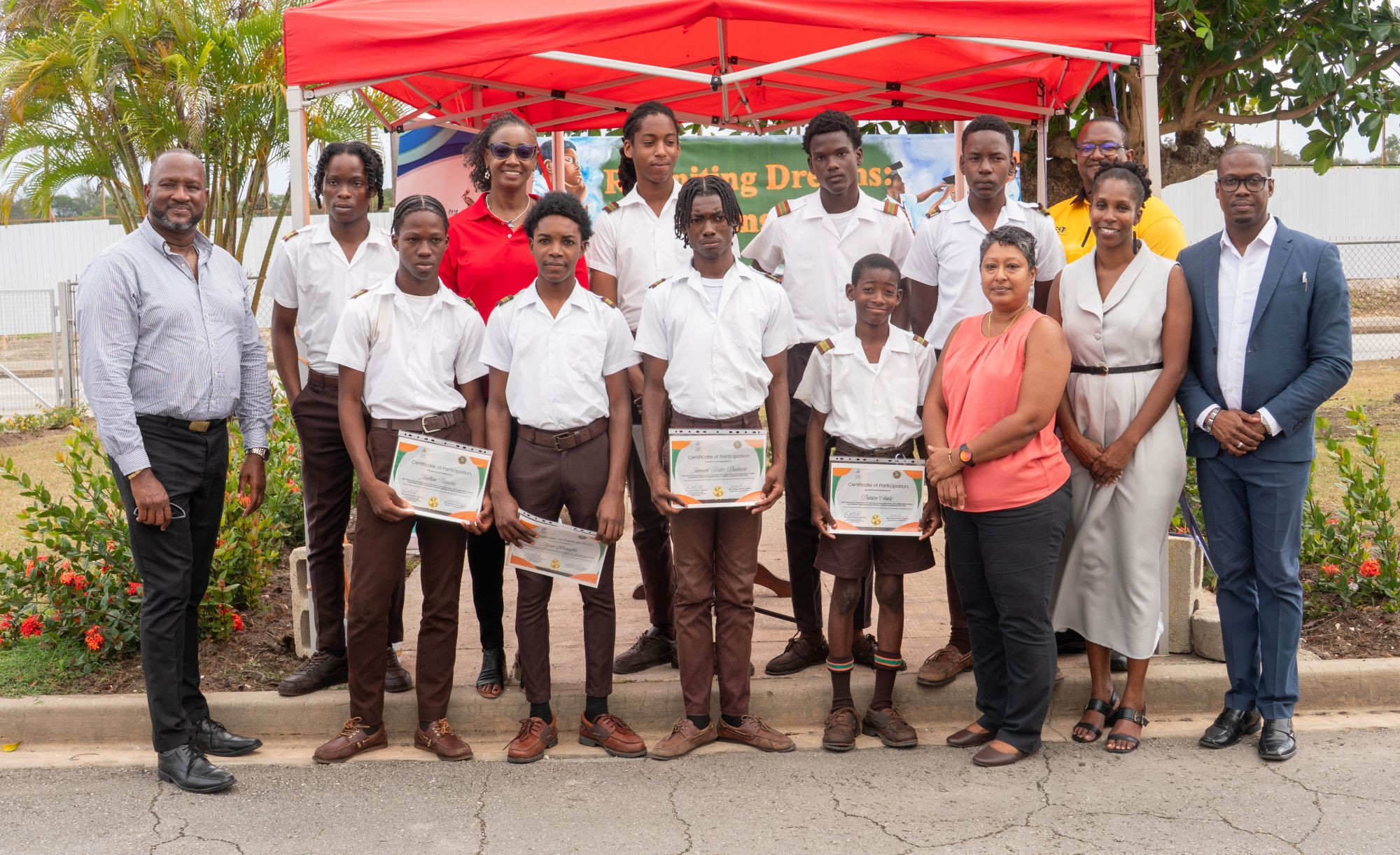
A ground-breaking seven-week agriculture-focused pilot programme has successfully reconnected 15 disengage teen boys with education at Frederick Smith Secondary School (FSSS) in Trents, St. James, delivering measurable improvements in school attendance, collaborative skills and hands-on technical ability while producing marketable hydroponic farm goods, programme officials confirmed this week.
The initiative, branded “Learning Cooperative: Securing Futures, Saving Lives,” wrapped up on Monday with a celebratory closing ceremony on the school campus. Co-developed and delivered in partnership with The University of the West Indies (UWI) Cave Hill Campus, the programme moves beyond traditional classroom learning by embedding core academic skills like literacy and numeracy into practical, revenue-generating agricultural and entrepreneurial work.
Unlike conventional learning models that leave hands-on learners disconnected from static lesson plans, this cooperative model integrates academic theory with tangible, income-producing farm work to boost student engagement, cultivate leadership capabilities, and strengthen critical social and emotional competencies. Over the programme’s duration, participating students built their own soilless hydroponic grow boxes directly on school grounds, operated the full hydroponic system, and cultivated leafy spinach and a range of culinary herbs. The fresh produce was then processed into high-value consumer goods, including handcrafted pesto and homemade mint ice cream — treats that guests sampled during the closing ceremony.
Dr. Michele Singh, Director of UWI’s Centre for Agricultural Research and Innovation (CAGRI), highlighted the programme’s core mission to reframe secondary education for diverse learning styles. “When we launched this project, we saw a clear opportunity to rewrite the story around what effective education can look like,” Singh explained. “We live in a rapidly changing world, and traditional classroom settings too often leave bright, hands-on learners behind. We believed that tying academic concepts to the practical, revenue-driven reality of modern agriculture could create something truly transformative — and that is exactly what we achieved with the FSSS Learning Cooperative.”
Singh emphasized that the pilot’s success relied on cross-sector collaboration, crediting the UWI School of Education, FSSS administration, and the Barbados Trust Fund Limited, which donated the programme’s hydroponic infrastructure. “By turning their agricultural work into tangible revenue and contributing to community well-being, these students have proven that agriculture is a viable, respected, and highly profitable career path,” she added.
The programme was designed specifically as an intervention for 15 boys who had increasingly disengage from traditional classroom instruction. Using sustainable food production as a framework for holistic personal development, the curriculum also embedded training in conflict resolution, emotional self-regulation, and team collaboration. School leaders report that outcomes have far exceeded initial expectations, and the pilot’s model is already being considered to shape future curriculum design across the school.
Acting FSSS Principal Shanelle Waithe spoke to the unexpected broader impact the small pilot has had on the entire school community. “We did not fully anticipate how far this small intervention would reach,” Waithe noted. “Over seven weeks, these 15 young men planned, built, planted, nurtured, and harvested their own hydroponic operation. They have learned to work through conflict, show up for their teammates, and take pride in something they built with their own two hands. In doing that, they have given our school far more than 15 individual success stories — they have given us a replicable blueprint.”
What launched as a targeted support programme for a small group of at-risk students has grown into a pilot that now serves as a model for project-based, integrated learning across the entire institution, Waithe added. The initiative also aligns with wider regional education reform efforts, echoing global conversations about student-centered curriculum design and collaborative school governance.
Dr. Laurette Bristol, Director of the UWI School of Education at Cave Hill, emphasized the critical role of community partnerships and relevant, hands-on curricula in 21st-century education. “The UWI School of Education embodies engaged scholarship and leadership, working directly with schools and teachers to drive authentic education transformation,” Bristol explained. “This is not superficial change: it is about helping school communities identify their unique educational challenges, build cross-sector partnerships, and design education that is sustainable and regenerative. That is what it means to reignite young people’s dreams for the future.” Bristol also extended gratitude to parents, faculty, and school leadership for their ongoing support of participating students throughout the pilot.