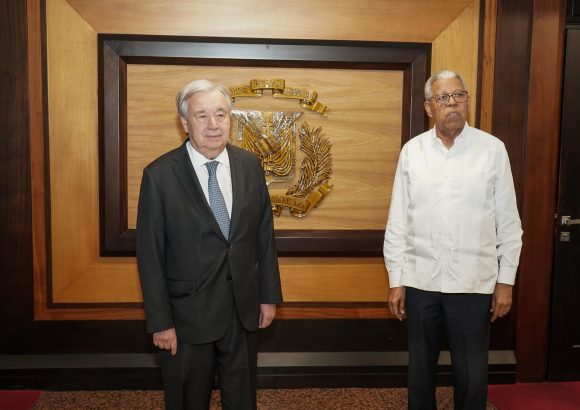
On Monday, United Nations Secretary-General António Guterres touched down in the Dominican Republic for an official visit centered on the spiraling humanitarian and security crisis in neighboring Haiti, with a core schedule that includes high-level talks with Dominican President Luis Abinader.
Shortly after arriving at Las Américas International Airport, Guterres opened his remarks by praising the Dominican government and public for their unwavering backing of global initiatives to bring stability back to Haiti, emphasizing that the country has emerged as a linchpin for multilateral action targeting the ongoing emergency.
“On behalf of the entire United Nations, I extend my deepest gratitude to the Dominican Republic for its extraordinary generosity,” Guterres stated. “The country’s support has enabled us to rapidly stand up a support mission for the newly activated Gang Suppression Force in Haiti. This milestone would not have been achieved at such speed without the Dominican Republic’s firm commitment, openhandedness, and seamless cooperation.”
The UN leader specifically highlighted the Dominican Republic’s critical role in securing the passage of a United Nations Security Council resolution that greenlit the creation of the multinational Gang Suppression Force (GSF). The joint mission is tasked with aiding Haitian national authorities in cracking down on surging gang-related violence and reestablishing foundational security across the country.
Guterres’ visit unfolds against a backdrop of deepening crisis in Haiti, where heavily armed criminal gangs currently hold sway over large swathes of national territory and have brought most essential public services to a halt. For months, the Dominican Republic has repeatedly sounded the alarm about the spillover risks of Haitian instability, urging the international community to ramp up its engagement and warning that unaddressed chaos poses severe threats to broader regional security.
Over the past several years, the Dominican government has led an active diplomatic push at the United Nations, the Organization of American States (OAS), and other major global multilateral bodies, pushing the international community to take on greater responsibility for resolving the protracted crisis.
Beyond diplomatic advocacy, the Dominican Republic has delivered tangible, on-the-ground support to global stabilization efforts. This includes providing medical care for personnel deployed to Haiti, offering critical logistical and transit support, and setting up a dedicated support office for the GSF on its own territory.
During his time in the country, Guterres is scheduled to hold in-depth talks with President Abinader covering regional security frameworks, enhanced international cooperation, and ongoing work to shore up stability and support long-term development in Haiti. Following these meetings, the UN chief will proceed to Haiti to continue his official agenda.
The high-profile visit underscores the sharp increase in international attention focused on Haiti’s worsening crisis, while also cementing the Dominican Republic’s standing as a central regional partner in global efforts to deliver security, humanitarian aid, and lasting stability to the troubled Caribbean nation.