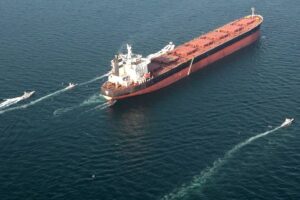
EVIAN-LES-BAINS, France — On the eve of the G7 summit hosted in France, U.S. President Donald Trump made a sweeping announcement Monday during opening remarks for bilateral negotiations with French President Emmanuel Macron: the strategically critical Strait of Hormuz will return to full, unrestricted navigation starting Friday, following a landmark agreement between the United States and Iran that brings an end to the regional conflict that had restricted commercial and military passage through the global energy bottleneck.
The narrow waterway, which carries roughly a fifth of the world’s daily oil consumption and a large share of global liquefied natural gas trade, has been a flashpoint for regional tension for decades. Trump’s announcement comes after the United Kingdom and France had recently put forward a proposal for a coordinated multinational naval escort mission to secure the strait, a framework the U.S. leader indicated would likely not be necessary moving forward. “I don’t think we are going to need much help” to maintain open access through the passage, Trump told reporters.
Trump added that the strait is already partially open to traffic, with de-mining operations currently underway to clear any unexploded ordnance left from the recent conflict, describing the ongoing work as “hunting” for residual explosive threats.
Central to the new agreement, Trump emphasized, is a core commitment from Iran that it will abandon any pursuit of a nuclear weapons program. “The main thing is Iran will not have a nuclear weapon,” he said, hailing the negotiated deal with the Islamic Republic.
The announcement follows a major upheaval in Iran’s leadership: on February 28, the first day of what Trump described as a U.S.-Israeli war on Iran, the country’s long-serving Supreme Leader Ayatollah Ali Khamenei was killed. In remarks Monday, Trump claimed that Washington now enjoys positive relations with Iran’s new governing establishment. “The first set (of leaders) is gone, the second set is gone, and we found the third set to be very smart… We ended up making a deal,” Trump said, declining to elaborate on which specific leaders he was referencing when describing the successive leadership transitions.
Looking ahead, Trump expressed optimism about the future of the Middle East, saying “I think a lot of great things are going to happen in the Middle East right now.” He confirmed that U.S. Vice President JD Vance will attend the official signing ceremony for the agreement this coming Friday, though he offered no details on the location of the event.