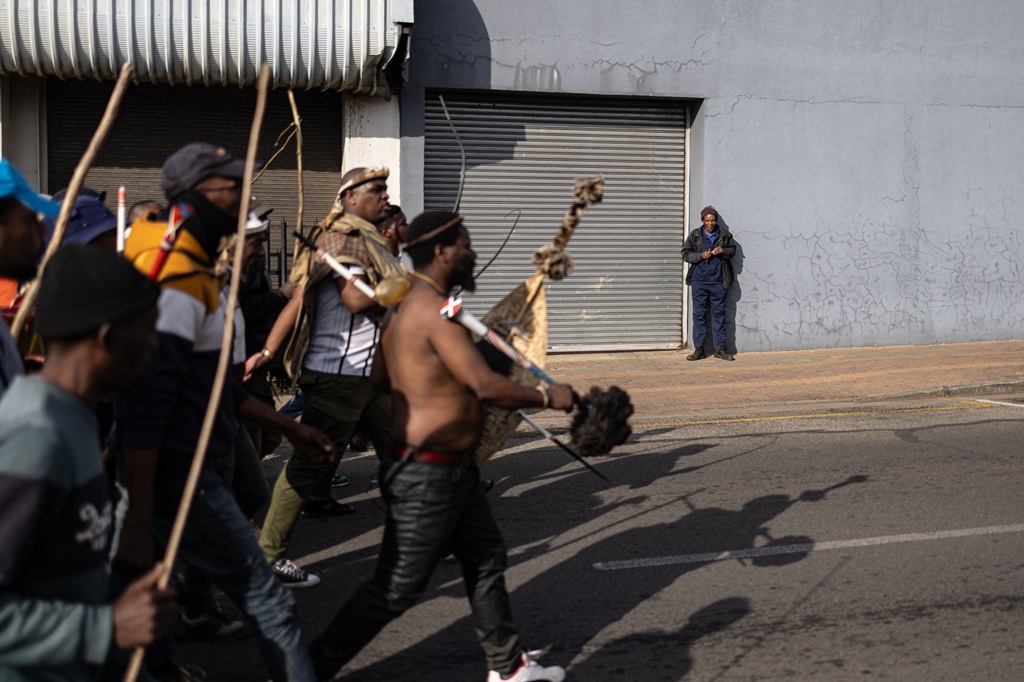
Along the sun-scorched southern coast of South Africa, the informal Giyani settlement in Mossel Bay now bears the brutal scars of a wave of targeted violence that has pitted neighbor against neighbor, killed three people, and forced hundreds to flee their homes. What started as growing anti-migrant sentiment, stoked by a months-long campaign against undocumented foreign nationals, has exploded into open bloodshed, spilling over into neighboring coastal communities and sending waves of panic across the region.
Walking through the settlement today, visitors are met with a landscape of charred, blackened remains of torched shacks, gutted structures stripped clean by looters, and skeletal frames of abandoned homes being dismantled by locals looking to seize the empty plots. On the flimsy wooden doors of a handful of surviving dwellings, a crude graffiti message marks them as off-limits to attackers: “I’m taken, Xhosa” — a signal that the home belongs to a member of South Africa’s Xhosa ethnic group, and should be spared.
Even South African natives not belonging to the Xhosa group now find themselves targeted, caught up in the spreading unrest. A 30-something South African woman, too afraid to share her name but showing her official South African identity document to an AFP reporter, described how she was ordered to leave her corrugated metal shack just days after the initial violence broke out. Attackers falsely accused her of living with a Shangaan man, another South African ethnic group seen as an outsider by local attackers. “They said they don’t care about IDs,” she explained, her voice trembling. “Now it seems like nobody is safe. A lot of my neighbours, they are citizens, they just ran.”
In total, 55 homes have been completely destroyed in the unrest, which erupted after a public protest targeting foreign nationals, who attackers falsely claim are stealing local jobs. In the days following the initial violence, locals told reporters that abandoned homes left empty by fleeing residents are dismantled daily, their materials taken and plots repossessed by local people.
Official data from South Africa’s border management authority confirms that nearly 600 Mozambicans have fled Mossel Bay and crossed back into their home country since the violence began. Nearly a week after the worst of the clashes, around 100 foreign nationals from Malawi, Mozambique, and Zimbabwe remain crowded into a local community hall, their belongings piled around them, under constant police guard. Joining them are 17 South African natives from the northern province of Limpopo, who also face targeting because they speak Tsonga and are not ethnically Xhosa.
“Seventeen South Africans were chased away from their house,” explained Ernest Sithole, who has been coordinating support for displaced people at the community hall since Sunday. He added that all those displaced spoke Tsonga, the majority language of their home province.
The violence has already claimed three lives. Two Mozambican nationals, aged 27 and 43, were killed in the initial outbreak of unrest — making them the first known foreign casualties in a months-long national wave of anti-migrant sentiment that has seen mass protests across the country and a flood of xenophobic hate speech on social media. A 19-year-old South African Tsonga man was also stabbed to death the same night. While police have so far refused to officially link his killing to the anti-migrant and ethnic tensions, his stepfather is adamant the murder was a targeted attack.
“I understand they killed my son because of a tribal war,” Steve Winston Kamwendo told AFP, standing beside his stepson’s coffin ahead of the young man’s burial in Limpopo.
The violence comes after a citizen-led group opposing irregular migration recently issued a public ultimatum ordering all undocumented foreign nationals to leave South Africa by the June 30 deadline. In response, several African nations including Ghana, Mozambique, Malawi, and Nigeria have already repatriated hundreds of their citizens who chose to flee the growing hostility.
Mossel Bay, long viewed as one of South Africa’s quieter coastal towns in the Western Cape province, has become the flashpoint for the worst violence to date, and the unrest has already spread to neighboring communities. Municipal authorities confirm that around 400 displaced foreign nationals are now sheltering in community centers in the towns of Kleinmond, Gansbaai, and Stanford, roughly 155 miles east of Mossel Bay. In Gansbaai, just one morning last week, around 100 local residents went door-to-door through the town’s informal settlement, issuing a blunt warning to all African-born foreigners: leave the town by the end of June, regardless of whether you hold valid documentation to live in South Africa.