As the 2026 FIFA World Cup kicks off this afternoon, global football governing body FIFA has once again emphasized its strict commitment to protecting the tournament’s broadcast rights, match footage and commercial exploitation rights. These regulatory standards apply not only to hospitality businesses looking to screen matches for patrons, but also to media outlets using official World Cup photographs, video clips and other tournament-related intellectual property.
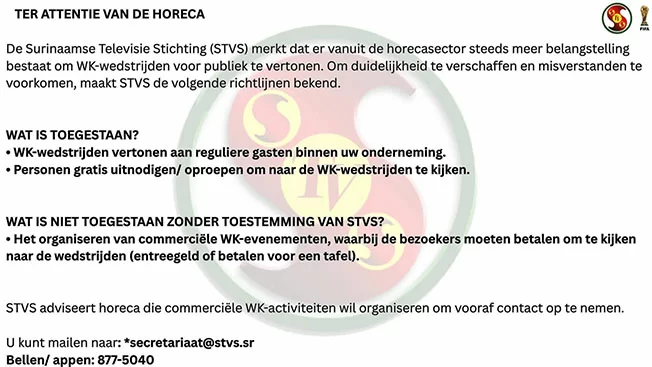
In the South American nation of Suriname, the Surinaamse Televisie Stichting (STVS) holds the exclusive official broadcast rights for the 2026 World Cup. As the authorized rights holder for the country, STVS is required to adhere to FIFA’s global regulatory guidelines and oversee all screening and usage of World Cup broadcasts within Suriname’s borders. Currently, the organization’s primary focus is on clarifying rules for local hospitality operators.
Under FIFA’s framework, regular restaurants, bars, sports cafes and other hospitality venues are permitted to screen World Cup matches for their everyday patrons. Venue owners are also allowed to host free public viewing events for fans to gather and watch matches together without prior approval. What is not allowed without explicit permission from STVS is any commercial World Cup event that requires attendees to pay for access to the match screening. This includes entry fees, mandatory consumption packages, and charges for reserved tables or seating that are specifically tied to World Cup match viewing.
According to STVS, these rules are a direct requirement of the standard terms FIFA imposes on broadcast rights holders around the world. The strict copyright enforcement is designed to protect the commercial value of the World Cup tournament, as well as the legitimate interests of FIFA’s official sponsors and global media partners.
FIFA’s regulatory guidelines extend far beyond public screenings by hospitality businesses. Media organizations of all kinds are also bound by strict usage terms for official tournament content. The use of full match footage, short video clips, official photographs and any other branded World Cup content is only permitted within the clear boundaries set by FIFA. Unlicensed media outlets that have not reached formal agreements with FIFA or an official rights holder are prohibited from freely downloading, distributing or publishing official match content. Even the sharing of short video clips on websites, social media and other digital platforms is subject to FIFA’s usage rules.
That said, FIFA has established specific partnership and licensing agreements for legitimate news organizations, which allow these outlets to use official World Cup content under pre-negotiated terms. Multiple local Surinamese media outlets have already entered into official cooperation agreements with STVS to access and use tournament content legally.
In recent years, FIFA has significantly strengthened its oversight of copyright compliance and unauthorized digital distribution of World Cup content. The organization now actively monitors unapproved publication of video content across social media, unauthorized live streaming platforms and other digital channels, cracking down on piracy that erodes the value of official rights.
With the World Cup now underway, STVS has moved to issue clear guidance to both local hospitality businesses and media organizations to avoid unintended violations of copyright rules. For the average football fan in Suriname, very little changes: all matches remain freely accessible to watch through official broadcasts. For businesses and organizations that seek to commercially exploit World Cup broadcasts or official content, however, clear international regulations set and enforced by FIFA remain fully in effect.
FIFA’s core message is straightforward: football fans around the world are welcome to enjoy the 2026 World Cup, but all commercial use of match footage, broadcast signals and official events remains subject to the terms and conditions set by official authorized rights holders.