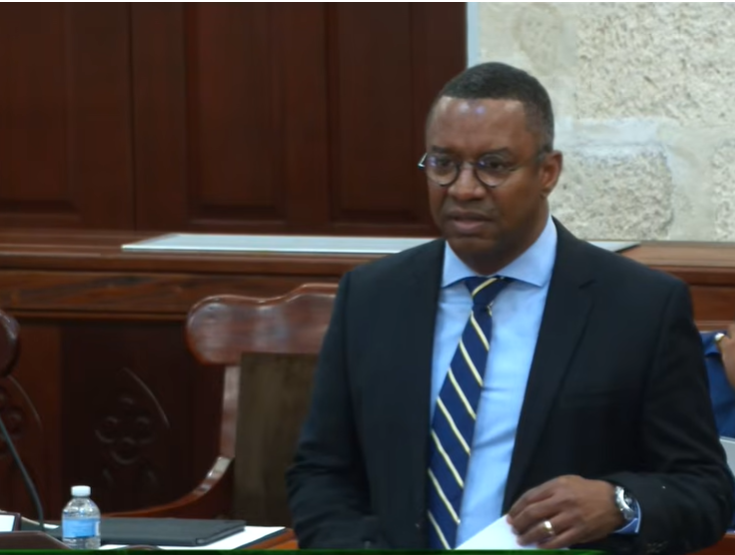
Barbados has launched a groundbreaking specialized firearms court, a key pillar of the government’s sweeping national security reform agenda designed to cut crippling delays in gun crime prosecutions and address growing public anxiety over violent offending, Attorney General Wilfred Abrahams announced Tuesday during parliamentary debate on the Supreme Court of Judicature (Amendment) Bill.
The new legislation comes just one week after parliament passed strict new anti-gang statutes, marking the latest step in a broader legislative push to rebuild public trust in Barbados’ judicial system. Abrahams framed the court as a direct response to widespread public pressure over escalating violent crime, noting that constituents from across the political divide are demanding urgent action. “Everywhere I go, I get the same question: What is the government doing to get gun violence under control,” he told lawmakers, acknowledging that while no administration can prevent every individual from choosing to commit crime, the state bears an non-negotiable responsibility to protect citizens through robust security infrastructure and responsive legal processes.
The reforms build on existing security initiatives that already include joint patrols conducted by the Barbados Police Service and the Barbados Defence Force, whose personnel are currently completing specialized training in civilian policing protocols to support domestic security operations. A core flaw the new court aims to fix is the systemic delay that has allowed people charged with serious firearms offenses to easily obtain bail. Under Barbados’ constitution, every accused person has a right to a speedy trial, Abrahams explained. When prosecution teams fail to bring a case to trial or share disclosure documents within two to three years, courts are legally required to grant bail — even for defendants charged with heinous crimes such as murder. “A person is innocent until proven guilty,” Abrahams said. “When an accused has already waited two years in prison without any progress on their case or disclosure, a court bound by constitutional rights cannot justify holding them indefinitely.”
To close this gap, the legislation imposes strict, tight timelines for all firearms cases. Simple cases must be fully resolved within six months, while more complex matters are required to be concluded within nine months. Abrahams admitted that for years, regional governments avoided creating specialized gun courts because establishing such an institution required publicly acknowledging that firearm violence had reached a crisis point. “Nobody wanted to admit we had a problem big enough to need a dedicated court,” he said, noting that political hesitation has been set aside in favor of the government’s duty to answer to voters. “That horse has already bolted. The problem is here, and we have to address it.” With this reform, Barbados joins regional neighbors Jamaica and Trinidad and Tobago, which have already implemented similar specialized court frameworks.
Under the new law, the Firearms Court will hold exclusive jurisdiction over all firearms-related offenses, as well as any related matters assigned by the Chief Justice, eliminating duplicative use of limited state resources. Addressing long-running debate over the death penalty, which remains on Barbados’ statute books for murder and treason, Abrahams clarified that the country’s de facto abolitionist status remains unchanged. He cited the landmark Pratt and Morgan ruling from the Privy Council, which established that holding a prisoner on death row for more than five years qualifies as cruel and inhumane punishment. While Barbados now recognizes the Caribbean Court of Justice as its highest appellate body, the five-year principle remains binding precedent in regional legal practice. Because Barbados’ existing appellate process routinely takes longer than five years to exhaust all appeals, and defendants often petition international human rights bodies that further extend proceedings, capital punishment cannot lawfully be carried out under current frameworks. The accelerated trial timelines introduced by the new court are designed to address this systemic sluggishness, though no change to the country’s de facto abolitionist position is being made.
The legislation also includes a series of operational adjustments designed to protect witnesses, preserve the pace of proceedings, and safeguard due process. The Firearms Court is authorized to convene at any location approved by the Chief Justice, including high-security sites such as Dodds Prison, reducing the security risks associated with transporting high-risk gang members. The law also allows for virtual hearings and video testimony to shield vulnerable witnesses from intimidation by associates of the accused. While the right to a jury trial remains intact for all defendants, the new legislation formally introduces the option of judge-alone trials to counter widespread juror intimidation. “Jurors are frightened, and that is the reality,” Abrahams said. “No one wants to sit opposite one of Barbados’ most wanted suspects. We have to accept that judge-alone trials will become more common for these serious offenses, and that is a necessary change to keep proceedings fair and safe.”
Crucially, the legislation enshrines that the rights of minors remain the top priority in any case involving children in conflict with the law. Provisions from the existing Child Protection Act and Child Justice Act will take precedence over the new firearms legislation in all youth cases. Abrahams added that the government will continue refining the framework to close any additional loopholes that defense counsel may identify. “Systemic delays frustrate victims, they frustrate families, and they erode public confidence in our judicial system and the rule of law,” he said. “We will update and amend this legislation whenever it is needed. Our only goal is to do what is right for the people of Barbados.”