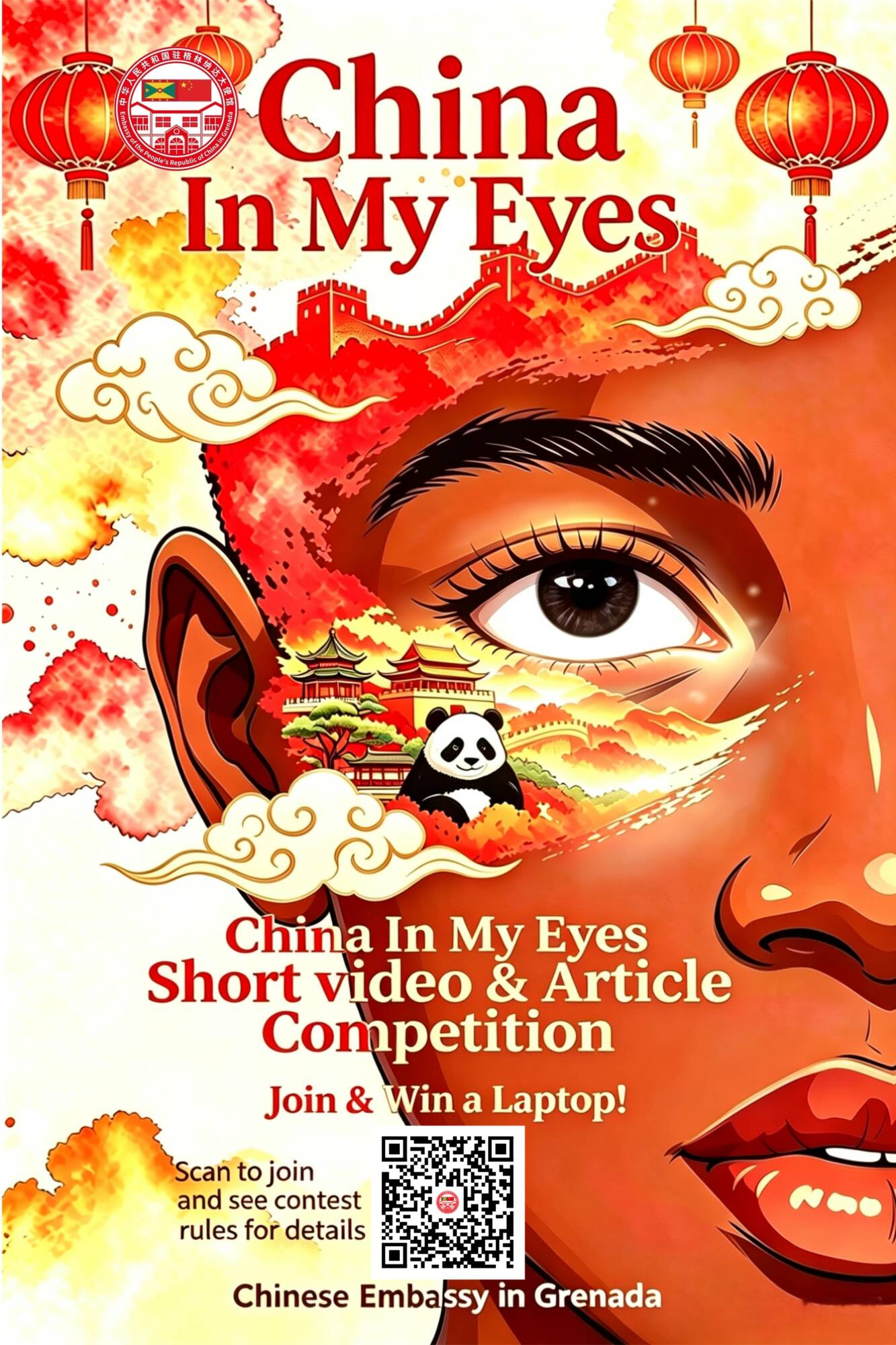
Against the backdrop of a global landscape defined by rapid transformation and growing geopolitical turbulence, the Chinese Embassy in Grenada kicked off a groundbreaking cross-cultural initiative on June 5, 2026. Held during celebrations for the second United Nations International Day for Dialogue Among Civilisations, the event formally launched the ‘China In My Eyes’ Short Video and Article Competition, a project designed to connect people across two distinct cultural contexts through personal storytelling and creative expression.
The International Day for Dialogue Among Civilisations, observed globally every June 10, is itself a product of Chinese diplomatic leadership. First proposed by China during the 78th session of the UN General Assembly, the initiative was formally adopted and established as an annual UN observance in 2024. At a moment when clashes over cultural identity have become an increasingly pressing global challenge, the day carries a clear core message: open dialogue remains the only sustainable bridge to lasting peace, and mutual learning between different cultures acts as the guiding compass for shared human progress.
The launch event in Grenada centered on the vision laid out in the Global Civilisation Initiative, introduced by Chinese President Xi Jinping in March 2023, which is built around four foundational calls to action. The first core principle is respect for the inherent diversity of global civilisations. As a nation with an unbroken 5,000-year cultural heritage that has nurtured centuries of philosophy, art, and social thought, China values its own unique cultural legacy while rejecting the harmful idea that any single civilisation can claim a monopoly on wisdom or inherent superiority over others. Every cultural tradition, the initiative argues, carries irreplaceable unique value and makes distinct contributions to the broader tapestry of human experience.
This principle of diverse coexistence finds tangible expression in the cultural landscape of Grenada, where vibrant traditions such as soca rhythms during the annual Spicemas festival and the iconic Jab Jab ritual – where participants coat themselves in oil and black paint to symbolize centuries of resilience, resistance, and renewal – thrive as living expressions of local identity. A traditional Chinese dragon dance and a Grenadian Jab Jab performance may differ sharply in form and history, but both respond to the same fundamental human needs: creative self-expression and collective belonging.
The second core call of the Global Civilisation Initiative is to advance and protect the common values shared by all humanity. Beneath the surface of differing customs, languages, and traditions, people across every culture hold the same universal aspirations: peace, sustainable development, equity, justice, democracy, and freedom. These values are not the exclusive property of any single civilisation; they are the shared birthright of every person on Earth. A soca artist writing lyrics about overcoming intergenerational hardship and a classical Chinese poet penning verses about social harmony may use different languages, rhythms, and literary devices, but their words resonate with the same core human experiences. A young Grenadian student dreaming of a better future and a young Chinese scholar pursuing advanced research are far more alike than they are different; their native languages may set them apart, but their shared hopes for tomorrow are nearly identical. The International Day for Dialogue Among Civilisations makes clear that embracing these shared values does not require abandoning unique cultural identities. When people recognize that all humans share the same desire for peace and progress, they stop seeing cultural difference as a threat – and start seeing others as reflections of themselves.
The initiative’s third core principle is a call to prioritize both the inheritance of cultural heritage and the innovation of cultural expression. As President Xi Jinping has emphasized, communities must protect tangible cultural heritage – from historic villages to distinctive architectural landmarks that give a place its unique identity – while also safeguarding intangible cultural traditions passed down through generations. At the same time, communities must pursue creative transformation and innovative development to keep these traditions alive for new generations. China has put this principle into practice in recent years: for example, the hit action role-playing game *Black Myth: Wukong* has reintroduced the centuries-old legend of the Monkey King to global audiences through cutting-edge digital game design, bridging ancient myth and modern technology. In Grenada, similarly, beloved traditions like Spicemas and Jab Jab remain vital cultural touchstones because they have adapted to incorporate new musical styles and resonate with younger generations while remaining rooted in their historical origins. The shared lesson for both nations is clear: communities can honor the lessons and heritage of the past without being chained by it, and remember their origins while continuing to imagine new paths forward.
The fourth and final core call of the Global Civilisation Initiative is for expanded, people-centered international exchanges and cross-cultural cooperation. 2026 marks a meaningful milestone for China-Grenada relations: it is the 21st anniversary of the resumption of diplomatic ties between the two countries. Over the past two decades, people-to-people connections have grown steadily: more than 3,200 Grenadians have traveled to China to participate in professional and educational training programs, and 251 Grenadian students have received full Chinese government scholarships to pursue higher education in China. At the T.A. Marryshow Community College (TAMCC), the local Confucius Institute continues to offer access to Chinese language learning and cultural programming for local residents, building people-level connections year-round. Just last year, Grenada’s Chief Cultural Officer Kelvin Jacob was invited to participate in the Liangzhu Forum in China, one of the world’s leading international gatherings focused on cross-civilisation dialogue.
To build on this decades-long foundation of exchange, the Chinese Embassy launched the ‘China In My Eyes’ competition. The initiative invites all Grenadians – with a particular focus on students, working journalists, and independent content creators – to share their personal perspectives on China through original short videos and written articles. Participants are free to explore any topic that resonates with them, from the ancient grandeur of the Great Wall to the dynamic energy of Shanghai’s city streets, from the bold flavors of Sichuan cuisine to the lasting impact of a Chinese teacher who changed their life. While the competition offers generous cash and material prizes to honor outstanding creative work, organizers emphasize that the core goal is not to reward winning entries, but to foster open dialogue. Every submission, regardless of its topic, represents a small but powerful act of cross-cultural connection. Through the personal perspectives of Grenadian participants, China shifts from an abstract, distant concept on the other side of the world to a living, human story. And through these shared stories, the geographic and cultural distance between the two peoples continues to shrink. Participants are not just entering a competition – they act as grassroots cultural ambassadors, shaping how their generation in Grenada sees China, and how Chinese people see Grenada.
As the event made clear, the Global Civilisation Initiative provides a clear global roadmap for cross-cultural coexistence, the UN International Day for Dialogue Among Civilisations serves as an annual reminder of the urgent need for this work, and the ‘China In My Eyes’ competition turns this vision into a tangible, local platform for action. Ultimately, however, meaningful cross-cultural connection depends not on institutions or governments alone, but on individual people. Through this competition, every Grenadian has the opportunity to help build a bridge of creativity and mutual understanding, turning the ideal of inter-civilisation dialogue into concrete action, and celebrating the decades-long friendship and shared future between the people of China and the people of Grenada.