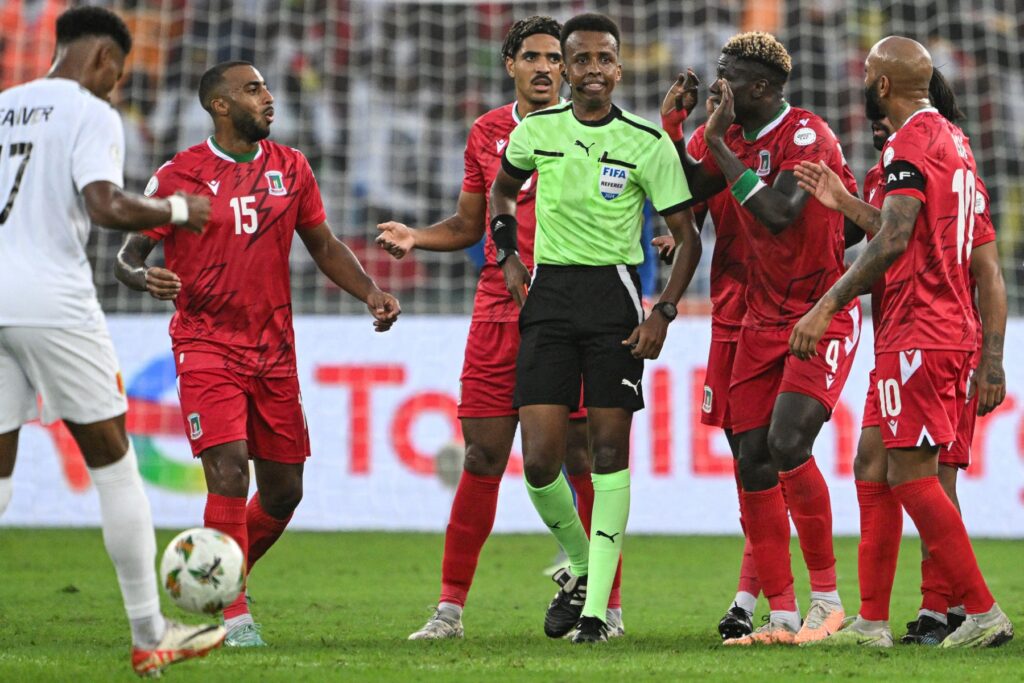
What was set to be a landmark moment for both Somalia and African football has crumbled into disappointment, after top Somali referee Omar Artan was denied entry to the United States and stripped of his spot officiating at the 2026 FIFA World Cup just days before the tournament kicks off. Somalia’s government has publicly stood by Artan, condemning the U.S. decision that cut short what would have been a history-making opportunity for the decorated official.
Artan, who was named 2025 Men’s Referee of the Year by the Confederation of African Football (CAF), landed at Miami International Airport on Saturday ahead of the quadrennial tournament co-hosted by the U.S., Canada and Mexico. Despite holding all required documentation and a valid visa – a claim confirmed by a Somali government advisor to AFP – U.S. Customs and Border Protection (CBP) officials detained Artan for more than 14 hours, splitting his processing between an 11-hour interview and a multi-hour hold in a separate detention cell, before putting him on a return flight to Istanbul. A CBP spokesperson only described the denial as the outcome of a routine inspection, offering no further explanation.
Somalia remains on the U.S. travel ban first implemented under former President Donald Trump’s administration as part of a sweeping immigration crackdown, a policy that has restricted entry for citizens of multiple majority-Muslim nations. FIFA later confirmed that Artan would be removed from the 52-person roster of referees selected for the finals, which opens its first matches on Thursday. CAF officials added that the continental governing body had no power to override the U.S. decision, and expressed sympathy for the referee.
For Somalis, Artan’s selection to the World Cup was far more than a personal achievement: it was a source of national pride, and a beacon of hope for young people across the country. Earlier this year, Somali President Hassan Sheikh Mohamud called Artan “a symbol of inspiration for the new generation of Somalis”, a reputation the country’s Ministry of Sports reaffirmed this week. In an official statement released Tuesday, the ministry expressed deep regret that diplomatic efforts with U.S. authorities and FIFA failed to reverse the entry ban. “Artan represents the very best of Somali talent,” the statement read, adding the country maintains “full confidence in his integrity, professionalism, and continued contribution to the advancement of football both in Somalia and internationally.”
From Istanbul after his deportation, Artan spoke to the New York Times about the shattering of his life’s biggest goal. “The biggest dream of my life has been ripped away,” he said. “I’m very, very disappointed. I’m just simply a referee who’s trying to live his dream, the biggest dream of my life, to come to the World Cup.”
News of Artan’s rejection has sparked widespread outrage across Somalia and the wider African football community. Former Somali Prime Minister Hassan Ali Khaire wrote on X that he was “deeply disappointed” and assured Artan that “Africa and the world stand with you.” He added that Artan “represents not only Somalia, but also the aspirations of millions of young Africans who believe excellence should be recognized on the world stage.”
Former Somali government minister Abdirashid Hashi called the denial a politically motivated decision, and urged FIFA to take action to support Artan. “Football is supposed to unite people, not exclude,” Hashi said. “He should be judged by his merit and professionalism — not by the passport he carries.” Hashi also pointed to the tournament’s three-nation host format, arguing that FIFA could still arrange for Artan to officiate matches held in Canada and Mexico. “I hope Canada and Mexico issue visas to Artan,” he said. “There is no reason a referee denied entry to one host country cannot still contribute to a World Cup being hosted across three countries.”