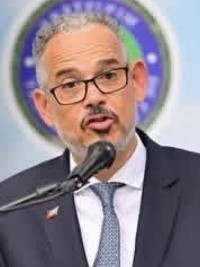
On June 5, 2026, top Haitian government officials, cross-sector partners, youth environmental activists, and education leaders gathered at Port-au-Prince’s Karibe Hotel for an official World Environment Day ceremony hosted by the country’s Ministry of Environment. Centered on the theme “Green Jobs Serving a Sustainable Haiti,” the event brought together cabinet ministers from eight key government departments alongside technical, financial, and community stakeholders to outline the nation’s path forward for climate action and sustainable development.
Opening the proceedings, Minister of Environment Valéry Fils-Aimé centered youth leadership as the foundational pillar of Haiti’s environmental transition. He detailed the ministry’s ongoing work across six core priority areas: public sanitation expansion, protected area conservation, degraded ecosystem restoration, widespread environmental education, national climate change mitigation, and targeted green job development. Reaffirming the government’s commitment to realizing Haitian youth’s vision for a sustainable 2050, Fils-Aimé highlighted key recent milestones, including the official launch of the national clean-up initiative “Konbit Ayiti Zewo Dechè” and the removal of more than 60,000 cubic meters of accumulated waste from urban centers across the country.
In his keynote address, Prime Minister Alix Didier Fils-Aimé underscored the untapped economic potential of green industries to create stable, accessible employment for Haitian young people. The centerpiece of his announcement was a landmark policy change: the full elimination of import and consumption taxes on both batteries and solar panels. Framed as a concrete, ambitious step forward, the policy formalizes the Haitian government’s commitment to advancing a national energy transition, protecting critical ecosystems, and building an inclusive, green-centered sustainable economy. The reform is designed to lower barriers to renewable energy access for households, small businesses, and public institutions, while cutting the nation’s reliance on carbon-intensive traditional energy sources.
Following the formal ceremony, the Prime Minister toured on-site exhibition spaces hosted by the Ministry of Environment’s technical departments, the National Agency for Protected Areas (ANAP), the National Solid Waste Management Service (SNGRS), private environmental enterprises, and local green artisans. Displayed innovations and achievements spanned recycling technology, waste-to-resource recovery, biodiversity conservation, renewable energy solutions, and circular economy initiatives.
Minister of Planning Sandra Paulemon used her remarks to outline the severe, interconnected environmental challenges Haiti continues to face. She outlined the extent of existing damage: widespread deforestation has stripped mountain ecosystems, critical watersheds are in decline, rivers suffer from dangerous silt accumulation and pollution, unmanaged waste overwhelms public spaces, residential neighborhoods, and coastal areas, and the nation faces extreme climate vulnerability to recurrent hurricanes, flooding, prolonged drought, soil erosion, and deadly landslides that disproportionately harm low-income and marginalized communities.
Paulemon emphasized that environmental action is not an abstract policy goal but a matter of national survival. “The environment is the land we cultivate, the water we drink, the air we breathe, and the legacy we will leave to our children,” she stated. Turning to the event’s theme of green job development, she outlined the strategic role that sustainable employment can play in driving Haiti’s broader economic and social transformation. Key green sectors including reforestation, urban sanitation, integrated waste management, watershed protection, sustainable agriculture, renewable energy, recycling, ecotourism, and green infrastructure offer a unified solution to multiple national crises, simultaneously driving job growth, reducing poverty, advancing environmental protection, and strengthening social cohesion across communities.
Despite acknowledging the scale of the challenges ahead, Paulemon closed with a message of determined hope for the nation’s future. “I refuse to believe that Haiti’s destiny is one of decline, vulnerability, or resignation,” she said. “I believe in the Haitian people’s capacity to transform difficulties into opportunities, challenges into solutions, and crises into new beginnings.”