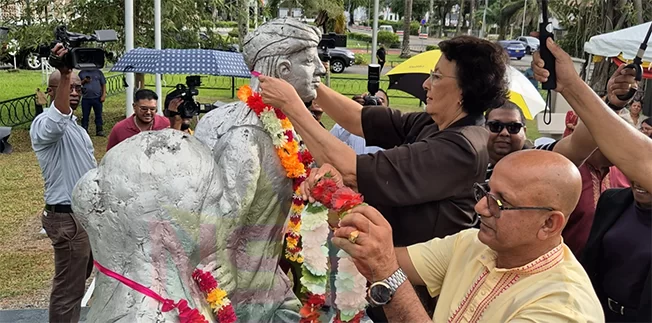
On June 6, communities across Suriname gathered in multiple districts including Paramaribo, Nickerie, Saramacca and Commewijne to mark the 153rd anniversary of Hindostani immigration to the South American nation. The commemorative events, which centered on honoring the legacy and contributions of early immigrant ancestors, also shone a spotlight on a longstanding local request: the development of a dedicated open-air cremation ground in Commewijne.
Local residents and business owners have turned to the Hindostani Immigration Memorial Foundation (SHI) to advance this initiative, which caters to the religious and cultural traditions of Suriname’s large Hindostani community. SHI chairperson Ramon Jawalapersad confirmed that private entrepreneurs have already stepped forward to cover the full cost of constructing the facility. The only outstanding requirement from the national government is a formal allocation of a suitable plot of land for the project. The request for support has officially been forwarded to Suriname President Jennifer Simons, who led the main commemorative ceremony in the capital Paramaribo.
During the Paramaribo event, President Simons carried out the traditional wreath-laying ritual at the iconic Baba and Mai monument, a national memorial erected to honor the first Hindostani immigrants who arrived in Suriname. She made history as the first head of state to place sacred mala garlands around the monument’s two figures, in a symbolic gesture of recognition for the immigrant community’s journey.
Multiple speakers at the ceremony reflected on the outsized impact the Hindostani community has had on Suriname’s national development, emphasizing that this history is an inseparable core of the broader Surinamese national story. President Simons echoed this sentiment in her address, noting that Hindostani influences are visible across every sector of Surinamese life. She explained that the community’s contributions extend far beyond economic growth, shaping the nation’s cultural, spiritual and moral fabric for generations. “The values of hard work, family honor, discipline, education and faith that the community brought with it have shaped generations of Surinamese, and those values remain visible across our society today,” Simons said. She even highlighted the community’s impact on national cuisine, joking, “I cannot go a week without masala.”
The president also stressed that Suriname’s full national history cannot be separated from the experiences of the nation’s Indigenous peoples, whose presence on the land predates all immigrant communities. “No matter how we all came to live together here, we must never forget that everyone who arrived encountered the Indigenous peoples who have called this land home for centuries,” she said. “We also must never forget the sacrifices made by all of our ancestors, from every background.”
While much of the ceremony focused on reflecting on the past, President Simons emphasized that the day’s remembrance must also serve as a foundation for collective future progress. “For me, this remembrance does not end with the story of how we all came together here,” she said. “That story is just the beginning of how we will continue to move forward together. We already know our shared history; now our work is to build our shared future.”
President Simons did not offer an official substantive response to the open-air cremation ground request during the event, but Jawalapersad remains optimistic that the project will move forward. “It will happen yet,” he said. “Commewijne has plenty of available land, and we actually do not need very much to build this facility. Private entrepreneurs are still fully willing to cover all the necessary investment. The only thing we need is the land allocation.”
Jawalapersad explained that a plot of land was previously approved and allocated for the cremation ground years ago, and environmental impact studies were even completed for the project. But in a final twist, the allocated parcel was ultimately reissued to a different third party, leaving the initiative stalled. Community organizers now hope this renewed call during the 153rd immigration commemoration will help move the project across the finish line.