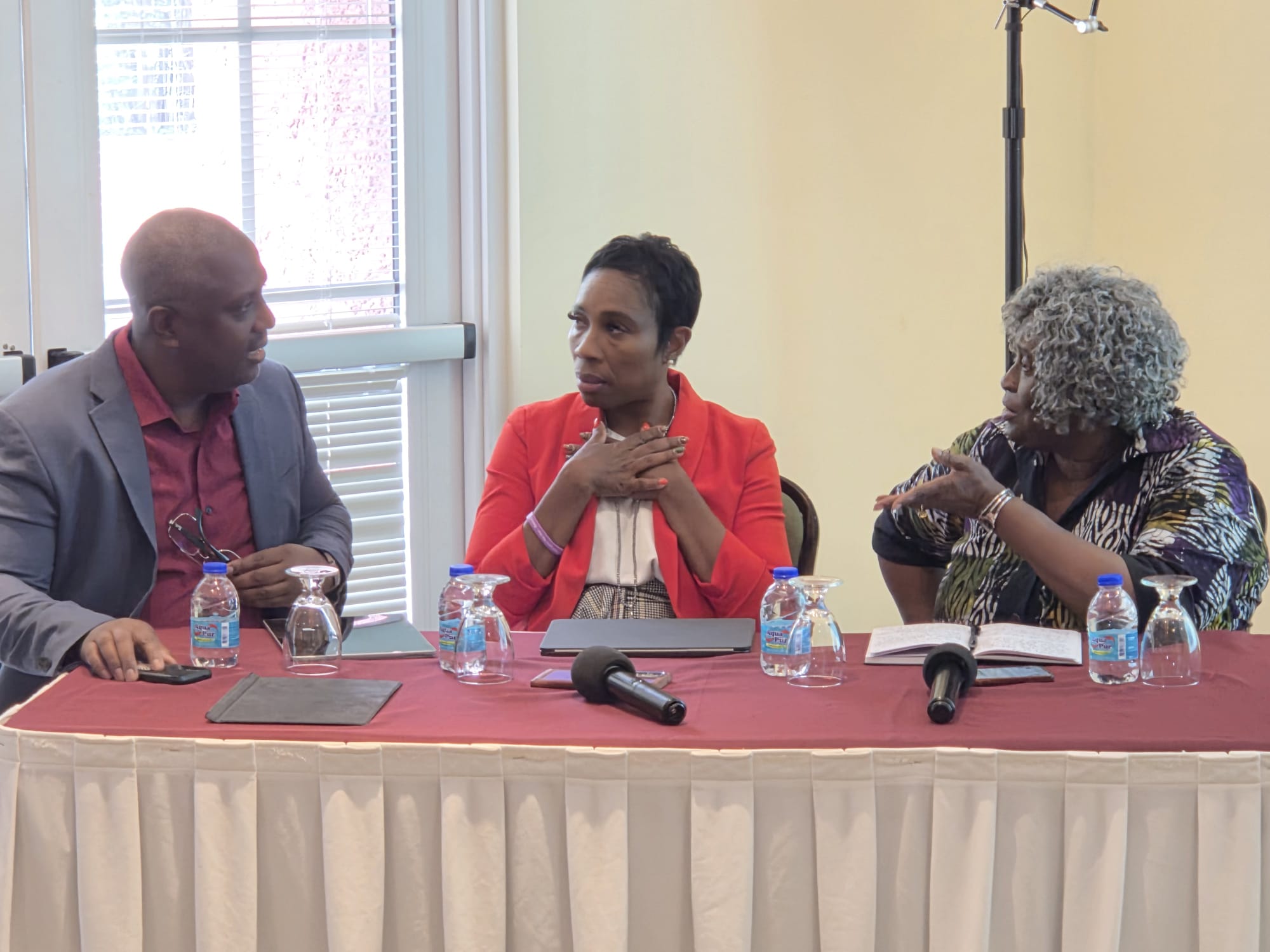
At the official launch of the Caribbean Policy Development Centre (CPDC)’s new documentary *Tides of Debt* held at the Marriott Hotel in Hastings on Wednesday, Barbados Agriculture Minister Dr. Shantal Munro-Knight delivered a sharp rebuke of the global financial system’s framing of Caribbean debt, rejecting the widely used term “sovereign debt” as an inaccurate, harmful misnomer that erases the structural roots of the region’s growing fiscal crisis.
A former executive director of the CPDC itself, the regional umbrella NGO behind the documentary project, Dr. Munro-Knight argued that the crippling debt burden holding back Caribbean nations does not stem from domestic policy missteps, but rather from centuries of historical inequity and a global economic architecture built to ignore the region’s acute climate vulnerability. She invoked Nigerian author Chimamanda Ngozi Adichie’s work on the danger of single stories to warn against reducing complex regional economic struggles to a narrative of national failure.
“I stay away from that notion of sovereign debt. I don’t like it,” Dr. Munro-Knight stated. “Because even that word, ‘sovereign debt,’ it makes it national; it makes it country-owned. If you understand all of our history, we would know that our challenge of debt is nuanced, it’s systemic, it’s structural, it is global, and it is historical. That notion of sovereign debt as being owned nationally as having a place within the context of what countries singly do—we need to be able to repudiate that.”
Data presented at the launch backed this claim, drawing on Inter-American Development Bank (IDB) research that quantifies the direct link between climate shocks and debt accumulation. The analysis shows that one major climate disaster pushes a small Caribbean nation’s public debt up by an immediate 10 percent, with that figure surging to 18 percent just three years after the event. These persistent, unplanned climate-driven costs, the minister emphasized, are the primary driver of the region’s debt, not excessive domestic spending.
This shared understanding of the debt crisis is what led Barbados to develop the landmark Bridgetown Initiative, a global policy framework designed to overhaul outdated international financial rules to better support climate-vulnerable developing nations. Dr. Munro-Knight called out traditional multilateral lenders for their crippling bureaucratic delays, which leave small island states defenseless when disaster strikes. She gave a stark example: “You’ve got to take two years to write the proposal before then you can get the readiness grant to get ready, then to do the actual proposal, and by that time two hurricanes, a flash flood, ash fall, and everybody dead—but we’re still waiting on the release of funds. The Bridgetown Initiative said hold on, stop. Let’s re-look. Let’s restructure.”
She also highlighted the gap between global guidance and on-the-ground reality for small island economies. International institutions often pressure developing nations to “mobilize private finance” to address climate and development challenges, but Dr. Munro-Knight noted that Caribbean private sectors are inherently small and risk-averse, making global de-risking mechanisms a non-negotiable prerequisite for progress. The Bridgetown Initiative, she argued, has gained global traction not because it is a Barbados-led project, but because it gives voice to a long-silenced crisis shared by dozens of vulnerable nations across the Global South. “We either lie down, play dead, or we get up and we act in the moment,” she said.
Dr. Munro-Knight pointed to Barbados’ own dramatic economic turnaround since 2018 as proof that region-led innovative fiscal strategies can work, even when dismissed by international observers. When the current administration took office that year, Barbados faced a fiscal catastrophe: a 176 percent debt-to-GDP ratio, the third highest in the world, just 6.6 weeks of import cover, and the immediate threat of Tropical Storm Kirk. To pull the country out of crisis, the government pioneered new tools, including pandemic and natural disaster clauses in sovereign bonds that allow the government to pause interest payments after a catastrophe, as well as groundbreaking debt-for-climate swap agreements.
Critics predicted the restructuring would fail, but the results have exceeded expectations. The process generated $165 million in new capital and $125 million in annual savings, Dr. Munro-Knight revealed. None of those savings were absorbed into general government spending; instead, they were directed to a sustainability trust that funds critical environmental and development projects, including the south coast reclamation and wastewater initiative that now provides irrigation for local agriculture. Today, Barbados’ debt-to-GDP ratio has fallen to 93.3 percent, the first time it has dropped below 100 percent in the country’s modern history. “When Barbados restructured its debt and went to the international market in 2018, everybody said it would fail,” the minister said. “Look at where we are now… The metrics show that it worked. We can’t be afraid.”
Turning to her role as agriculture minister, Dr. Munro-Knight connected this fiscal innovation directly to food security, which she framed as core to regional sovereignty and survival. Under the government’s current Barbados Economic Recovery and Transformation (BERT 3.0) plan, national growth targets are explicitly tied to cutting the country’s food import bill. She noted that Barbados spent $8.6 billion on imported fresh produce last year, despite a national strategic crop plan that identified 16 crops that can be grown locally for a fraction of the import cost.
Recalling her decades of work in trade negotiations with the CPDC, the minister highlighted how global trade rules are rigged against small developing nations seeking food sovereignty. She shared an anecdote from a past World Trade Organization negotiation, where a senior American official told developing country delegates that pursuing domestic food production was an “anachronism of bygone days” that should be abandoned in favor of relying on cheap imports. “The structural inequalities and the constraints of debt force the region into situations where we are making hard choices—we call it the developer’s dilemma,” she explained.
To address this, the Barbados government has launched “Mission 2”, a cross-sectoral initiative to legally and socially protect the country’s water and food security. In closing, Dr. Munro-Knight urged Caribbean civil society to preserve their collective memory of these structural injustices and push back against efforts by global actors to dilute the meaning of regional resilience. For the Caribbean, food security is not just a technical policy goal, she argued—it is core to national development and cultural identity. “What we are doing is not just about growing. We are feeding a nation, but in feeding a nation, we’re also changing a cultural pattern. It is about people fundamentally. It is about how we feed our children, how our children through generations will have a relationship with land and ownership of land,” she said. “If we allow others to define that and remove our relationship from the earth, then part of us as people of the Caribbean is going to be lost.”