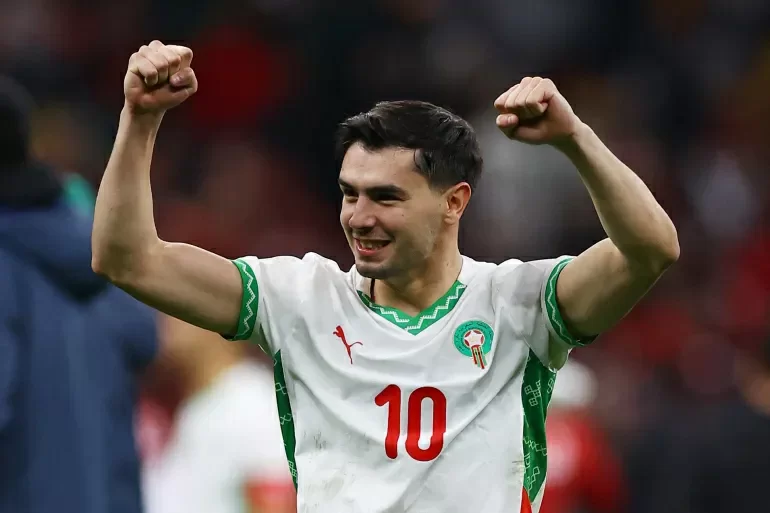
Over the past two decades, Moroccan football has undergone one of the most dramatic transformations in modern global soccer. What began as a program consistently mired in early group-stage exits at the African Cup of Nations (AFCON) and repeated failures to qualify for the men’s FIFA World Cup has evolved into a powerhouse that now sits 8th in the March 2026 FIFA global rankings – the highest-ranked African and Arab nation in the world. Following a historic fourth-place finish at the 2022 Qatar World Cup, the Atlas Lions enter the 2026 FIFA World Cup as one of the most feared and respected contenders, with success stretching across every age group and division of the sport.
Morocco’s impressive trophy haul in recent years confirms the program’s rapid growth: the country inherited the 2025 AFCON title after Senegal was stripped of the championship, finished as runners-up at the 2025 Women’s WAFCON, claimed victory at the 2025 FIFA Arab Cup and 2025 African Nations Championship (CHAN), won the 2025 U-20 FIFA World Cup, took home the 2025 U-17 AFCON title, earned bronze in men’s football at the 2024 Olympics, and won the 2024 Futsal AFCON.
For those wondering how this transformation happened, there is no secret magic formula. According to an anonymous source close to the Royal Moroccan Football Federation, who spoke on condition of anonymity due to restrictions on speaking to media, the success rests on three foundational pillars: strong governance, targeted financial investment, and skilled human capital.
“King Mohammed VI laid out this national strategy during the 2008 Skhirat Sports Conference, which marked the start of a long-term national football development project,” the source explained. “The first pillar was governance reform, including the creation of a national financial oversight department that helped professionalize the entire financial structure of Moroccan football.”
Following governance reform came massive investments in infrastructure at every level of the game. Working in partnership between the federation and the national government, Morocco built thousands of community football pitches dubbed “proximity fields” that are open and accessible to all members of the public, unlocking mass grassroots participation across the entire country.
Beyond these local community facilities, Morocco constructed the state-of-the-art Mohammed VI Complex and Academy in Maamoura, just outside the capital Rabat. Boasting immaculate training pitches, cutting-edge physiotherapy equipment, and an on-site hotel, the facility is regularly compared to the world’s top national training centers, including France’s famed Clairefontaine. The academy has already produced a host of elite talent that now forms the core of the senior men’s national team, including Nayef Aguerd of Olympique Marseille, Azzedine Ounahi of Girona, and Youssef En-Nesyri of Al-Ittihad.
Another critical shift that fueled Morocco’s rise came from a coordinated lobbying effort by African football federations to FIFA to change nationality eligibility rules, allowing players of Moroccan descent from the European diaspora to represent the country. This rule change opened the door for the Atlas Lions to recruit elite talent including Hakim Ziyech, Nordin Amrabat, and Brahim Díaz – the 2025 AFCON top scorer who leads the line for Real Madrid.
The latest high-profile addition to Morocco’s roster is 18-year-old Lille midfielder Ayyoub Bouaddi, rated one of the most promising young talents in French football. Even Zinedine Zidane, who is widely expected to replace Didier Deschamps as France’s head coach after the 2026 World Cup, reportedly contacted Bouaddi’s representatives to convince him to represent Les Bleus. Despite a clear pathway to the senior French national team, Bouaddi remained committed to representing Morocco, a decision that resonated deeply with the country’s football community.
“I don’t think we’ve ever had a young player with this much potential choose Morocco before,” long-time Atlas Lions supporter Tom Yousef Drissi told Al Jazeera. “It feels different, more meaningful, unprecedented. We’ve had talented young players from Europe before, but France is the dominant power in world football right now, and their midfield is aging. Bouaddi would have had a guaranteed spot with them, and he still chose us. With players like Samir El Mourabet, Neil El Aynaoui, and Bilal El Khannous, we have an incredible foundation for the next decade.”
While Morocco’s long-term trajectory is undeniably positive, recent controversy following the 2025 AFCON final has created uncertainty ahead of the 2026 World Cup. In second-half stoppage time of the goalless final, with the match heading for extra time, referee Jean-Jacques Ndala awarded a controversial penalty to Morocco. What followed sent shockwaves through global football: the Senegalese team walked off the pitch in protest, while Senegalese supporters clashed with security staff behind Morocco’s goal.
In a decision that surprised many observers, the match was not abandoned. After a 15-minute suspension, Senegal returned to the pitch, and Brahim Díaz stepped up to take the penalty, attempting a panenka that was saved easily by Senegal keeper Edouard Mendy. Senegal went on to win the match in extra time, and the title was later stripped from them for off-field violations.
In the post-match press conference, Walid Regragui, the manager who led Morocco to its historic 2022 World Cup semi-final run, was immediately asked whether he would resign. He dismissed the question, but stepped down from his post several weeks later. It had been widely reported ahead of the tournament that Regragui would be replaced if Morocco failed to win the AFCON title, with the federation ultimately selecting Mohamed Ouahbi, who led Morocco’s U-20 side to the 2025 World Cup title with an exciting attacking style of play.
There is a notable parallel between Ouahbi’s appointment and Regragui’s 2022 taking of the job: Ouahbi, like Regragui, took charge of the senior side just a few months before the start of the World Cup. “Ouahbi has already begun implementing his tactical ideas and style of play in friendly matches back in March, but everything is still taking shape,” said Said Abadi, a Moroccan sports journalist and author of *The History of African Football*, told Al Jazeera. “He is still working to find the right balance between the experienced veterans from the Regragui era and the exciting new generation of talent. A full overhaul of the squad and tactical setup isn’t possible in such a short timeframe.”
While Ouahbi is widely praised for his work with young talent, questions remain about whether Regragui’s pragmatic, counter-attacking style might have been better suited to the unique pressures of a World Cup knockout tournament. In Qatar, Morocco remained undefeated in every match where they held less than 50% of possession, with their only loss coming against France in the semi-final – a match where they held the majority of possession. It remains to be seen whether Ouahbi’s more adventurous attacking approach can deliver the same resilient results in knockout matches.
Morocco has been drawn into a challenging Group C for the 2026 World Cup, alongside Brazil, Scotland, and Haiti. Their group stage fixtures are scheduled as: June 14 vs Brazil in New York/New Jersey, June 20 vs Scotland in Boston, and June 25 vs Haiti in Atlanta.
Even with high expectations from around the world for the 2026 tournament, Moroccan football officials view this World Cup as just one milestone on a longer development journey that will lead to co-hosting the 2030 World Cup on home soil. “Even the 2030 World Cup is not the final end goal,” the federation source said. “It is a milestone that will accelerate broader development across all key sectors of our country: infrastructure, human capital, transport, mobility, and our international appeal.”