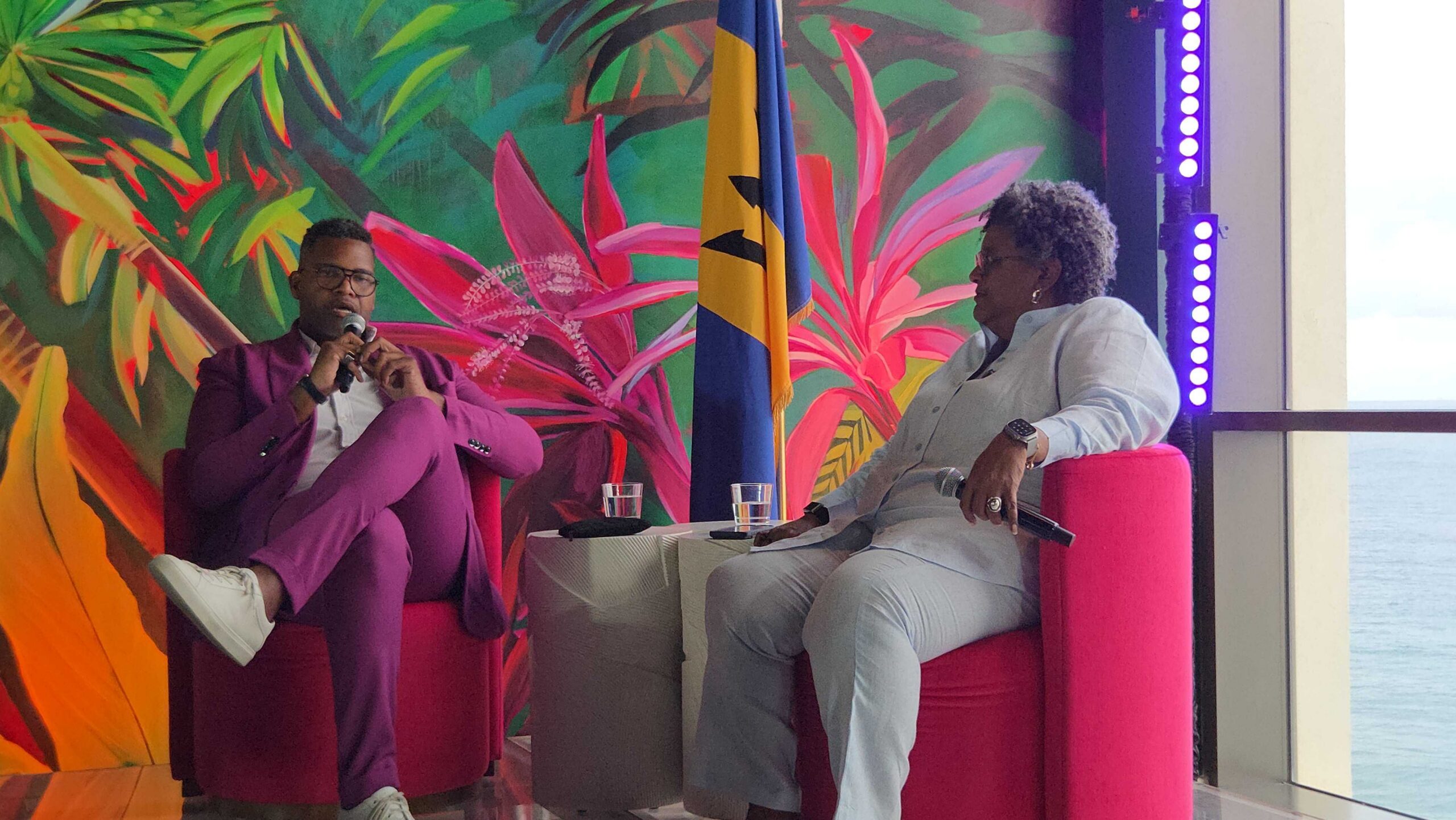
Against a backdrop of escalating global uncertainty and overlapping cross-border crises, Barbadian Prime Minister Mia Mottley has delivered a bold call to action for the small island nation: shed outdated psychological limitations tied to geographic size and rebrand itself as a world-leading testing ground for cutting-edge innovation, arguing that incremental economic progress will never be enough to shield the country from mounting global volatility.
Mottley’s remarks came during a candid, informal fireside-style dialogue with Minister of Innovation Senator Jonathan Reid, which served as the centerpiece of the national Possibility Summit. The event convened a high-profile global cohort of technology executives, United Nations officials and leading international scientists to collaboratively map out a sustainable, technology-powered development path for the Caribbean region.
Opening the discussion, Reid turned to the foundational governance philosophy that has defined Mottley’s tenure, recalling a defining moment on the eve of her first electoral victory. At that time, Reid shared that he had considered leaving Barbados to pursue world-class professional opportunities abroad. In response, Mottley challenged him: “Why can’t you do world-class work in Barbados? Why don’t you come with me, let’s do some world-class work.” That exchange, Reid noted, has set the tone for the administration’s work over the past eight years. Reid then pressed Mottley on what fuels her relentless, often round-the-clock work ethic that sees her pushing forward with policy work as late as 3 a.m.
Tracing her motivation back to her upbringing in a newly independent Barbados, where she was surrounded by dedicated early public servants and national icons like cricket legend Sir Garfield Sobers, Mottley explained her drive grows from an unshakable belief in Caribbean potential and a deep rejection of systemic inequity. “God has blessed me with the ability to love this country beyond anything else and to believe that we are special,” she said. “The fact that I am a young person going into public life never crossed my mind that I was young. The fact that I was a woman going into public life, it never crossed my mind… I feel passionate about the Caribbean civilization, and that is the purpose of my life.”
The conversation soon shifted from personal conviction to tangible national development strategy. Reid noted that while Barbados has notched an extraordinary milestone of 20 straight quarters of economic expansion and cut its debt-to-GDP ratio substantially, there is a clear gap between short-term macroeconomic stability and long-term transformative change, asking Mottley to outline her long-term vision for the nation.
Mottley stressed firmly that incremental, traditional economic gains are not enough to insulate the island from coming global disruptions. “Comfort does not give us sufficient buffer to withstand the gale force winds that are coming at us individually as a small state but collectively as a planet,” she warned. “The country has had on average 2.5 per cent growth… that’s not enough for us to do the transformation.”
For Mottley, building genuine long-term economic resilience requires three core shifts: boosting national productivity, strengthening inclusive social capital, and restructuring the economy to deliver widespread citizen ownership of assets. She issued a blunt challenge to the local private sector over its approach to workforce treatment, stating: “If you tell me you can’t make money by treating your workers right, get out of the wrong business, shut shop and go home. Fundamental to any enterprise is in fact the workers… I feel that Barbados can continue to lead the world in showing what dignified labor producing at high levels can look like, creating opportunities for ownership.”
Reid then turned to the balancing act of modern leadership for small island states, recalling the overlapping crises of the COVID-19 pandemic and the 2021 ash fall from the La Soufrière volcano that strained national capacity. He asked how Barbados can preserve its laid-back, distinctive cultural identity while embracing the urgency needed to capture global economic opportunities.
Mottley acknowledged that constant uncertainty is now a permanent feature of the global order, pointing to the ongoing “polycrisis” that combines accelerating environmental degradation and intensifying geopolitical tensions. She voiced particular alarm over the rapid unregulated deployment of artificial intelligence without a coordinated global governance framework, as well as the growing fragmentation of global action to address climate change.
Rather than giving in to pessimism, Mottley argued that pragmatic, science-backed diplomatic action is still achievable, highlighting global methane reduction efforts as a critical, actionable starting point. She emphasized that Caribbean nations cannot afford to remain passive consumers of foreign technology or collateral victims of global policy decisions made by larger powers. Instead, she argued, the region must step into a new role as the testing ground for the innovative solutions that the entire world urgently needs to build a more sustainable and resilient future.