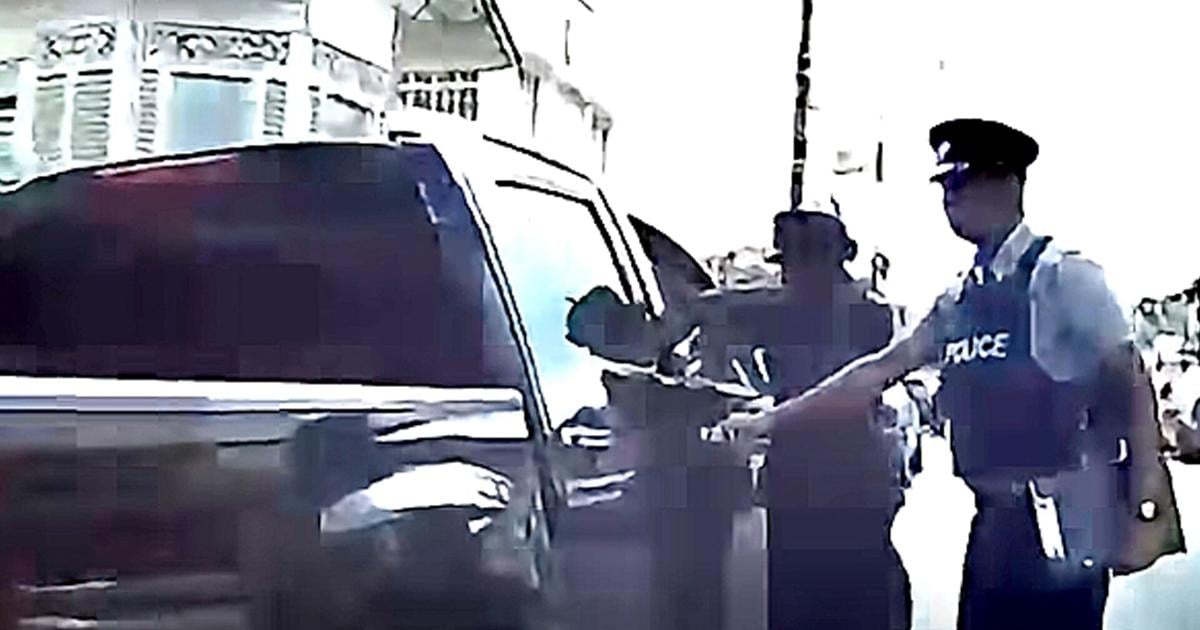
Last Friday, a routine traffic enforcement stop outside the Arima Magistrates’ Court in Trinidad and Tobago spiraled into a violent altercation that left a community divided and reignited long-simmering debates over police accountability and institutional reform. What began as a dispute over a fixed-penalty parking ticket quickly escalated, ending with a female police officer firing her weapon and the involved driver and her husband taken into custody. A full recording of the encounter, captured on the body-worn camera of a Trinidad and Tobago Electricity Commission (T&TEC) estate constable, spread rapidly across social media platforms, drawing millions of views and thousands of public comments.
In the four-plus minutes of verified footage, the sequence of events unfolds clearly: the female officer first issues a parking ticket to the driver of a black van, informing her she has parked in a restricted no-parking zone and ordering her to move the vehicle. The driver immediately pushes back, claiming a different officer had explicitly directed her to stop in that exact spot. The disagreement draws a second officer to the scene, who begins negotiating with the driver. When the driver pulls out her smartphone to record the interaction and refuses to follow the officers’ order to surrender her driver’s license, the confrontation grows tenser. The driver’s husband exits the van to join the argument, and as officers continue pressing for her license, the driver restarts her van and attempts to pull away from the scene.
Officers moved to block the van and demanded she immediately turn off the engine. It was at this critical juncture that the female officer reached for the sidearm at her hip, and a single gunshot rings out on the recording. In the immediate aftermath of the discharge, officers at the scene can be heard discussing the accidental or intentional firing of the weapon. The couple was taken into custody shortly after the altercation ended.
Since the video went viral, social discourse has split sharply along two lines: some users have defended the officers’ actions, arguing the driver’s attempt to flee posed a legitimate safety threat that justified a show of force. Other observers, however, have questioned whether the use of a firearm was a proportional or necessary response to the situation, calling for a full independent investigation into the officer’s conduct.
The incident has also drawn commentary from senior former law enforcement leadership, who framed the encounter as a symptom of deeper systemic flaws in Trinidad and Tobago’s police oversight framework. Former Police Commissioner Gary Griffith spoke publicly to local outlet *Express* on the incident, noting that reports of excessive police authority are not an anomaly, but a daily occurrence reported by citizens across the country. Griffith emphasized that most citizens who seek recourse for alleged police abuse turn to the local Police Complaints Authority (PCA), but the oversight body lacks the statutory authority to hold errant officers accountable.
Unlike the United States’ Internal Affairs units, which have the power to impose disciplinary action directly, Griffith explained the PCA is only permitted to conduct investigations into complaints. Even when the authority issues findings of misconduct, there is no legal requirement for the Trinidad and Tobago Police Service (TTPS) to act on its recommendations, and the PCA often faces institutional pushback, with officers and department leadership refusing to cooperate with probes. Griffith also noted that the incident underscores why many factions within the TTPS have long opposed mandatory body-worn cameras for officers: the technology creates an immutable public record of conduct that makes covering up abuse of authority far more difficult.