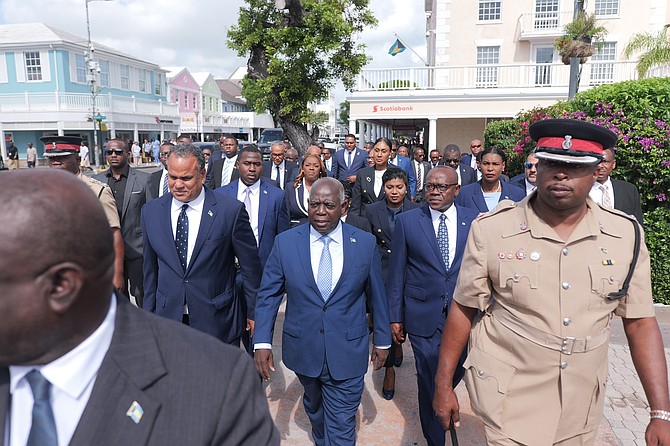
Fresh off its re-election victory in the May 12 general election, the Davis administration of The Bahamas has laid out its ambitious fiscal roadmap in the 2026-2027 budget, unveiling a plan to boost recurrent revenues by $470 million even as it cuts its projected surplus by 24 percent and navigates ongoing global economic volatility. Newly sworn-in Finance Minister Michael Halkitis delivered his maiden budget address to the House of Assembly on Wednesday, outlining that the projected 2026-2027 fiscal surplus has been revised downward from the previously forecast $291.4 million to $223.1 million, a $68.3 million reduction that Halkitis framed as a deliberate policy choice.
Halkitis explained the downward adjustment stems from two key driving forces: first, the administration’s commitment to prioritizing Bahamian citizens’ livelihoods by directing additional funding to upgrade the country’s healthcare system, and second, persistent volatility sparked by the unresolved Middle East conflict, which has disrupted global energy and fuel markets and reignited inflationary pressures that raise import costs for small open economies like The Bahamas. Despite the narrower surplus, Halkitis emphasized that the country’s overall fiscal position remains positive, noting that the projected $223.1 million surplus still means government revenue will outpace total spending.
The administration is holding firm to its existing $75.5 million surplus target for the 2025-2026 fiscal year, which concludes at the end of June, even amid widespread volatility in global economic and trade conditions that threaten to dampen tourism demand — the backbone of The Bahamas’ economy — and push up consumer prices. Halkitis did not provide an updated closing surplus figure for the current fiscal year, but expressed confidence the target will be met, citing disciplined government spending restraint and growing optimism that the full $130 million in projected Domestic Minimum Top-Up Tax (DMTT) revenues will be collected before the fiscal year closes.
The government’s bold $470 million, 12 percent revenue growth target for 2026-2027 — which would lift total recurrent revenues to $4.357 billion from the current 2025-2026 projection of $3.887 billion — comes against a mixed backdrop. Data shows that for the first nine months of 2025-2026 through the end of March, revenue collection has lagged the prior year’s pace, with only 65.3 percent of the full-year target collected, compared to 69.4 percent at the same stage in 2024-2025. Additionally, the budget forecasts that real GDP growth will slow sharply from 6.5 percent in the current fiscal year to 1.8 percent in 2026-2027, a rate that is projected to remain steady the following year. This growth projection also differs from the 3.8 percent 2025 growth estimate released last week by the Bahamas National Statistical Institute, which was stronger than the budget forecast. The disconnect between slowing projected growth and the large revenue increase has drawn attention, given The Bahamas’ consumption-focused tax system that ties revenue growth closely to economic expansion.
A large portion of the projected revenue gain is expected to come from a dramatic expansion of DMTT collections. The 15 percent minimum corporate tax, introduced to bring The Bahamas into compliance with the G-20/OECD global minimum corporate tax initiative designed to curb profit shifting by multinationals to low-tax jurisdictions, is projected to see revenues nearly triple from $130 million in 2025-2026 to $350 million in 2026-2027, a 169 percent year-over-year increase. This $220 million year-over-year jump will account for nearly 47 percent of the total $470 million revenue increase the government is targeting.
The Bahamas’ top independent fiscal watchdog, the Fiscal Responsibility Council, previously raised doubts that the full $130 million in 2025-2026 DMTT revenues would be collected on time, as the necessary collection frameworks, regulatory guidance and implementing mechanisms had not been finalized by the time of its mid-year assessment. But Halkitis pushed back on those concerns Wednesday, confirming he expects the first full round of DMTT revenues to be received in June, just before the current fiscal year closes. He also revealed that the expected taxpayer base for the new levy is larger than initial projections: when the 2025-2026 budget was drafted, officials expected fewer than five entities to be subject to the tax, but updated data shows the number of liable taxpayers will exceed that initial estimate, creating an upside surprise for the current year-end fiscal position.
Major entities already expected to fall into the DMTT net include the country’s two largest resort complexes, Atlantis (owned by Canada’s Brookfield Asset Management) and Baha Mar (owned by Hong Kong’s Chow Tai Fook Enterprises), as well as regional resort chain Sandals. All three major Canadian banks operating in The Bahamas — Royal Bank of Canada, Scotiabank and CIBC — have already set aside funds to cover their DMTT liabilities. Other notable entities that will likely be subject to the tax include Commonwealth Brewery, the leading Bahamian beer maker majority-owned by Heineken, Bahamas Telecommunications Company (BTC) controlled by Liberty Latin America, and Hutchison Whampoa’s Freeport port and container terminal assets. Shell’s Bahamian subsidiary already reported a $248 million accrued corporate tax liability on its 2024 books, per prior reporting by Tribune Business. Commonwealth Brewery even requested an extension to publish its 2025 year-end financial statements to accurately calculate its full DMTT tax obligations.
Beyond DMTT, the government has identified three additional key revenue streams to hit its $470 million target. First, it has added a $99.228 million charge to the Grand Bahama Port Authority to cover the cost of public services provided in the Freeport port area that exceed tax revenues generated by the city. Second, it projects $24 million in new annual revenue from a revised real property tax category for foreign-owned primary residences: the new 0.625 percent rate will be applied to properties qualifying as the owner’s primary residence (down from the previous 180-day annual occupancy requirement), while the maximum annual tax liability (or cap) for these properties will rise 33 percent from $150,000 to $200,000. Third, the government forecasts VAT revenues will rise $110 million year-over-year to $1.635 billion in 2026-2027, with more than 60 percent of that increase coming from VAT on property sales over $1 million, which is projected to rise from $170.472 million in 2025-2026 to $237.366 million. Current year VAT collection is already on pace to exceed its $1.525 billion 2025-2026 target.
Outlining the full 2026-2027 fiscal breakdown, Halkitis confirmed total revenues are projected to hit $4.4 billion, equal to 23.6 percent of GDP, while total expenditure will reach $4.1 billion (22.4 percent of GDP). Recurrent expenditure accounts for $3.7 billion (20.1 percent of GDP), with capital expenditure totaling $415.8 million (2.2 percent of GDP). The $223.1 million surplus equals 1.2 percent of GDP, with a primary surplus of 5.2 percent of GDP, and the debt-to-GDP ratio is projected to fall to 59.9 percent by the end of the 2026-2027 fiscal year.
“While this surplus is lower than previously projected in the Fiscal Strategy Report 2025, the revision reflects a changing global and domestic environment. Ongoing tensions in the Middle East have increased uncertainty, particularly around energy and import costs,” Halkitis said. “At the same time, we have made the deliberate decision to strengthen our healthcare system, including increased support for the Public Hospitals Authority and further investment in hospital services. These are necessary and responsible choices. Although they have narrowed the surplus, the fiscal position remains positive, underscoring this Government’s continued commitment to sound financial management while prioritising the needs of the Bahamian people.”