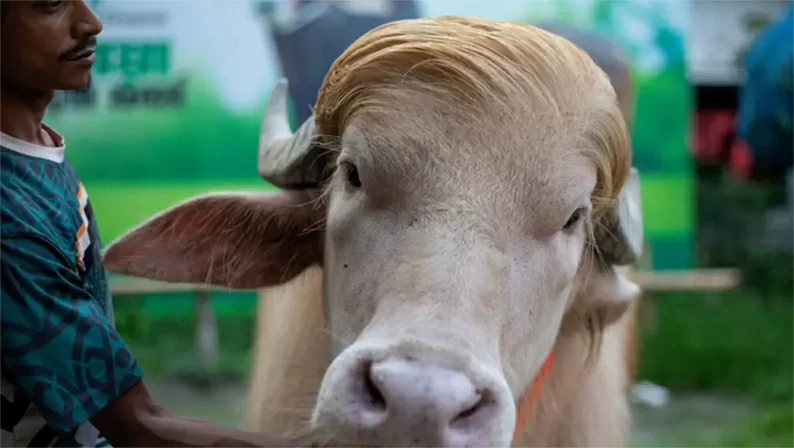
A rare, creamy-furred albino buffalo that took social media by storm in Bangladesh has been spared from ritual slaughter just days before the major Islamic festival of Eid al-Adha, and will now receive lifetime care at the country’s national zoo.
The 700-kilogram young buffalo, which earned its viral nickname “Donald Trump” for its striking pale blonde coat that bears an uncanny resemblance to the former U.S. president’s iconic hairstyle, was originally set to be sacrificed as part of traditional Eid al-Adha observances. As a majority-Muslim nation of 170 million people, Bangladesh celebrates Eid al-Adha, or the Feast of Sacrifice, each year, when millions of livestock including goats, sheep, cows and buffalo are slaughtered per religious custom, with much of the meat distributed to low-income families who rarely get to eat meat throughout the year. In 2024, the festival falls on Thursday this year.
What began as an ordinary preparation for the festival turned into a viral nationwide sensation after images and videos of the unique buffalo circulated across social media platforms. The unusual pale animal drew crowds of curious visitors to its former owner’s farm in Keraniganj, a subdistrict of Dhaka, with countless people flocking to snap photos of the one-of-a-kind creature.
Amid the outpouring of public attention, Bangladeshi authorities stepped in at the eleventh hour to spare the buffalo’s life. Following the public outcry sparked by viral social media content, government officials ordered the rare animal to be transferred to the national zoo instead of being slaughtered. Local police took the buffalo into custody at the request of the country’s veterinary department, which noted that the young albino specimen is healthy and capable of living for many years with proper professional care.
“We have prepared a special, dedicated enclosure for the buffalo, and it will undergo a mandatory quarantine period before we begin full-time care for it,” Atiqur Rahman, a conservator at the national zoo, confirmed to media outlets. Mohammad Ruhul Quddus, an officer with Keraniganj Police, added that the buffalo’s young age and extreme rarity made it a valuable specimen worth preserving for public education and enjoyment.
The buffalo’s former owner, Zia Uddin Mridha, had already sold the animal ahead of the festival, but the unexpected government intervention saved it from the slaughter block. Mridha confirmed that the nickname originated directly from the buffalo’s extraordinary pale coat, which immediately reminded locals of the former American president’s signature blond hair.
Each year, an estimated 12 million livestock are sacrificed across Bangladesh during Eid al-Adha, a tradition that provides critical access to protein for millions of poor households. The unexpected story of the “Trump” buffalo has emerged as a rare, heartwarming highlight of this year’s festival celebrations, demonstrating how grassroots public attention amplified by social media can intervene to change the fate of a rare animal.