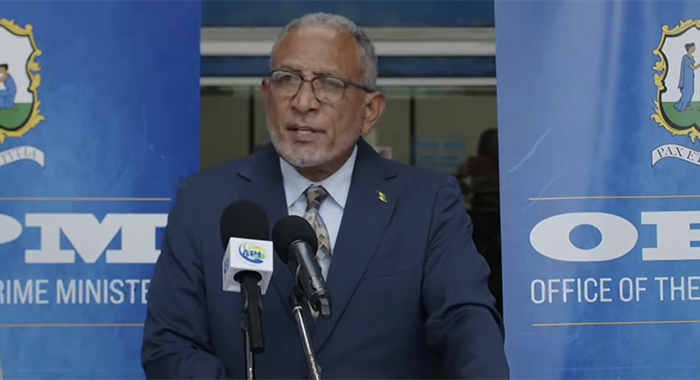
Six months to the day after the New Democratic Party won office in St. Vincent and the Grenadines (SVG), Prime Minister Godwin Friday announced a targeted 90-day relief package in a national address from Kingstown on Wednesday, cutting import-related taxes and fees on fuel to cap retail gasoline and diesel prices amid a crippling global energy cost surge.
Friday framed the intervention as a necessary response to what he called a “difficult global reality”, where skyrocketing crude oil prices and elevated global shipping costs have created a crisis for small, fuel-dependent developing nations like SVG. Between January and May this year alone, the price of Brent crude jumped 68%, climbing from roughly US$64.50 per barrel to more than US$108 per barrel. As a small island nation that relies 100% on imported fuel, SVG would feel these price hikes immediately and directly, he emphasized.
Without proactive government action, Friday warned, SVG’s retail fuel prices would have surged to among the highest in the Eastern Caribbean, with ripple effects across every corner of the national economy. Based on current global market conditions, passing full import cost increases directly to consumers would have pushed gasoline prices up by an estimated EC$5.60 per gallon — a more than 42% jump from the current rate of EC$13.22. That would have taken gasoline to nearly EC$18.82 per gallon. Diesel would have climbed from EC$12.56 per gallon to roughly EC$17.71, while low sulphur diesel would have risen from EC$12.93 per gallon to almost EC$17.85, he projected.
Such dramatic increases would not only harm private motorists, Friday explained. The cost shock would quickly filter through to higher public transport fares, elevated grocery prices, steeper electricity bills, increased operating costs for farmers and businesses, and ultimately a crippling spike in the cost of living for every household across the country.
Declaring that his government “refuses to sit back and allow that to happen”, Friday outlined two key policy changes to cap retail pump prices for three months: a cut to fuel excise tax, and a 50% reduction in the customs service charge applied to imported petroleum products.
Under the intervention, prices will be held at fixed capped rates: EC$16.92 per gallon for regular gasoline, EC$16.26 per gallon for standard diesel, and EC$16.40 per gallon for low sulphur diesel. The prime minister clarified that the policy works by having the SVG government absorb a portion of global price increases through forgone public revenue, transferring direct savings to consumers. The state will cover roughly EC$1.90 per gallon of gasoline and EC$1.45 per gallon of diesel that would otherwise be passed to consumers, he said.
The relief package is specifically designed to protect three core groups: ordinary motorists, public transport operators, and fuel-reliant local businesses and producers. For average household vehicle owners, the intervention prevents a sudden massive monthly jump in fuel expenses, putting meaningful savings back into family budgets to cover basic needs like groceries. For minibus operators, taxi drivers, farmers, and fishers — whose core operating costs are directly tied to fuel prices — the policy keeps operating expenses far lower than global market conditions would otherwise force, helping to prevent widespread price increases across food and transport services. Friday added that by capping fuel costs, the government is also slowing the pace of broader inflation across the SVG economy, delaying the need for producers and service providers to pass higher costs to consumers. He noted that with the new capped prices, SVG will remain among the Eastern Caribbean States (OECS) countries with the lowest fuel prices, rather than becoming one of the most expensive.
In opening his address, the prime minister acknowledged the difficult fiscal trade-offs the government is making to implement this relief package. His administration inherited a challenging economic situation when it took office six months prior, including a national debt-to-GDP ratio of 113% and a government overdraft exceeding EC$200 million — more than double the legal limit. Despite these significant fiscal constraints, Friday argued that responsible governance requires prioritizing household and business stability, framing the fuel relief package as a core part of his administration’s “people-first governance model”.
He described the intervention as “a fiscally responsible shield against extraordinary global pressures”, noting that the government is willing to accept short-term revenue losses to prevent a far more damaging economic shock for consumers. Friday also linked the fuel relief measures to a broader government push to curb rising living costs across key sectors of the SVG economy, announcing additional upcoming plans to stabilize electricity and food prices for residents.