A high-stakes police-involved fatal shooting in Trinidad and Tobago has ignited widespread public debate, after top prosecutors approved an arrest warrant for manslaughter and other charges against Kaia Sealy, a woman who maintains she has never touched a gun and is innocent of all allegations against her.
The incident, which unfolded on January 20, 2026, left Sealy’s common-law husband Joshua Samaroo dead and has raised pressing unanswered questions about the chain of events that led to officers opening fire. The case now stands at a crossroads, with conflicting accounts from law enforcement and the accused, who is currently outside the country receiving medical care for injuries she sustained during the shooting.
Per the official narrative outlined by Trinidad and Tobago Police Service (TTPS) investigators, the encounter began when Samaroo and Sealy traveled to the Maloney area in a white Toyota Aqua, registered under plate PDS 1703, to complete an illegal sale of a firearm and narcotics to a confidential police informant. The informant told investigators that after the pair arrived, the weapon — which Sealy had allegedly hidden in her bra — was pulled out by Samaroo to show to the source.
Once plainclothes officers from the Maloney Police Station moved in to intercept the vehicle, Samaroo allegedly sped away, triggering a high-velocity pursuit that spanned multiple jurisdictions. Police immediately notified the National Operations and Dispatch Centre (NODC) of the potential weapons and narcotics involvement, and the North Central Task Force Area West was called in to assist with the manhunt as the chase moved west along the Churchill Roosevelt Highway.
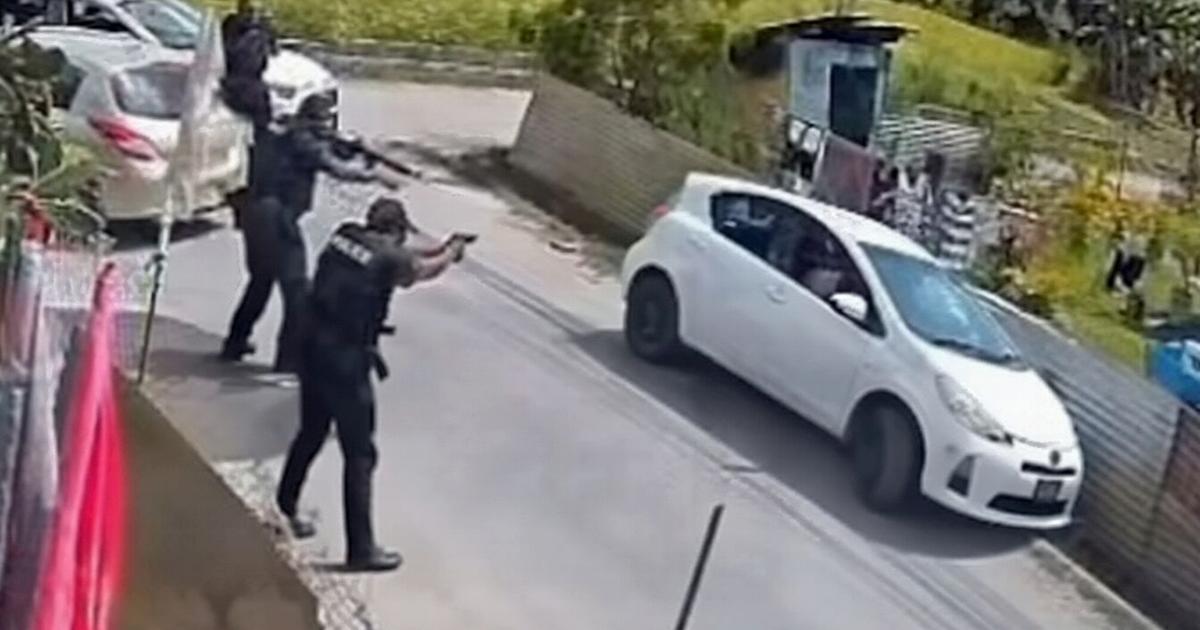
The pursuit finally ended when Samaroo lost control of the vehicle and crashed into a roadside drain on Bassie Street Extension in St Augustine. Cell phone video circulated widely on social media captured the immediate aftermath: the crumpled Aqua at a standstill, with Samaroo’s hands raised clearly through the open driver’s side window. Seconds later, officers opened fire, striking both Samaroo and Sealy.
Multiple responding officers have given consistent statements to investigators justifying the use of force. One officer, who approached the crashed vehicle from the rear, told investigators he saw Samaroo holding his hands up, but spotted Sealy — the front-seat passenger — aiming a gun directly at him through the windshield. He told investigators he heard what sounded like gunfire, saw the rear windshield shatter, believed he was under active attack, and returned fire. Seconds before additional shots were fired, multiple officers can be heard on scene shouting repeated commands of “drop the gun!”, according to the officer’s account.
A second officer at the scene corroborated this timeline, confirming he fired one round from his service weapon before seeing Sealy lower her right arm — which he described as holding a black object matching the description of a handgun. A third officer added that he also observed Samaroo moving his left hand toward the front passenger seat, prompting him to shout a warning for Samaroo to stop moving. After the shooting ended, officers recovered a loaded Glock 9mm pistol from the vehicle, which was packaged and sent to the Scene Evidence Recovery Unit (SERU) for forensic testing. Investigators also recovered three spent 9mm shell casings from inside the vehicle during processing at the St Joseph Police Station, and the confidential informant’s cell phone was sent to the TTPS Cyber Crime Unit for forensic analysis. Both the informant and a second named witness have provided formal statements to investigators.
Following the shooting, both injured victims were rushed to the Eric Williams Medical Sciences Complex (EWMSC) in Mt Hope for emergency care; Samaroo ultimately died of his injuries, while Sealy was later allowed to travel abroad for ongoing treatment of wounds she sustained in the shooting.
Sealy’s account of the incident, however, directly contradicts every key element of the police narrative. In her formal statement included in the case file submitted to prosecutors, Sealy claims she was simply running routine errands with Samaroo when he got an unexpected phone call asking him to meet someone in Maloney. After a short, tense conversation that ended with Samaroo saying “don’t bother” and reversing the car, a marked police unit pulled up with an officer holding a drawn gun — and Sealy says she witnessed the man Samaroo had just met get into the police vehicle.
Sealy told investigators she repeatedly begged Samaroo to stop the car as the chase unfolded, but he refused to pull over. After the crash, she said she saw Samaroo immediately raise both hands out the window before officers opened fire. She maintains that neither she nor Samaroo was in possession of a firearm at any point during the encounter.
In a formal statement released through her legal team last Saturday, Sealy doubled down on her claim of innocence. “I am not a gangster, and I have never held a gun in my life,” she reiterated, while openly questioning key gaps and inconsistencies in the TTPS investigation.
After reviewing all evidence collected by investigators, Director of Public Prosecutions Roger Gaspard, SC, approved the issuance of arrest warrants for Sealy on four total charges: three counts of shooting with intent to cause grievous bodily harm, and one count of manslaughter. The TTPS publicly confirmed the warrants in an official release issued last Thursday.
The public confirmation of the charges has sent shockwaves through Trinidad and Tobago, with members of the public raising a series of unanswered questions about the case: Why did Samaroo and Sealy flee instead of stopping for officers? Why did officers open fire when Samaroo’s hands were visibly raised and surrendered? The conflicting accounts from police and Sealy have left many demanding full transparency as the case moves through the legal system.