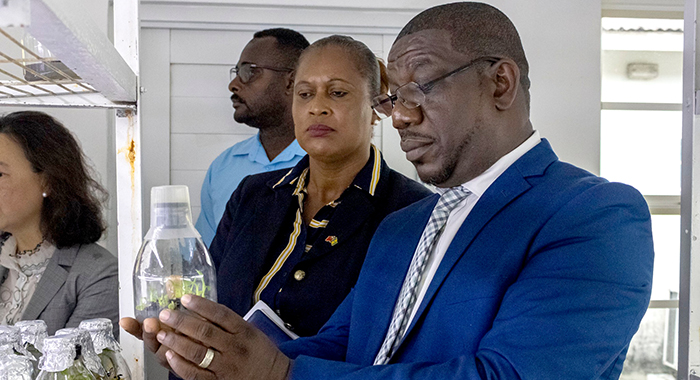
Against a backdrop of growing global market volatility and climate uncertainty, St. Vincent and the Grenadines (SVG) has launched a transformative three-year agricultural initiative aimed at addressing long-standing vulnerabilities in the nation’s food system. The Agricultural Productivity Recovery and Young Farmers Training Project, a $3.1 million collaboration between SVG and Taiwan, was formally introduced at the Orange Hill Agricultural Biotechnology Centre by Agriculture Minister Israel Bruce, who opened the event by sounding a clear alarm over the Caribbean nation’s overreliance on imported food.
Bruce emphasized that decades of heavy reliance on foreign food supplies have left SVG dangerously exposed to cascading global shocks, from geopolitical tensions to commodity price spikes. He specifically noted that ongoing conflicts involving the United States and Iran have driven sharp increases in fertilizer and fuel costs, pressures that other Caribbean nations have already passed to consumers. In SVG, Prime Minister Godwin Friday’s administration has absorbed these extra costs to protect local households from immediate price hikes, but Bruce warned this temporary relief can not mask the urgent need for systemic change.
Beyond geopolitical volatility, the initiative also directly confronts four interconnected challenges: rising production costs, the accelerating impacts of climate change, an ageing national farming population, and fragmented, inefficient market structures. Bruce clarified that the project is far more than a post-disaster recovery measure; it is a deliberate effort to drive intergenerational renewal for SVG’s agricultural sector, framing the initiative as centered on three core pillars: partnership, purpose, and possibility.
A key focus of Bruce’s speech was drawing a clear distinction between two critical concepts for SVG: food security and food sovereignty. He explained that true food security requires the nation to produce enough staple food to feed its population without excessive reliance on imports, pointing to current unhealthy dependencies: SVG imports Irish potatoes, onions, and garlic from Trinidad and Tobago, while lettuce and tomatoes arrive from the United States. This supply chain model, he argued, is inherently unstable, leaving the nation’s food access dependent on shipping schedules and cross-border trade dynamics that are completely outside SVG’s control. Food sovereignty, by contrast, centers on growing and celebrating food products unique to SVG’s identity as a sovereign nation, he added.
To demonstrate that local innovation already points the way forward, Bruce highlighted ongoing agro-processing work by students at SVG’s community college, where young people are developing value-added local products ranging from cheese and barbecue-flavored dasheen chips to breadfruit tacos. He challenged local consumers, particularly secondary school students, to choose these homegrown alternatives over imported global products, swapping Mexican tacos sold in supermarkets for SVG’s own breadfruit version to build demand for local agriculture.
The new project backs both goals: strengthening national food security while advancing SVG’s food sovereignty, with a strategic priority on core staples and high-nutrition crops grown for domestic consumption. A total of 75 young farmers will receive advanced targeted training through the initiative, while hundreds of additional smallholder farmers and agricultural extension officers will gain access to new agricultural technologies and business development support. Taiwan is contributing $2.5 million to the total project budget, with SVG’s government providing the remaining $630,000.
Bruce pushed back against outdated perceptions of farming as an old-fashioned industry, stressing that the initiative is inviting young people into a dynamic, future-facing sector rather than asking them to step back in time. Modern Vincentian agriculture, he explained, leverages cutting-edge tools including drones, data sensors, farm management software, and climate-smart growing practices. It blends rigorous agronomic science with entrepreneurial creativity, training young producers to fill multiple roles: farm manager, technologist, digital marketer, and community leader. The training curriculum covers practical hands-on farming skills, business planning, digital farm management, value-added processing, and market access strategy, all designed to create a clear growth pathway for young agri-entrepreneurs, from small startup operations to scalable, profitable enterprises.
Closing his remarks, Bruce framed the project as an investment in both literal and figurative seeds that will shape the nation’s future. The outcomes of this work, he said, will determine not only the food on Vincentian tables, but the long-term strength of rural communities and local economies, and the overall resilience of St. Vincent and the Grenadines for generations to come.