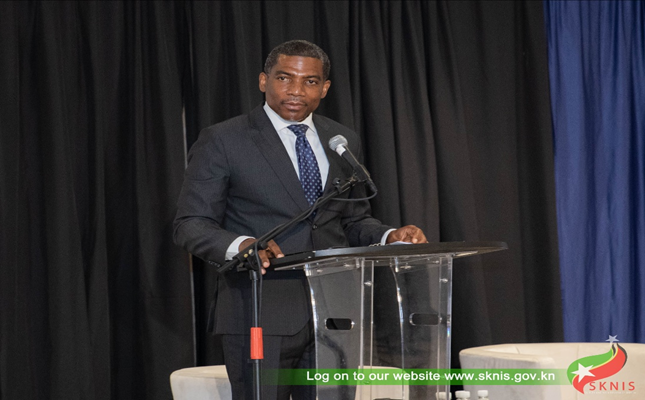
On May 21, 2026, at the official launch of the joint CARICOM-UNDP Diagnostic Document and the CARICOM-UN Action Framework on crime reduction held in Basseterre, St. Kitts, the Prime Minister of St. Kitts and Nevis and current Chairman of the Caribbean Community (CARICOM), the Hon. Dr. Terrance Drew, delivered a keynote address that centered political commitment as the non-negotiable foundation for sustained, meaningful progress against rising crime and violence across the Caribbean region.
In his remarks, Drew emphasized that turning ambitious crime prevention blueprints from theoretical documents into tangible, on-the-ground change depends entirely on decisive political will. “I’ve always held that nothing can really be done unless there’s political will,” Drew told attendees. “The political will is what allows us to be able to implement policies and to put whatever is necessary behind it to get it done.”
Drew, who previously served as St. Kitts and Nevis’ Minister of National Security, explained that the greatest barrier to advancing a preventative public health-focused approach to crime is not a lack of scientific evidence supporting its effectiveness, but resistance to shifting away from the decades-old dominant narrative that frames crime exclusively as a matter for policing and punishment. Drawing from his domestic experience building support for broad-based crime reduction in St. Kitts and Nevis, he detailed the challenging but necessary cross-sector conversations required to reframe the issue.
“Crime and violence is not a political football, it is a societal matter. It is not merely a law enforcement matter,” he said. “And if we are going to deal with a societal issue, then all of us need to be on board.”
Drew noted that building this collective buy-in requires unprecedented collaboration across every segment of society, including ruling and opposition political actors, social service agencies, public health professionals, faith groups, educational institutions, local businesses, and regional and international partners. This collaborative, root-cause focused model matches the St. Kitts and Nevis government’s existing Citizen Security framework, which prioritizes strengthened interagency coordination, expanded social intervention programs, evidence-led policy design, and deep community partnerships. Over the past several years, the administration has increasingly centered public health, prevention, and community resilience as core pillars of both national security and broader national development.
The Prime Minister acknowledged that elected leaders routinely face intense public pressure to deliver quick, visible crackdowns during spikes in violent crime. Even so, he argued that long-term, systemic transformation of regional security can only happen when leaders commit to addressing the underlying socioeconomic and social drivers of crime, rather than just responding to criminal activity after it occurs. He recalled that earlier leaders who attempted to champion this preventative model faced public criticism and ridicule, but noted that the approach is grounded in rigorous research, not political guesswork.
Looking ahead, Drew expressed confidence that the expanded partnership between CARICOM and United Nations agencies marks a key turning point for the region, signaling growing consensus around evidence-based preventative crime strategies. The CARICOM Chairman reaffirmed his unwavering commitment to advancing regional cooperation on this issue, noting that the goal extends far beyond cutting crime statistics: it seeks to build stronger, more resilient communities and lift overall societal well-being across every Caribbean nation. “I really want this to be successful,” he said. “I really want to see it implemented.”
The address was released via press release from the St. Kitts and Nevis Prime Minister’s Office and originally published by SKNVibes.com.