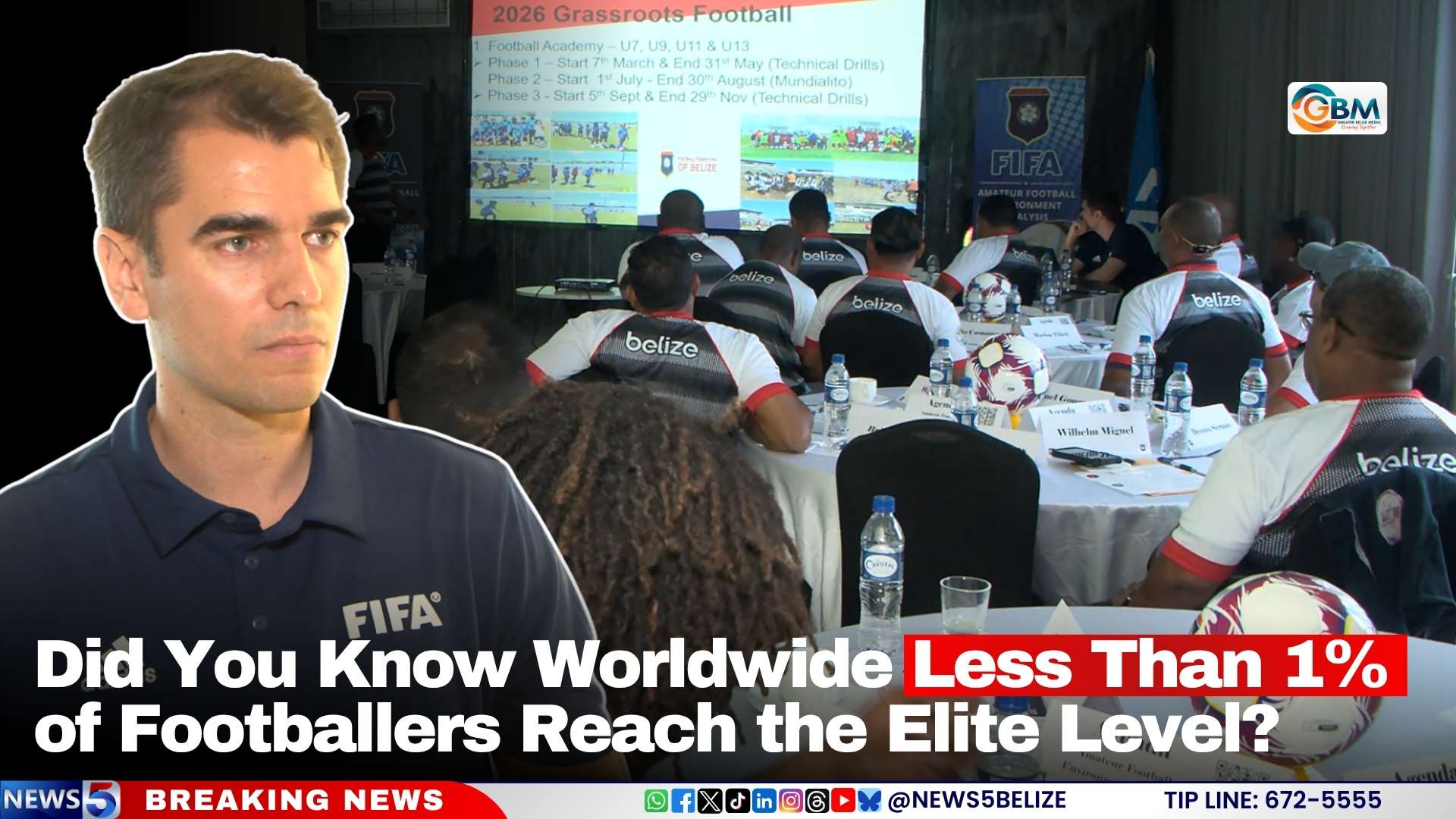
In a collaborative workshop held this week, the Football Federation of Belize (FFB) and global governing body FIFA reviewed newly compiled data from a landmark cross-national study of amateur and grassroots football, revealing encouraging progress for Belize’s developing program while shining a long-overdue spotlight on the critical role of non-elite football systems worldwide.
The study draws on survey data collected between 2023 and 2024 across 105 nations, creating one of the most comprehensive global snapshots of grassroots football ever assembled. This comparative dataset gives smaller footballing nations like Belize a unique opportunity to benchmark their development against global standards, and early assessments place Belize in a strong, competitive position.
FFB President Sergio Chuc emphasized that the preliminary findings confirm the country’s strategic direction is on track. “We will be looking at how far the other countries are compared to Belize, and for us it is looking pretty good that we are on the right path, well organised, and the work must continue,” Chuc said.
Javier Sanchez, FIFA’s manager for amateur football, who led the presentation of study findings, explained the initiative is part of a broader global push by the organization to expand access to the sport and boost overall participation. “We conducted the analysis to get a big picture of the amateur football worldwide and in Belize,” Sanchez noted, outlining the two core goals of the project: making the sport accessible to all people regardless of skill level, and growing total participation across all demographics.
The most striking statistic to emerge from the workshop serves as a critical reminder of the sport’s broader purpose: across the globe, fewer than 1% of all people who play football will ever advance to the elite professional level of the sport, FFB technical development director Phillip Marin confirmed.
This statistic underscores a simple but often overlooked reality: the overwhelming majority of football players will build their entire relationship with the sport within amateur and grassroots structures. As a result, these systems deserve the same level of investment, attention, and institutional support as elite player development pathways.
“It is important for us as a federation and FIFA and CONCACAF to cater to the players that cannot reach the elite branch,” Marin said, highlighting the shared commitment across regional and global governing bodies to serving all football lovers, not just the small fraction that advance to top-tier competition.