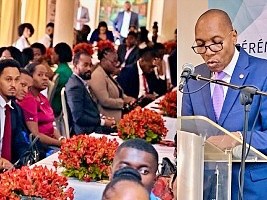
In a formal ceremony held at Port-au-Prince’s Ritz Kinam Hotel on May 15, 2026, Haitian academic leaders and stakeholders marked the official launch of the long-awaited Youth Employment Initiation Program, known locally by its Haitian Creole acronym PIJE, an initiative designed to bridge the gap between academic training and professional employment for the country’s young graduates.
Dr. Jean Denis Saint-Felix S.J., dean of the Faculty of Economic, Social, and Political Sciences at Notre Dame University of Haiti (FSESP-UNDH), delivered opening remarks at the event, expressing heartfelt appreciation for the collaborative effort behind the program’s rollout. He emphasized that youth unemployment remains one of Haiti’s most pressing social and economic challenges, and called on the Haitian government to prioritize long-term, sustainable funding and implementation of PIJE to ensure that thousands of job-seeking young people across the country can access its benefits in coming years.
Unlike generic unpaid internship programs that leave young graduates covering their own living costs during training, PIJE is structured to remove common barriers to entry for early-career workers. The initiative targets recent graduates from all accredited public and private universities and vocational training institutions across Haiti, placing selected participants into three-month paid internships at both public sector agencies and approved private companies. All participant stipends are fully covered by Haiti’s Public Treasury, eliminating the financial barrier that often prevents low-income young people from accessing skill-building work experience.
The core mission of PIJE is to equip new graduates with hands-on, practical professional skills that cannot be taught in a classroom setting. By offering structured on-the-job training, the program prepares participants to enter the open job market with verifiable work experience, expanding their employment prospects while encouraging them to contribute actively to Haiti’s ongoing economic and social recovery.
The program’s selection process is managed through coordinated outreach between the Ministry of Economy and Finance and Haiti’s post-secondary institutions. Each cohort of participants is selected through a progressive process: ministry officials contact participating universities and vocational schools in phases, requesting institutions to nominate candidates based on a combination of strong academic performance and demonstrated professional aptitude. To date, more than 60 post-secondary institutions across Haiti have already participated in earlier iterations of the program, including 16 vocational training centers, 14 public universities, and 33 private higher education institutions.
As Haiti continues to work toward stabilizing its economy and expanding opportunities for its growing youth population, PIJE represents a targeted policy intervention that addresses a critical gap in the country’s workforce development ecosystem.