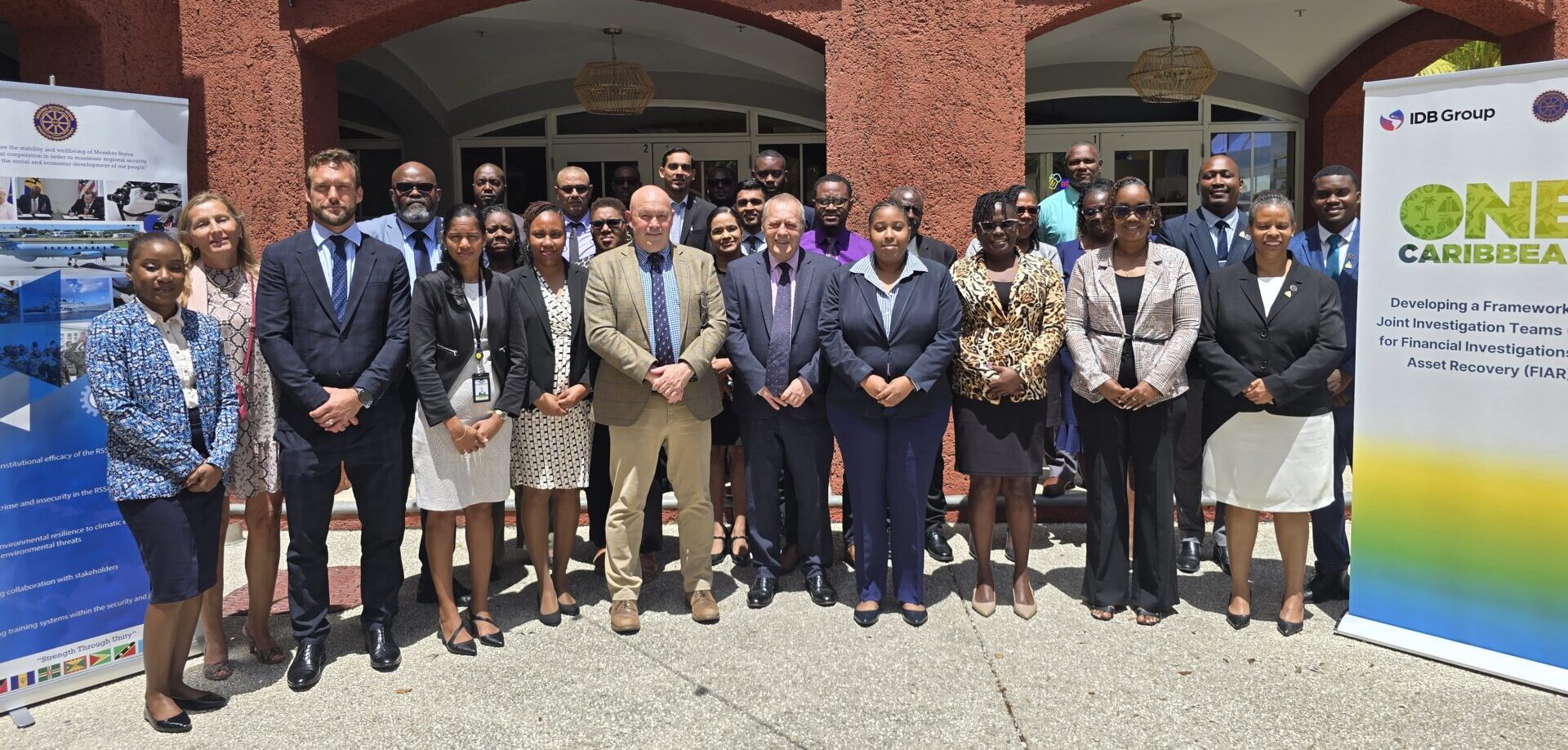
Five days of specialized training focused on Joint Investigation Teams (JITs) kicked off in Bridgetown, Barbados, bringing together security and law enforcement professionals from across the Caribbean region to strengthen collective defenses against transnational organized crime, cross-border financial fraud, and illicit money flows.
Hosted at the Courtyard by Marriott Bridgetown, the collaborative workshop is co-organized by the Inter-American Development Bank and the Regional Security System (RSS) Headquarters. According to an official press statement from the RSS, the event draws a diverse cohort of participants, including seasoned prosecutors, criminal investigators, customs enforcement representatives, intelligence analysts, and technical specialists from multiple Caribbean territories.
In her opening remarks to attendees, RSS Programme Officer Elizabeth Bynoe framed the JIT model as a transformative step forward in cross-border investigative cooperation. Unlike traditional information-sharing frameworks, Bynoe explained, the JIT structure enables authorities across different jurisdictions to rapidly exchange sensitive intelligence, synchronize operational plans, and collectively admissible evidence—all while upholding the sovereign legal authority and investigative independence of every participating nation.
Bynoe emphasized that this targeted training could not come at a more critical juncture for the region, noting that transnational criminal organizations have rapidly adapted their operations, adopting increasingly sophisticated tactics to evade detection and expand their illicit activities across Caribbean borders.
“This second in-person JIT workshop is a rigorous, top-tier training initiative built to sharpen our collective ability to counter complex transnational crime,” Bynoe told participants. “Over the next five days, we will move beyond foundational concepts to hands-on, real-world practice, equipping every attendee with the specialized tools needed to systematically dismantle modern criminal networks.”
A core distinguishing feature of the workshop, Bynoe added, is its intentional focus on practical application rather than theoretical instruction alone. “Theory alone will not put criminals behind bars,” she noted. “For the final three days of the program, immersive, real-world case simulations will take center stage. These exercises will challenge participants to operate as a cohesive cross-border team, navigating differing national legal requirements, distinct inter-agency operational cultures, and complex overlapping intelligence streams—all to build the muscle memory needed to deploy the JIT framework seamlessly in the field.”
Attendees were also urged to leverage the in-person gathering to build lasting professional relationships and strengthen collaborative ties between regional agencies tasked with combating serious organized crime.
Throughout the five-day program, participants will dive into all aspects of JIT structure and operations, covering topics including standardized case management protocols, advanced intelligence analysis techniques, the critical function of Financial Intelligence Units in disrupting illicit finance, and the strategic use of Open-Source Intelligence (OSINT) in contemporary cross-border investigations.
Sessions are also dedicated to addressing rapidly evolving criminal trends in illegal financial activity, including the growing misuse of virtual assets for money laundering, the transnational smuggling of gold, links between financial crime and human trafficking, and other emerging forms of transnational financial offending that present new challenges for Caribbean law enforcement.