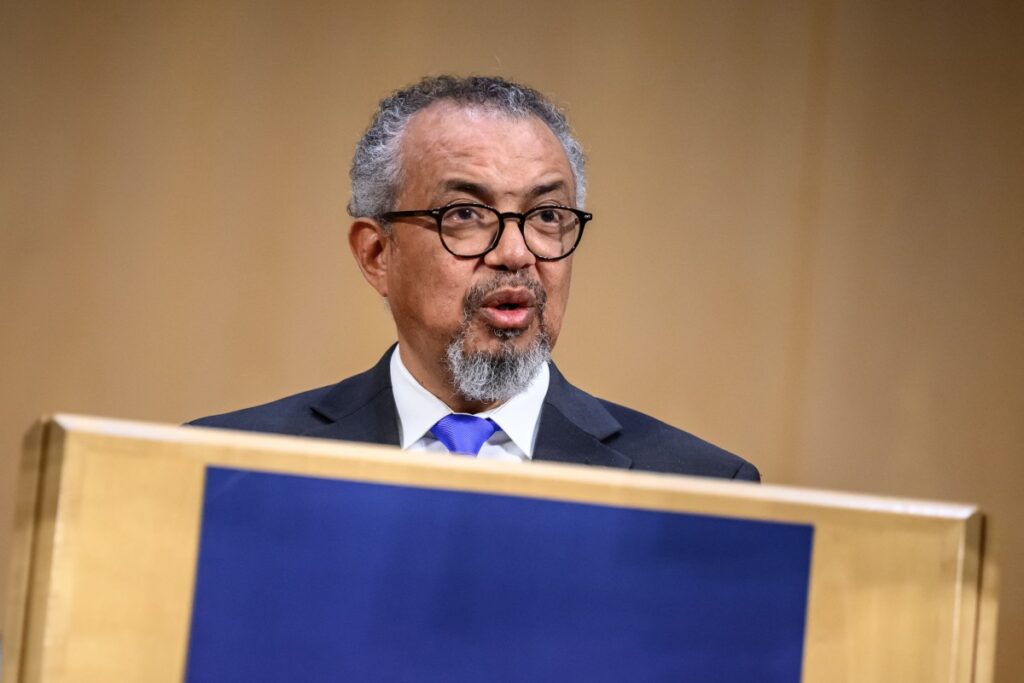
GENEVA, Switzerland — Against a backdrop of escalating global instability and mounting institutional pressure, the World Health Organization kicked off its 2026 annual World Health Assembly on Monday, with WHO Director-General Tedros Adhanom Ghebreyesus opening the gathering by framing two recently emerged infectious disease outbreaks as just the latest warning signs of a fractured, high-risk world.
Tedros pointed specifically to two pressing public health events: a new Ebola outbreak in the eastern Democratic Republic of Congo, which he formally declared a Public Health Emergency of International Concern just over the weekend, and an unusual outbreak of hantavirus on the Dutch cruise ship MV Hondius, which forced an emergency evacuation off the coast of the Canary Islands last week. These two outbreaks, he told assembled health ministers and senior diplomatic delegates from more than 190 member states, are far from isolated incidents. “From protracted conflicts to simmering economic crises, accelerating climate change to deep cuts in global development aid, we are living through an era that is difficult, dangerous and increasingly divisive,” he said, noting he would expand on these risks in his keynote address to the week-long assembly Tuesday morning.
Spain, which stepped in to allow the virus-stricken MV Hondius to anchor off the Canary Islands for evacuation after multiple other countries turned the vessel away, has drawn widespread international praise for its response. Spanish Prime Minister Pedro Sánchez used an unexpected guest address to the assembly to underline the core logic of collective global health action, drawing a standing ovation from delegates. “Protecting others is the most effective way to protect ourselves,” Sánchez argued, adding that no nation can insulate itself from transboundary health threats on its own. He went on to decry what he called a growing “pandemic of egoism” in global politics, saying that “today, defending common sense has itself become an act of rebellion.”
The 2026 assembly comes at one of the most challenging junctures in WHO’s 78-year history. The institution has been reeling from the announced withdrawal of the United States, its largest single contributor, alongside deep across-the-board funding cuts that have forced major restructuring. Swiss Health Minister Elisabeth Baume-Schneider, opening the assembly alongside Tedros, outlined the scale of the financial crunch: WHO’s core operating budget has been cut by roughly 21 percent, equal to nearly $1 billion, forcing hundreds of layoffs and scaling back critical public health programs around the world. Even so, she noted that the organization has managed to implement deep, structural institutional reforms while continuing to respond to simultaneous emergencies. Suerie Moon, co-director of the Global Health Centre at the Geneva Graduate Institute, agreed that WHO has so far weathered the immediate storm, adding that the MV Hondius hantavirus outbreak offers a stark reminder of the global need for a well-supported, impartial and trusted global health authority. “This crisis is a clear illustration of why the world needs an effective, trusted, impartial, reliably-funded WHO,” Moon said.
From the opening hours of the assembly, geopolitical friction was already on display. Member states for the consecutive year rejected a proposal to add Taiwan’s request for observer status to the assembly’s agenda, a decision that follows long-standing diplomatic pressure from Beijing, which claims Taiwan as part of its sovereign territory. Taiwan held observer status at the assembly from 2009 to 2016, but has been excluded every year since. Other highly sensitive geopolitical issues on the assembly’s agenda this year include the ongoing health crisis in war-torn Ukraine, the collapsing health system in occupied Palestinian territories and growing tensions over public health cooperation with Iran, all of which are expected to spark heated debate over the course of the week.
Beyond geopolitics, long-running divides between high-income and low- and middle-income countries have stalled progress on WHO’s landmark global pandemic preparedness and response treaty, which was first launched in 2023 in the wake of the COVID-19 pandemic. Member states had originally aimed to finalize a critical annex to the agreement during this year’s assembly, covering rules for sharing virus samples with pandemic potential and ensuring equitable access to life-saving tools like vaccines, tests and treatments developed from those samples. But multiple diplomatic sources confirmed this week that negotiators have failed to bridge core divides, and will likely agree to extend negotiations for another 12 months.
The future status of the United States and Argentina, both of which submitted formal withdrawal notices in 2025, also remains shrouded in ambiguity. Former US President Donald Trump submitted a mandatory one-year withdrawal notice on his first day back in office in January 2025, and Argentina followed shortly after. Unique among international organizations, WHO’s founding constitution does not include formal provisions for member state withdrawal, and the organization has so far declined to officially confirm either departure.
When the US joined WHO in 1948, it reserved the right to withdraw following a one-year notice period, on the condition that it fulfills all outstanding financial obligations for the fiscal year. While the one-year notice period expired this January, Washington still has not paid its 2024 and 2025 assessed membership dues, owing the organization roughly $260 million. When WHO’s executive board met in January, Israel submitted a formal procedural resolution to approve Argentina’s withdrawal, which will go before the full assembly this week, but no similar resolution was submitted for the US withdrawal. Multiple diplomatic and institutional sources familiar with the discussions say there is broad agreement among member states to keep the US’s status ambiguous, rather than formalizing its exit.
A major focus of this year’s assembly will be a proposal to launch a formal, comprehensive reform process for the so-called global health architecture — the fragmented, overlapping network of global, regional and national health bodies that often fail to coordinate effectively during cross-border crises. Six years after the end of the COVID-19 pandemic, which exposed deep gaps in global preparedness and coordination, many leaders are calling for a systemic overhaul. “Six years after the last global pandemic, COVID-19, the world health architecture is changing rapidly,” Ghana President John Dramani Mahama told the opening plenary. “We are witnessing the end of an era. We must have the courage to build the next one.”