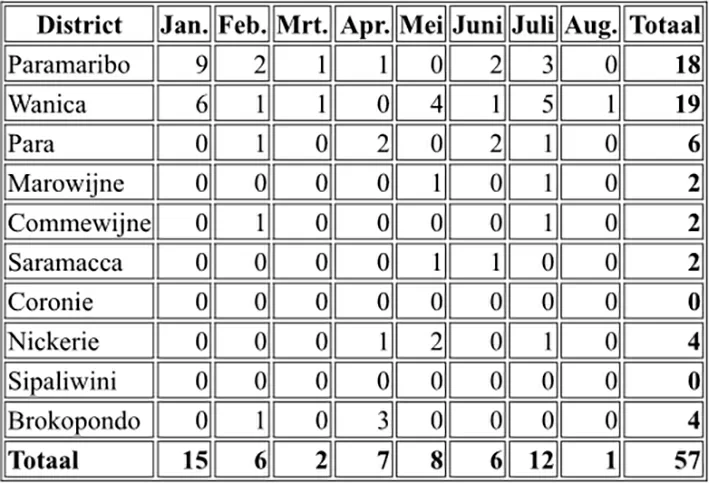
Between January and July 2025, Suriname has recorded 57 fatal road traffic casualties, according to new official data published by the country’s Road Safety Institute (VVI). Alongside these fatalities, a total of 2,259 people injured in road incidents have required emergency department (SEH) care across the nation, averaging out to nearly 11 people treated for crash-related injuries every single day. A breakdown of the fatal victims shows just how vulnerable two-wheeled road users are: 18 of the 57 people killed were moped riders, followed by 9 car drivers, 7 pedestrians, 6 vehicle passengers, and 5 bus passengers, among other groups. Geographically, the burden of fatal crashes is heavily concentrated in just two districts. The coastal district of Wanica recorded 19 fatalities, while the capital district of Paramaribo saw 18 deaths. Combined, these two districts account for almost 65% of all fatal road casualties in the country for the period measured. When looking at monthly trends, January was the deadliest month with 15 fatalities, followed by July with 12 deaths, marking two clear peak periods for fatal incidents. Purcy Landveld, VVI’s deputy director for Data, Education and Information, notes that these geographic and monthly trends mean Paramaribo and Wanica must be prioritized for targeted traffic enforcement, infrastructure upgrades, and public road safety education. The emergency department data also highlights a stark demographic gap in crash risk. Nearly 60% of all 2,259 injured patients treated for road crashes were between 15 and 34 years old, a young age group disproportionately affected by traffic incidents. Moped and motorcycle riders again make up the largest share of injured patients, accounting for nearly 59% of all emergency department registrations, with vehicle passengers following at 24%. Researchers also found that weekends carry the highest risk of injury-causing crashes: 45% of all emergency department admissions for road incidents occur between Friday and Sunday, with Sunday seeing the highest number of casualties of any day of the week. The VVI’s analysis also identified specific high-risk routes that have seen repeated fatal incidents, including Indira Gandhiweg, Garnizoenspad, and Martin Luther Kingweg. The institute emphasizes that urgent improvements to road design, street lighting, and public education on safe road behavior are needed to reduce preventable deaths and injuries on these routes. Currently, the four leading causes of fatal crashes in Suriname are loss of vehicle control, failure to yield right of way, excessive speeding, and collisions involving pedestrians or cyclists. Additional contributing factors, including alcohol impairment and driver fatigue, are still undergoing further investigation to confirm their impact on crash rates. Landveld stressed that road safety cannot be addressed by a single stakeholder: it is a shared responsibility across government agencies, civil society, and road users themselves. He called for the rapid establishment of a dedicated national road traffic authority to centrally coordinate all policy areas related to traffic management and safety. Only through cohesive, long-term structural measures, Landveld argues, can Suriname achieve a sustained reduction in the number of road crash casualties across the country.