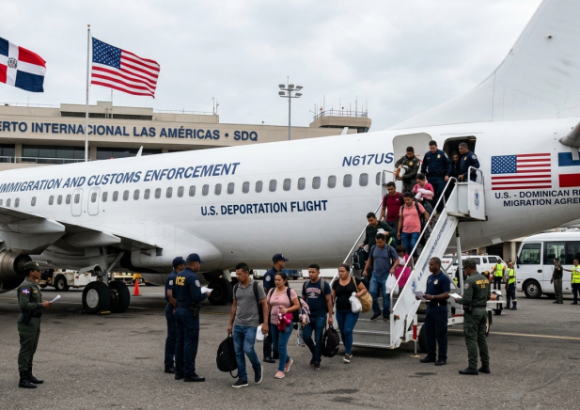
In the capital of the Dominican Republic, Santo Domingo, a newly signed migration cooperation agreement between the administration of President Luis Abinader and the United States has ignited widespread social discontent across the country. What is more, this wave of public uncertainty has quickly rippled beyond Dominican borders, spreading to three other Latin American nations – Panama, Costa Rica, and Ecuador – all partners with the Dominican Republic in the Alliance for Development in Democracy (ADD).
Across the four-nation bloc, growing segments of civil society and political analysts fear that the agreement will erode national sovereignty, a concern that has resonated deeply with patriotic sentiment in the Dominican Republic in particular. While all four regional governments have attempted to frame the pact as a measure to advance “national security” and “strategic stability” to reassure uneasy populations, massive public outcry has erupted both in street protests and in public discourse, with demands for strengthened sovereign protections and rigorous oversight of migrant human rights.
The debate has now moved to the center of regional political life, with critics increasingly vocal in their warning that the bloc could drift toward external dependency, ultimately becoming little more than geopolitical pawns advancing United States interests in the Western Hemisphere.
Among the signatory-adjacent nations, Costa Rica has seen the most immediate parallel to Dominican unrest, after it signed a nearly identical agreement earlier this year in March. Under the terms of Costa Rica’s pact, the country agrees to process up to 25 deported migrants of various nationalities transferred from the United States each week, coordinating their eventual return to their home countries. Public opinion in Costa Rica has become sharply polarized: while the government defends the deal as proof of its status as a reliable U.S. strategic ally, national police unions and prominent human rights organizations have raised sharp questions about the lack of sufficient operational resources to manage the expected migrant flows. Costa Rican media outlets have framed the recent Dominican agreement as formal validation of their own government’s regional strategy, consolidating a coordinated bloc of “transit destination” countries across the Caribbean and Central America.
For its part, Panama has approached the new Dominican agreement through a national security lens, after the country achieved landmark reductions in irregular migrant flow through the Darien Gap in early 2026. Panama already holds its own migration memorandum with the United States, which includes Washington-funded repatriation flights, and the Panamanian government has welcomed the move of other regional states taking on shared responsibility for migrant processing. Recently, Panama has also received new interceptor boats and advanced technological support from the United States for border management. For Panamanian officials, the Dominican Republic’s participation in the pact eases growing migratory pressure coming from South America by creating additional processing points for migrants before they rejoin irregular migration routes further north.
Under the administration of President Daniel Noboa, Ecuador has maintained close de facto diplomatic and political ties with the Abinader government, with the two countries currently negotiating a partial bilateral trade agreement set to conclude in May 2026. This alignment explains Ecuador’s official public support for the new migration pact, which it has backed strongly on diplomatic fronts. While Ecuador has not signed an explicit “deportation transit” agreement on the same model as the Dominican Republic and Costa Rica, local Ecuadorian media have noted that Noboa is actively building the Abinader administration as a key regional ally to advance his agenda of continental stability.
A key common detail across all the pacts is that the United States covers 100% of associated operational costs, a point that regional governments have highlighted as a benefit that allows them to strengthen their national migration agencies without drawing from domestic public budgets. Regional analysts also note that by joining these agreements, the four Latin American partners have positioned themselves as cooperative actors separate from less aligned regional governments, unlocking tangible benefits in return: the Dominican Republic, for example, has already gained admission to the U.S. Global Entry expedited travel program, while other members have secured pledges for new infrastructure investment.
The core public debate across all four nations centers on whether these countries are effectively becoming de facto “safe third countries” for migrants deported from the United States, a designation that governments uniformly reject. Dominican officials, including Foreign Minister Roberto Álvarez, have repeatedly emphasized that any migrants transferred to the country will only stay for temporary, controlled transit. To defuse rising public anger, the Dominican Ministry of Foreign Affairs has released multiple clarifications: the agreement does not apply to Haitian migrants, individuals with criminal records will not be accepted, unaccompanied minor migrants are completely excluded from any transfers, and the country will not become a permanent destination for refugees. Transiting migrants will not enter the Dominican immigration system, are not eligible to apply for asylum in the country, and every migrant’s case will be individually reviewed and approved by Dominican authorities before they are allowed to enter Dominican territory.
Under the terms of the agreement as outlined by the government, third-country nationals deported from the United States will only enter the Dominican Republic under controlled, temporary transit status for the sole purpose of coordinating onward travel to their countries of origin, with stays expected to last only a matter of days. The Abinader administration also stresses that the agreement is non-binding legally, and either party can unilaterally withdraw from the pact at any time, a condition that the government argues means it does not require prior approval from the Dominican Congress or Constitutional Court.
These assurances have done little to calm critics, however. Civil society groups, political opposition parties, and geopolitical analysts across the region have decried the process as deeply non-transparent, noting that no public consultation or legislative review was conducted before the agreement was signed. Critics also warn that the deal will create unacknowledged logistical pressure on domestic institutions, generate hidden long-term operational costs, and carry unacceptable risks of eroding national sovereignty to align with U.S. regional policy goals. Public opinion across all four affected countries remains deeply divided: while some members of the public welcome the agreement as a way to restore control over irregular migration routes, others remain deeply concerned about what the deal means for national self-determination and the human rights of transiting migrants.