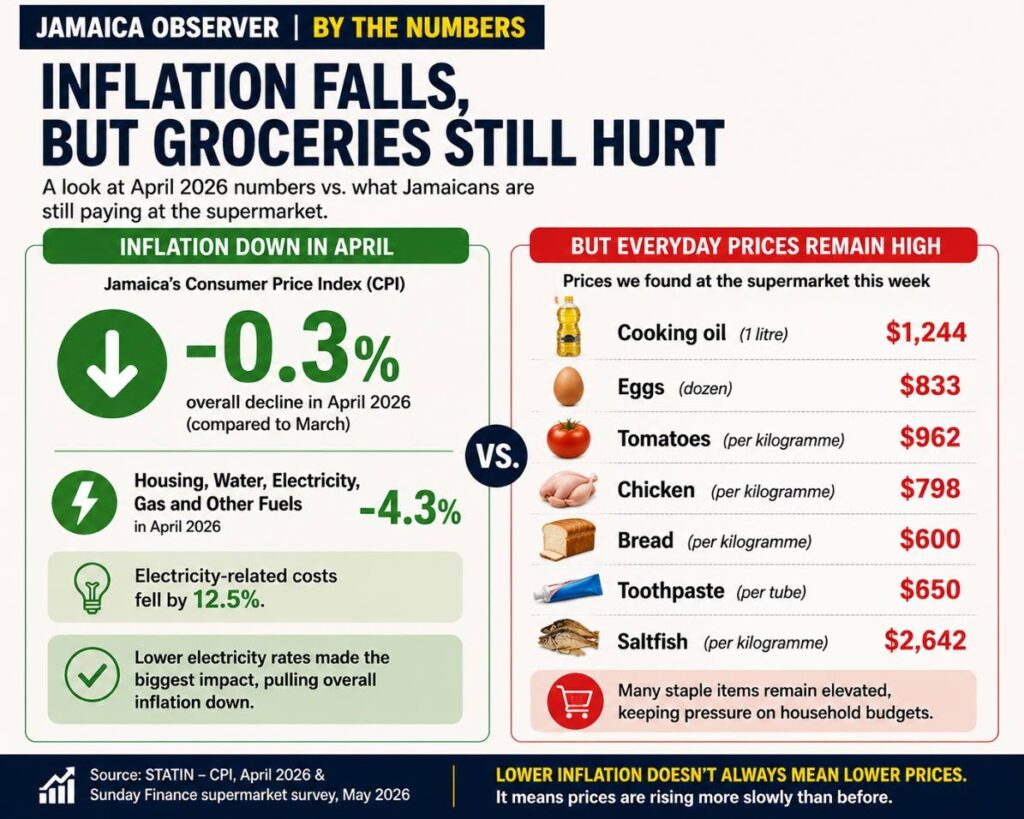
Jamaica’s national inflation rate recorded another downward shift in April, with official data pointing to sharp drops in electricity costs as the primary driver. The Statistical Institute of Jamaica (Statin) announced that the country’s Consumer Price Index (CPI) fell by 0.3% for the month, a move that looks encouraging on paper but has failed to translate into tangible relief for the majority of Jamaican households.
The reality on the ground tells a more complicated story: grocery costs remain elevated, petrol prices have climbed once again, rent stays at historically high levels, school fees are increasing, and dining out has grown more expensive. After years of consecutive price hikes triggered by the COVID-19 pandemic, global supply chain disruptions, and repeated hurricane damage to local infrastructure and agriculture, most families are still adjusting to a permanently higher cost of living that shows little sign of reversing.
This gap between falling official inflation figures and widespread persistent financial pressure has emerged as one of the most widely misunderstood features of Jamaica’s current economy. The confusion stems from a common misinterpretation: lower inflation does not mean prices are decreasing across the board. Instead, it simply means that prices are rising at a slower pace than they were previously. In April’s case, the overall decline was only made possible by a single large category — electricity — dropping enough to cancel out price increases across every other major sector.
Statin’s breakdown confirms this disparity: food prices rose by 0.6% in April, led by a dramatic 6.2% jump in the cost of fruits and nuts including ripe bananas, oranges, and watermelon. Higher petrol prices also pushed up overall transport costs for consumers and businesses alike. That means while the headline inflation number moved downward, most of the goods and services Jamaicans purchase on a regular basis continued to get more expensive.
This mismatch explains why so many households still feel financially squeezed even though headline inflation now sits squarely within the Bank of Jamaica (BOJ)’s official target range, a development policymakers frame as a sign of economic stability.
Clearing Up the Inflation Misconception
A core source of public confusion is the frequent mixing up of inflation and general price levels. Inflation does not measure how cheap or expensive goods are — it measures the rate at which prices are changing over time. For example, if inflation falls from 8% to 4%, prices are still going up; they are just increasing at half the speed they were previously.
After several years of sustained high inflation across the global economy, most prices remain far higher than they were in the pre-pandemic period. A family that once spent JMD 15,000 a week on groceries may now pay JMD 23,000 or more for the same basket of goods. Even if inflation slows sharply, prices almost never drop back to their previous levels, leaving families permanently adjusting to higher costs. This is the key reason official inflation statistics and everyday lived experience so often feel out of alignment: official numbers may show stabilizing price growth, but consumers are still dealing with long-term financial fatigue from cumulative increases.
Electricity Carries the Weight of April’s Decline
April’s drop in inflation was driven almost entirely by a single factor: falling electricity costs. Statin reports that the “Housing, Water, Electricity, Gas and Other Fuels” category fell by 4.3% in April, after electricity costs themselves dropped by 12.5%. This shift is economically significant, because electricity touches nearly every part of the national economy. Lower electricity costs can reduce pressure on businesses, transport operators, manufacturers, distribution networks, and household budgets all at the same time.
Over the past year, Jamaica’s inflation trends have increasingly been shaped by movements in global energy prices, paired with weather-related disruptions to local food production. When global oil prices ease and fuel-related utility charges fall, inflation tends to soften quickly. Food prices, by contrast, follow a much more volatile pattern.
Agricultural prices remain extremely vulnerable to droughts, hurricanes, supply chain breakdowns, and seasonal shortages, and this volatility consistently shows up in monthly inflation data. Over the 12 months leading up to April, prices for fruits and nuts jumped 26.3%, while fish and seafood costs rose 11.4%, both adding steady upward pressure to household grocery budgets. This explains why consumers feel the impact of inflation most acutely at supermarkets and local markets, even when the overall headline inflation rate is moderating.
What This Means for the Bank of Jamaica’s Policy
The Bank of Jamaica does not aim to drive prices down across the entire economy — its core mandate is to prevent inflation from becoming unstable and eroding purchasing power too quickly. Sustained high inflation creates widespread economic uncertainty: businesses struggle to set accurate prices for goods and services, borrowing becomes riskier for all parties, savings lose value more quickly, consumers delay major discretionary purchases, and long-term investment decisions become far harder to make.
To avoid these outcomes, the BOJ targets an inflation range of 4% to 6%. April’s 4.3% year-over-year inflation rate falls comfortably within that target, a reading that is widely expected to reinforce the central bank’s plan to keep interest rates relatively stable when the Monetary Policy Committee meets later this month.
Stable interest rates have direct benefits for consumers: higher rates push up the cost of mortgages, car loans, credit cards, and business borrowing, so holding rates steady eliminates the risk of even higher debt repayments for households and enterprises. But stable, moderate inflation does not immediately solve widespread affordability problems — it primarily prevents economic conditions from worsening more quickly than they otherwise would.
The Long-Term Structural Shift in Living Costs
What Jamaica appears to be entering right now is not a return to the era of cheap living many consumers remember, but rather a period of slower, more stable price growth after years of rapid increases. These are two very different outcomes.
For decades before the pandemic, the global economy saw unusually low inflation, and consumers grew accustomed to gradual, barely noticeable price increases. The post-pandemic world upended that reality entirely. Global shipping disruptions, geopolitical conflicts, climate-related extreme weather, widespread labor shortages, and energy market volatility pushed costs higher across dozens of sectors at the same time.
Many economists now believe the global economy is entering a structurally more inflationary era than the period that existed before 2020. If that prediction holds, consumers will need to adjust their expectations of what counts as a “normal” price level. This does not mean inflation will spin out of control, but it does mean households will likely continue facing elevated costs even when headline inflation appears statistically stable.
Broader Social and Political Implications
Inflation is never just an economic metric — it is a major driver of public mood and political sentiment. When workers find their salaries do not stretch far enough to cover basic needs, public frustration grows regardless of what official statistics report. This dynamic has left governments around the world struggling politically even as inflation rates have moderated from their post-pandemic peaks.
Consumers experience prices through deeply personal, repeated encounters: the weekly grocery checkout total, the daily taxi fare, the monthly electricity bill, school lunch costs, and the quarterly rent payment. Food inflation in particular hits harder psychologically, because consumers encounter price increases at the grocery store every week, making the pressure impossible to ignore.
In Jamaica’s context, this pressure is especially acute because wages in most sectors have not kept pace with cumulative price increases over the past five years. Even with inflation slowing, many households are still working to recover financial ground after years of eroding purchasing power.
The real question facing Jamaican policymakers and households right now is not whether inflation is falling. Instead, the more critical question is whether incomes will rise fast enough to rebuild consumers’ purchasing power after several years of economic hardship. For most families, the only economic statistic that matters ultimately comes down to one simple, practical question: when will it be affordable to live comfortably again?