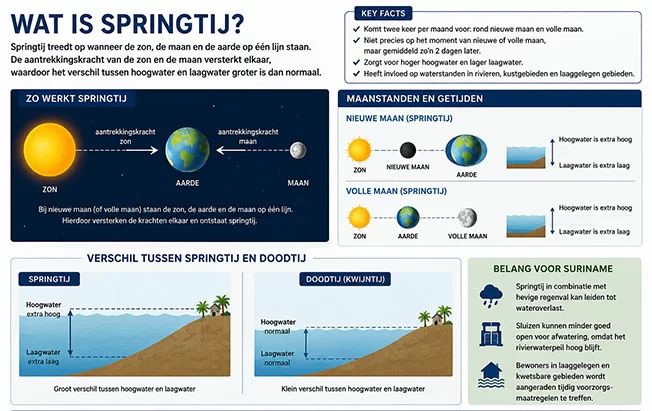
Residents across multiple regions of Suriname are on high alert for severe flooding after the nation’s Ministry of Public Works and Spatial Planning (OWRO) issued an urgent warning, pointing to a dangerous combination of spring tides and sustained rainfall that is expected to push water levels well above normal thresholds. The alert was issued May 16, which coincides with a new moon — the astronomical event that triggers the formation of spring tides, a natural tidal phenomenon characterized by far stronger gravitational pull on ocean waters.
During a spring tide event, the sun, moon, and Earth align almost perfectly along a single axis. This alignment combines the gravitational forces of the sun and moon, creating a much stronger pull on the world’s oceans than during non-spring tide periods. In Suriname, this amplified gravitational effect is driving higher than average high tide levels, and drastically slowing the rate at which inland water can drain out to the ocean.
OWRO officials project that peak water levels could reach roughly 2.60 meters above standard benchmarks. Even at low tide, water levels will remain unusually high, leaving only very narrow windows when drainage sluices can be safely opened. If operators open the sluices when ocean levels remain elevated, there is a major risk that seawater will flow backward into inland low-lying areas rather than letting inland water drain out to sea.
The outlook has grown even more concerning, as forecasters project substantial rainfall across Suriname this coming weekend, on Saturday and Sunday. With only extremely limited windows for safe sluice operation, the incoming rainwater will struggle to drain away from affected areas, raising the likelihood of prolonged, widespread inland flooding.
Spring tides occur roughly twice every month, aligned with the new moon and full moon phases. During these events, the difference between high tide and low tide levels is far larger than during other parts of the tidal cycle. Coastal experts note that the most severe impacts of spring tides typically become most noticeable one to two days after the actual new moon, due to the modifying effects of ocean currents and wave patterns across the Atlantic basin.
In line with the alert, the ministry has issued an urgent call to residents of low-lying and flood-prone regions across the country to put precautionary measures in place as soon as possible to protect their homes, vehicles, and other personal property from potential flood damage.