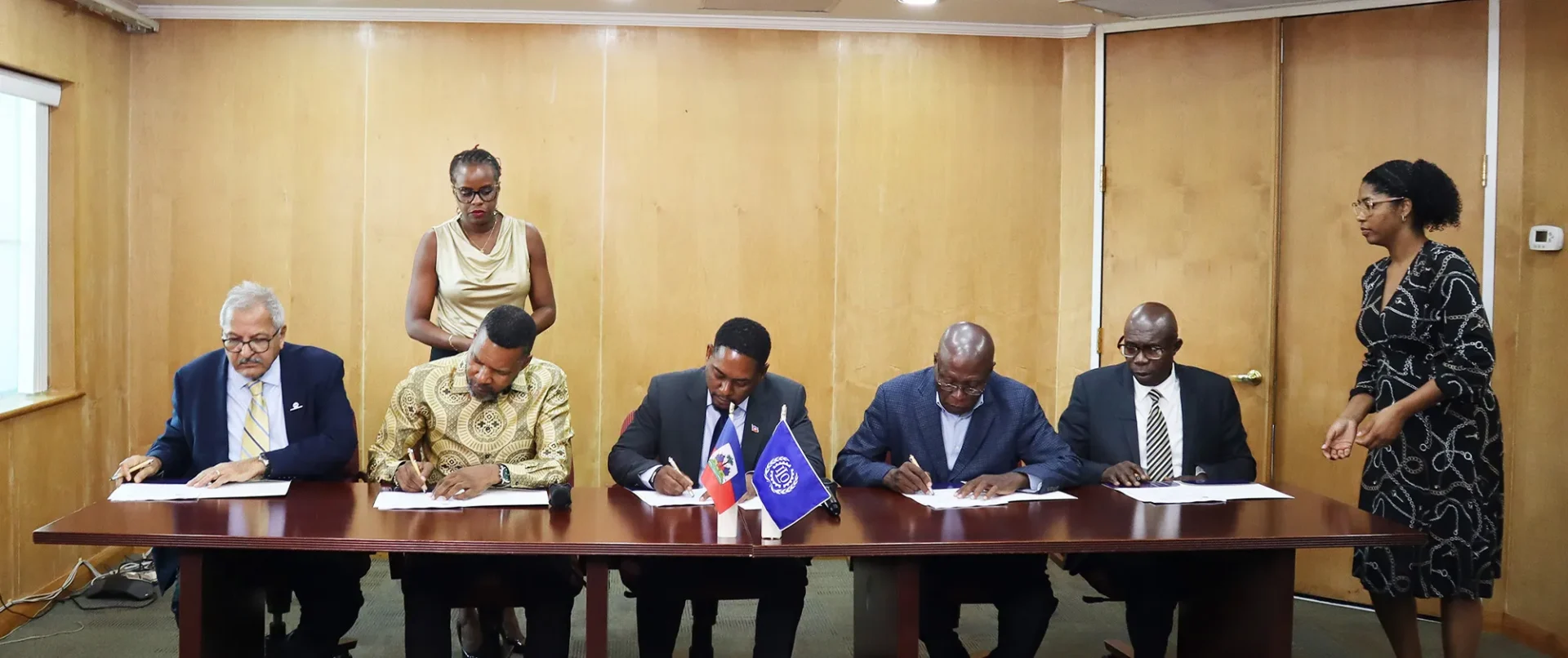
In a landmark collaborative step aimed at addressing deep-seated labor and socioeconomic challenges in Haiti, government, employer, and worker representatives formalized a two-year national decent work program with the International Labour Organization (ILO) during a signing ceremony held May 14, 2026 at the ILO Caribbean Office in Port of Spain, Trinidad and Tobago.
The agreement was signed by a cross-section of key stakeholders: Haiti’s Minister of Social Affairs and Labour Marc Elie Nelson represented the Haitian government; Association of Industries of Haiti (ADIH) president Maulik Radia stood in for national employer groups; Yvel Admettre, Secretary General of the Confederation of Public and Private Sector Workers, and Louis Fignole St Cyr, General Secretary of the Autonomous Central of Haitian Workers, signed on behalf of Haitian workers; and Joni Musabayana, Director of the ILO Decent Work Team and Office for the Caribbean, completed the signing for the ILO. Additional Haitian stakeholders joined the working sessions that preceded the signing remotely from Port-au-Prince, where the full delegation and ILO technical teams spent a full day refining program details, aligning priorities, and building consensus on how to structure existing and new development interventions to meet national goals. The finalized framework has already secured formal approval from Haiti’s Office of the Prime Minister, creating a shared roadmap for ILO technical cooperation across 2026 and 2027. This program marks the first national initiative developed under the ILO Caribbean Office’s recently expanded mandate, which added Haiti to its portfolio in a January 2026 restructuring designed to boost regional alignment and responsive support for the country.
The program is built around four core priorities, all identified through inclusive tripartite consultation between Haiti’s three key labor sector groups. First, the initiative will work to revitalize national social dialogue, including reactivating dormant national tripartite coordination mechanisms and strengthening protections for core fundamental principles and rights at work. Second, it will support improvements to national labor governance, through upgrades to labor administration and inspection systems, expanded access to fair labor dispute resolution, and tripartite-led reform of Haiti’s national Labor Code. Third, the program will expand access to viable employment and livelihood opportunities, with targeted support for micro, small, and medium-sized enterprises (MSMEs), expanded national skills development programs, and intentional inclusion of marginalized groups including youth, women, internally displaced persons, and workers employed in the informal economy. Fourth, the framework will strengthen national social protection systems, supporting institutional reforms for key social security bodies and working toward the gradual expansion of coverage to informal sector workers who currently lack protection. Cross-cutting priorities including gender equality, youth inclusion, conflict sensitivity, and climate-responsive employment and enterprise development are integrated across all four program pillars.
Speaking at the signing ceremony, Minister Nelson confirmed the Haitian government’s full political backing for the program and announced that implementation would begin without delay. “The government, through the Prime Minister, has approved the proposal submitted, thereby marking an important milestone in this preparatory process,” Nelson said, praising the collaborative spirit that shaped the weeks of discussion leading up to the signing. He thanked Musabayana and all participating stakeholders for their commitment and high-quality input, adding that his technical team would immediately begin work on initial program documentation to keep the initiative on track for upcoming international labor governance processes.
Musabayana emphasized that the program’s tripartite foundation is its greatest strength, noting that Haitian stakeholders led the process of defining their own priorities. “Haiti’s tripartite constituents have shown real leadership in defining what support they need and on what terms. This programme of work is built on that ownership. Our role as the Caribbean Office is to turn these commitments into results that Haitian workers and enterprises can feel – more productive dialogue, stronger institutions, and more decent jobs,” he said.
ADIH President Radia framed the agreement as a rare show of cross-sector unity amid Haiti’s ongoing political and socioeconomic crisis. “Haiti, as everybody knows, is going through a major crisis. And in a crisis, when we come together as a unity, it is very positive. This brings all sectors of the country together and will allow us to work in a very formal but cooperative way,” he added.
Worker representatives highlighted the historic nature of the new framework. Louis Fignole St Cyr noted, “It is extraordinary and it is historic. The social dialogue championed by the ILO has become a backbone for us, a foundation for the labour movement in Haiti and for trade union organizations to function within tripartism.” Yvel Admettre called for sustained momentum to embed collaborative dialogue as a core part of Haitian labor governance: “We must build a culture of dialogue. Without that culture, you will not always feel the need to come together to talk. With dialogue, we know we can find solutions even in the most difficult situations. I hope this will be a beginning, not an end.”
The new program opens a fresh chapter in ILO’s cooperation with Haiti, which comes on the heels of the January 2026 decision to reassign Haiti to the Port of Spain-based ILO Caribbean Office, a shift designed to strengthen regional alignment and responsiveness to Haitian needs. As a founding member of the ILO since the organization’s creation in 1919, Haiti has ratified 25 ILO conventions, including eight of the organization’s 10 core Fundamental Conventions. This new national program builds on longstanding normative commitments to turn those standards into tangible, on-the-ground results for Haitian workers and employers over the next two years.
In advance of the signing, the week-long working visit also included peer learning exchanges for the Haitian delegation with Trinidad and Tobago’s labor market institutions, including the Ministry of Labour, Small and Micro Enterprise Development, the National Trade Union Centre, and the Employers Consultative Association. The exchanges allowed Haitian stakeholders to study good practices and lessons learned from Trinidad and Tobago’s experience in advancing social dialogue and national labor governance.
Implementation of the program is set to begin immediately. The ILO Caribbean Office will deploy technical expertise through its existing Decent Work Team and ongoing projects in Haiti, working in close coordination with United Nations agency partners, bilateral donor governments, and Haitian national institutions. A tripartite national steering committee will oversee ongoing progress, and annual strategic reviews will be conducted to track outcomes and adjust priorities as needed. The full program is aligned with the 2025 Punta Cana Declaration for democracy, peace, decent work and social dialogue, ILO Recommendation No. 205 on Employment and Decent Work for Peace and Resilience, and the United Nations Sustainable Development Cooperation Framework for Haiti covering 2023 to 2028.