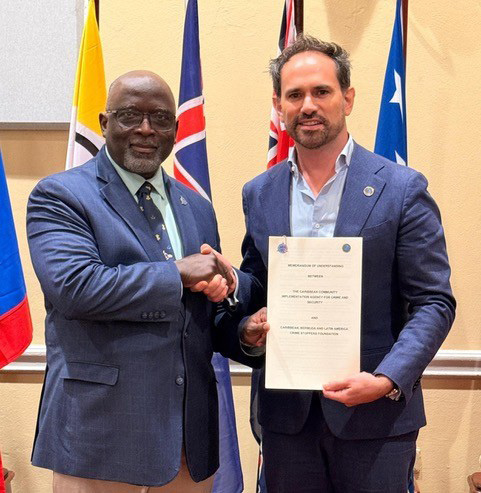
On May 12, in Paramaribo, Suriname, two key regional security organizations have formalized a groundbreaking partnership aimed at tackling growing transnational criminal threats across the Caribbean. The Caribbean Community (CARICOM) Implementation Agency for Crime and Security (IMPACS) and the Crime Stoppers for the Caribbean, Bermuda and Latin America (CBLA Crime Stoppers Foundation) signed a formal Memorandum of Understanding (MoU) during the Annual Conference of Caribbean Commissioners of Police (ACCP), laying out a structured path for deeper collaboration on crime prevention, intelligence sharing and citizen engagement.
The agreement establishes a clear, sovereignty-respecting framework for secure information exchange between the two entities. It leverages Crime Stoppers’ proven anonymous, confidential citizen reporting systems, which allow members of the public to share details about criminal activity without fear of retaliation. Under the terms of the partnership, CARICOM IMPACS will take the lead on assessing, coordinating and conducting strategic analysis of the collected intelligence, aligned with existing regional security protocols and the national legal frameworks of all participating countries.
This collaboration prioritizes addressing the full spectrum of transnational organised crime that undermines stability, prosperity and public safety across the region. Key priority areas include drug trafficking, illegal arms trade, illicit commercial activity, money laundering, gang violence, human trafficking, cybercrime, and other evolving organised criminal threats that have cross-border impacts.
Speaking at the signing, CBLA Crime Stoppers Regional Director and CEO Alejo Campos described the agreement as a critical milestone in building stronger connections between regional governance institutions and civil society-led public safety mechanisms. He noted that transnational organised crime is changing and expanding at a rapid pace across the Caribbean, making coordinated regional action, public participation, and protected intelligence sharing more important than ever to protect nations, local economies and communities.
Lt. Col. Michael Jones, Executive Director of CARICOM IMPACS, echoed this sentiment, framing the partnership as a major advancement for the region’s collective security architecture. By combining Crime Stoppers’ extensive grassroots outreach and citizen engagement infrastructure with CARICOM IMPACS’ strategic cross-border coordination capacity, the partnership creates a far more robust and effective front against organised criminal networks. Jones emphasized that this shared commitment to collective intelligence will directly improve safety and security for residents across the Caribbean, Bermuda, and Latin America.
Beyond intelligence sharing, the partnership opens the door to future collaborative work across a range of complementary areas, including public education and awareness campaigns, training and capacity-building for law enforcement and community stakeholders, technical knowledge exchanges, and the development of unified regional crime prevention strategies.
As the operational arm of CARICOM’s regional crime and security agenda, CARICOM IMPACS plays a central role in coordinating intelligence and supporting operational cooperation between CARICOM Member States and Associate Members. For its part, CBLA Crime Stoppers already runs anonymous crime reporting programs and public safety partnerships across the Caribbean, Bermuda and Latin America, working alongside governments, law enforcement, international bodies and local communities to encourage greater citizen participation in crime prevention efforts.
This new agreement reflects a growing consensus across the region that effective action against modern organised crime cannot rely on law enforcement action alone. Successfully countering increasingly complex criminal threats requires trusted public engagement, coordinated cross-border cooperation, and modern, secure information-sharing ecosystems that can adapt to changing criminal tactics.