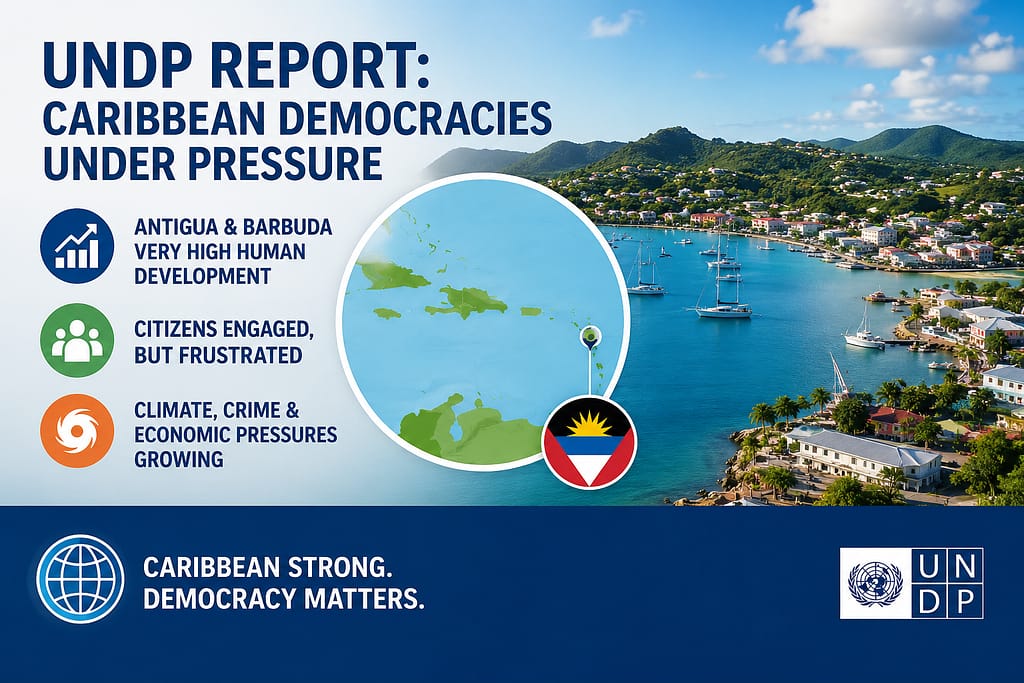
The United Nations Development Programme (UNDP) has published its latest Democracy and Development Report 2026, delivering a mixed assessment of progress and challenges across Latin America and the Caribbean. In a bright spot for the region, the report places Antigua and Barbuda among the group of Caribbean nations earning a “Very High Human Development” classification, with a 2026 Human Development Index (HDI) score of 0.851. The analysis covers 14 CARICOM member states, including major Caribbean economies and island nations such as Barbados, Jamaica, Trinidad and Tobago, and St. Lucia.
While the report affirms that the Caribbean region has retained its longstanding track record of generally stable democratic systems, it issues a clear warning that these governing institutions are facing mounting, multi-faceted strain that tests their capacity to deliver for citizens. Four core stressors are identified: rising criminal activity, accelerating climate change impacts, persistent economic vulnerability, and eroding public confidence in government.
One of the most stark inequities highlighted in the document centers on climate change. As the report emphasizes, Caribbean nations collectively contribute less than 1% of global greenhouse gas emissions, yet they bear some of the most severe and frequent consequences of global environmental degradation. Recurring climate-fueled natural disasters have repeatedly driven up national debt levels across the region, erasing years of incremental development progress and straining public budgets that could otherwise be allocated to social services and infrastructure.
Transnational security threats also pose a major challenge to regional stability. The report notes that organized criminal networks and illicit arms trafficking, most of which originate from outside the Caribbean, have permeated local communities, driving up violent crime rates, worsening public insecurity, and diverting state resources from development to law enforcement.
Despite these accumulating pressures, the report finds that democratic engagement remains robust in much of the region. Antigua and Barbuda, for example, recorded relatively healthy parliamentary voter turnout in recent cycles, reflecting continued public interest in formal electoral processes. That said, growing public frustration is evident across multiple domains: citizens increasingly express discontent over perceived corruption, lackluster economic growth, underperforming public services, and the failure of governments to address pressing priorities in a timely way. As trust in traditional political institutions wanes, more citizens are channeling their engagement through independent civil society groups and grassroots advocacy movements instead of established political parties and state structures.
Importantly, the report pushes back against narratives that Caribbean democracies are on the brink of collapse. Instead, it frames the current moment as a critical juncture that demands targeted reform: governments must prioritize improving governance accountability, strengthening weak institutional capacity, and aligning policy more closely with the needs and expectations of their populations. The report also highlights encouraging ongoing work through the Caribbean Community (CARICOM), which has launched regional initiatives to shore up democratic resilience, including programs advancing gender parity, youth economic and political empowerment, community-led crime prevention, and expanded social protection systems.
In closing, the UNDP stresses that long-term preservation of democratic stability and equitable sustainable development across the Caribbean will depend on two key pillars: the expansion of national social safety nets to buffer vulnerable communities from economic and climate shocks, and sustained, targeted collaboration between regional governments and multilateral international organizations to address shared transnational challenges.