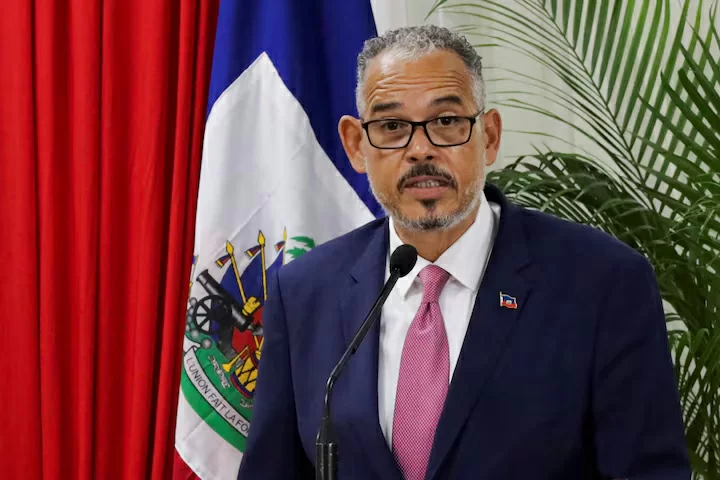
Port-au-Prince, Haiti – A fresh political and security crisis has deepened in Haiti, as Prime Minister Alix Didier Fils-Aime confirmed Monday that the deteriorating security situation across the Caribbean nation makes it impossible to hold the planned August presidential election. This long-delayed vote, which would mark Haiti’s first presidential election in a decade, has once again been thrown into uncertainty by escalating gang activity that has paralyzed much of the country.
For years, successive Haitian administrations have postponed national elections, as powerful armed gangs have steadily consolidated control over the capital Port-au-Prince and expanded their territorial influence into rural and central regions. Over the past five years alone, gang-related violence has killed thousands of civilians and displaced more than one million Haitians from their homes, creating one of the world’s worst humanitarian displacement crises in the Western Hemisphere.
Speaking in an interview with the editor-in-chief of Le Nouvelliste, Haiti’s oldest continuously operating newspaper, Fils-Aime stressed that the basic security conditions required for voters to cast ballots freely simply do not exist by the scheduled August timeline. “The security prerequisites simply are not in place to hold a vote in August,” he stated, while adding that he still holds out hope that a democratic vote can be held before the end of 2025, with a new democratically elected president inaugurated no later than February 7, 2027.
Fils-Aime took office as prime minister on February 7 of this year, a date long symbolic of presidential power transitions in Haiti – a tradition that has repeatedly been broken by leaders seeking to extend their terms in office. The current political vacuum that allowed gangs to expand their power traces back to the 2021 assassination of former president Jovenel Moïse, who was killed while postponing national elections. His assassination left a gaping leadership void that gangs exploited to seize control of nearly 80% of the capital, according to recent United Nations estimates.
Election preparations have been upended by the expanding security collapse. Gangs have strengthened cross-factional alliances and pushed into new regions, leaving national authorities unable to guarantee the safety required for a free and fair vote. Making the political calculus even more difficult, both the United Nations and the United States have tied critical security assistance to the Haitian government directly to progress on holding elections, creating significant external pressure to stick to the original schedule despite the growing risks.
Voter registration was originally scheduled to launch on April 1, and the Haitian electoral council had planned the first round of voting for August 30, with a runoff round scheduled for December. More than 280 political parties have already received official approval to participate in the vote, a number Fils-Aime argues is excessive. “We are not going to hand voters an encyclopedia of candidates to sort through,” he said. “Choice is a good thing, but too much choice is not inherently necessary. I would prefer to see a field of 10 to 15 presidential candidates.”
The prime minister added that the national government is currently holding negotiations with all major political blocs to reach a consensus on an election roadmap, but he confirmed that the government is still not satisfied with the budget proposal put forward by the electoral council, creating another roadblock to moving forward.
As political leaders negotiate, Haitian business and community leaders are sounding the alarm over a new wave of brutal gang attacks across the country. Delphine Gardere, CEO of Rhum Barbancourt, Haiti’s iconic 154-year-old rum manufacturer, announced that one of her employees was shot and killed in the capital just the night before the prime minister’s interview, the latest victim of ongoing gang intimidation and violence targeting workers and economic activity.
Haiti has struggled with systemic security breakdown for decades, a crisis that has been amplified by overlapping political instability and a deepening economic collapse. The 2021 assassination of Moïse accelerated gangs’ takeover of large swathes of the country, with armed factions now controlling most major urban centers and large stretches of rural territory. This ongoing violence does not only derail the country’s democratic transition; it also disrupts basic access to food, healthcare, and livelihoods for millions of Haitian civilians.
The international community, including the UN and U.S., has conditioned much of its security and humanitarian support on progress toward holding a credible democratic election, making the timing of the election process an extremely high-stakes issue for the Haitian government.
As the situation remains highly unpredictable, any further delay to the long-awaited presidential vote risks triggering deeper political polarization and widespread social unrest. At the same time, public pressure is growing across Haiti for leaders to find a path that can restore basic stability and security, allowing the country to finally install a democratically elected government after more than a decade of unfulfilled democratic transitions.